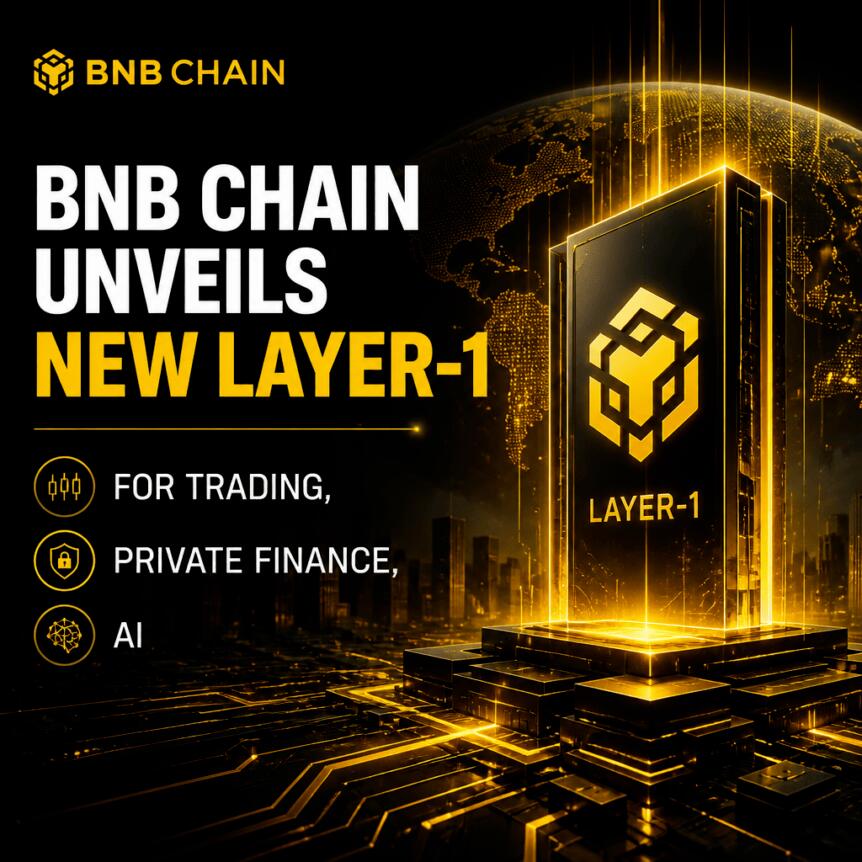
BNB Chain has published a new litepaper outlining plans for a dedicated layer-1 blockchain built for faster execution, payments, optional privacy features, and on-chain automation for autonomous AI agents. The proposal is positioned as an addition to, rather than a replacement for, the existing BNB Smart Chain (BSC), with BNB remaining the network’s native asset.
According to the litepaper released on Thursday, the network is already running as a development network. BNB Chain is targeting a public testnet launch in the first quarter of 2027 and a mainnet rollout in the second half of the year.
Key takeaways
- BNB Chain’s proposed layer-1 would run alongside BNB Smart Chain, using BNB as its native token with no plan for a new native asset.
- The network design includes “reserved” capacity for certain high-priority activities (including payments), aiming to reduce competition for block space during demand spikes.
- An optional shielded pool would support private transfers of BNB and other supported tokens, though BNB Chain warns the underlying circuits are unaudited.
- The litepaper also describes fee-payment flexibility and the ability to authorize AI agents to execute transactions within predefined limits.
A new layer-1 designed around execution and demand management
BNB Chain’s proposal starts from a familiar challenge in general-purpose blockchain systems: applications compete for limited block space, and congestion can raise latency and increase costs. In its litepaper, the network says it would reserve a portion of transaction capacity for targeted categories of activity—particularly payments services—so those flows face less competition when usage demand rises.
While many networks attempt to scale by adding throughput or shifting computation elsewhere, BNB Chain’s approach is more about differentiating capacity allocation on the same chain. For users and developers, that matters because it can change how predictable performance is during periods of peak demand—especially for payment-oriented applications where timing and reliability are often central to the user experience.
Optional privacy through a shielded pool
The litepaper also introduces an optional privacy component: a shielded pool meant to enable private transfers involving BNB and other supported tokens, including some decentralized finance transactions. BNB Chain states that not every detail would be hidden—some transaction information would remain publicly visible.
At the same time, the network’s documentation includes an important caution. It says the shielded pool’s “circuits” have not been audited and advises that the feature should not be used with real funds. That creates a clear boundary for early developers and users: the privacy mechanism is described as a capability within the design, but it is not presented as battle-tested infrastructure.
For investors and builders, this distinction is significant. Privacy features tend to carry higher execution and security expectations, and an explicit “unaudited” warning typically implies the team expects iteration before production-grade use.
BNB retained as the native token; no new asset planned
BNB Chain’s plan keeps the ecosystem’s existing token role intact. The proposed layer-1 would use BNB as its native token, and the litepaper specifies that it does not intend to create a new native asset for the new chain.
In practical terms, this reduces friction for holders and integrators who already associate BNB with BNB Chain activity. It also suggests the network’s value proposition is centered on architecture and application throughput rather than on a token migration or a separate token-led economy.
Fee flexibility and AI agents with guardrails
The litepaper describes additional functional features aimed at improving usability and enabling transaction automation. One element is the ability to transact without first acquiring BNB to pay network fees. Details are not expanded in the provided summary, but the core idea is to reduce friction for users who want to interact with dApps without pre-funding with the network’s fee asset.
Another notable component is support for autonomous AI agents. BNB Chain says users would be able to authorize AI agents to execute transactions within predefined limits. This is an attempt to combine on-chain authorization with agent-driven execution—potentially enabling recurring actions, workflow automation, and other semi-autonomous behaviors that remain constrained by user-set parameters.
As with privacy tooling, “within predefined limits” is likely where most of the safety model will live. The litepaper frames guardrails as a way to keep automation from becoming unrestricted, though the summary provided here does not spell out how those limits would be specified or enforced.
What to watch as the timeline approaches
BNB Chain’s stated milestones—public testnet in the first quarter of 2027 and mainnet in the second half—mean there is still substantial time before production deployment. For the market and for developers, the most immediate questions will be how the reserved-capacity model performs under real load, whether the shielded pool’s circuits move toward audited readiness, and how authorization flows for AI agents are implemented in ways that are both secure and practical.