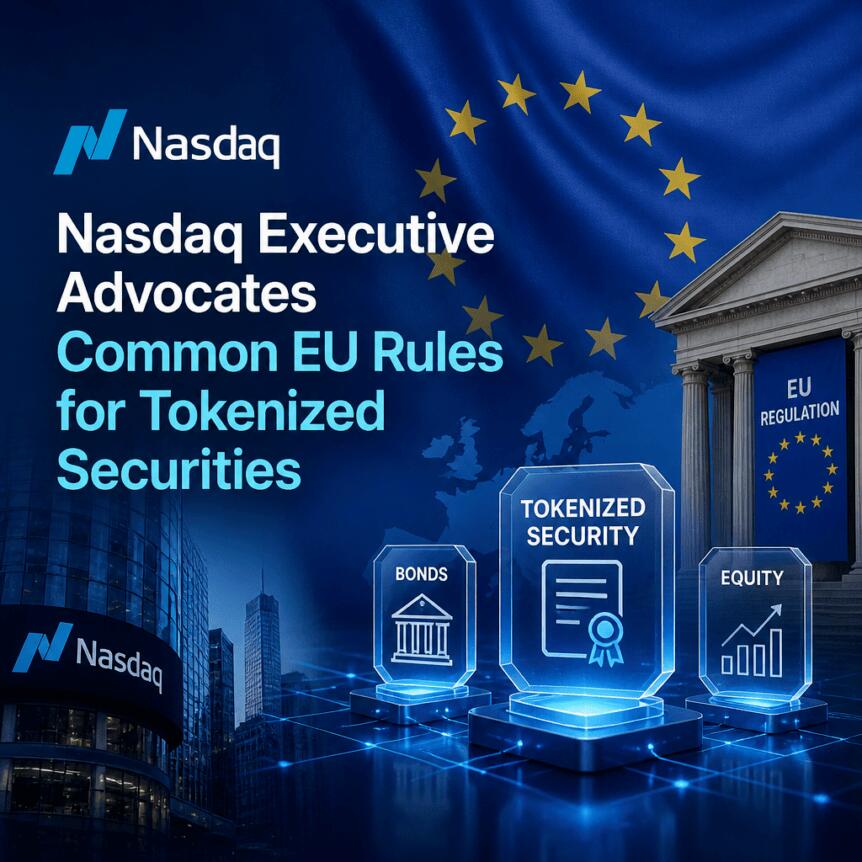
Executives and central-bank officials used a European Commission tokenization roundtable in Brussels to press for clearer rules for tokenized securities and tokenized funds—arguing that today’s patchwork of national regulation could hinder cross-border trading and settlement.
Nasdaq’s Roland Chai, head of digital liquidity networks at the exchange operator, urged EU lawmakers to consider an optional, EU-level “28th regime” for tokenized securities. The proposal would sit alongside existing national regimes, aiming to reduce legal uncertainty created by fragmented standards across the bloc’s 27 member states.
Key takeaways
- Nasdaq’s Roland Chai says EU-wide harmonized rules for tokenized securities could prevent legal uncertainty from fragmented national frameworks.
- Chai referenced Nasdaq’s efforts to obtain a distributed ledger technology (DLT) trading and settlement license in Sweden, while noting constraints for tokenized collateral under current EU rules.
- ECB President Christine Lagarde warned that Europe risks building a fragmented tokenized securities market without common standards.
- BlackRock’s Hannah Winter said institutional demand for tokenized money market funds is being driven by the benefits of on-chain operations and liquidity management, including potential 24/7 workflows.
Nasdaq calls for an optional EU framework for tokenized securities
Speaking at the European Commission’s roundtable on asset tokenization on Thursday, Roland Chai said Nasdaq supports exploring “a 28th regime” for tokenized securities—an additional, harmonized set of rules at the EU level that would be optional for issuers and platforms.
The “28th regime” concept is designed to operate alongside the existing national systems rather than replace them. Chai’s underlying argument is that legal and regulatory ambiguity can slow deployment, particularly when tokenized assets and services are expected to function across borders.
Chai also shared that Nasdaq’s Swedish subsidiary has applied for its first DLT trading and settlement license. Tokenization markets typically depend on the ability to execute trades and finalize settlements reliably, and licensing is a key step in aligning those operations with regulatory expectations.
In addition, Chai said Nasdaq is considering the use of tokenized collateral, but that it is constrained by current EU rules. That mismatch between what firms want to offer and what existing frameworks permit is one of the practical frictions that proponents of EU harmonization are trying to address.
Lagarde warns cross-platform settlement could fail without common standards
The call from Nasdaq comes with broader concerns from European monetary leadership. Cointelegraph previously reported that ECB President Christine Lagarde warned Friday that Europe could end up with a fragmented tokenized securities market unless it establishes common standards.
According to that warning, the risk is not only divided adoption across countries, but also interoperability problems—where trading venues may be unable to settle transactions with one another. For investors and market participants, settlement reliability is central: even if tokenized assets trade smoothly on a given platform, the wider ecosystem must be able to clear and settle transactions across systems.
In that context, Chai’s proposal for an EU-level harmonized framework can be read as an attempt to tackle the same structural issue Lagarde highlighted: fragmentation that undermines network effects.
BlackRock links tokenized fund interest to institutional liquidity needs
While Nasdaq focused on the legal architecture for tokenized securities, BlackRock brought the discussion back to end-user demand. Hannah Winter, head of digital cash at BlackRock, said institutional interest in regulated, tokenized money market funds is being driven by clients seeking exposure to structured, compliant liquidity products.
Winter described tokenization as “absolutely demand-driven,” adding that leveraging a tokenized money market fund could both improve returns on cash balances and “free up” operational capabilities through 24/7 accessibility. That combination—liquidity management with the prospect of more continuous operational workflows—addresses a key point for institutional treasury teams and liquidity managers.
She said primary use cases for tokenized funds include treasury and liquidity management, as well as serving as collateral for derivatives positions. Those applications underline why tokenized fund products are often positioned not merely as trading instruments, but as building blocks for broader financial operations.
BlackRock’s BUIDL provides a real-world benchmark for tokenized liquidity
Winter’s remarks align with BlackRock’s existing activity in the tokenized fund space. Earlier coverage from Cointelegraph noted that BlackRock plans to offer tokenized versions of select European money market funds using JPMorgan’s blockchain infrastructure, including pound sterling, euro and US dollar share classes as part of BlackRock’s Institutional Cash Series.
BlackRock also launched its first tokenized US dollar-denominated institutional liquidity fund, BUIDL, in March 2024. According to RWA.xyz, the fund had $1.55 billion in assets at the time referenced in the roundtable materials, down nearly 30% over the past 30 days, with a trailing one-year return of 3.59%.
For market observers, BUIDL functions as more than a flagship product—it offers a live data point on how institutional tokenized liquidity performs over time. Even with strong long-term framing, the reduction in assets over a recent window highlights that tokenized funds are still exposed to the same forces affecting traditional liquidity flows, including changing risk appetite and balance-sheet needs.
As lawmakers weigh whether to pursue an optional harmonized EU regime and as institutions continue testing tokenized fund infrastructure, readers should watch for concrete regulatory steps—particularly around how licensing, settlement rules, and collateral treatment will evolve to support cross-platform interoperability.