CFTC Chair Michael Selig says regulators can no longer treat autonomous AI agents as a theoretical risk. Speaking at the CFTC’s inaugural Frontier Forum in Washington, DC on Wednesday, Selig argued that financial rulebooks built for humans and identifiable market participants may not be adequate for a system where software can hold assets, find trading opportunities, and execute transactions on a user’s behalf.
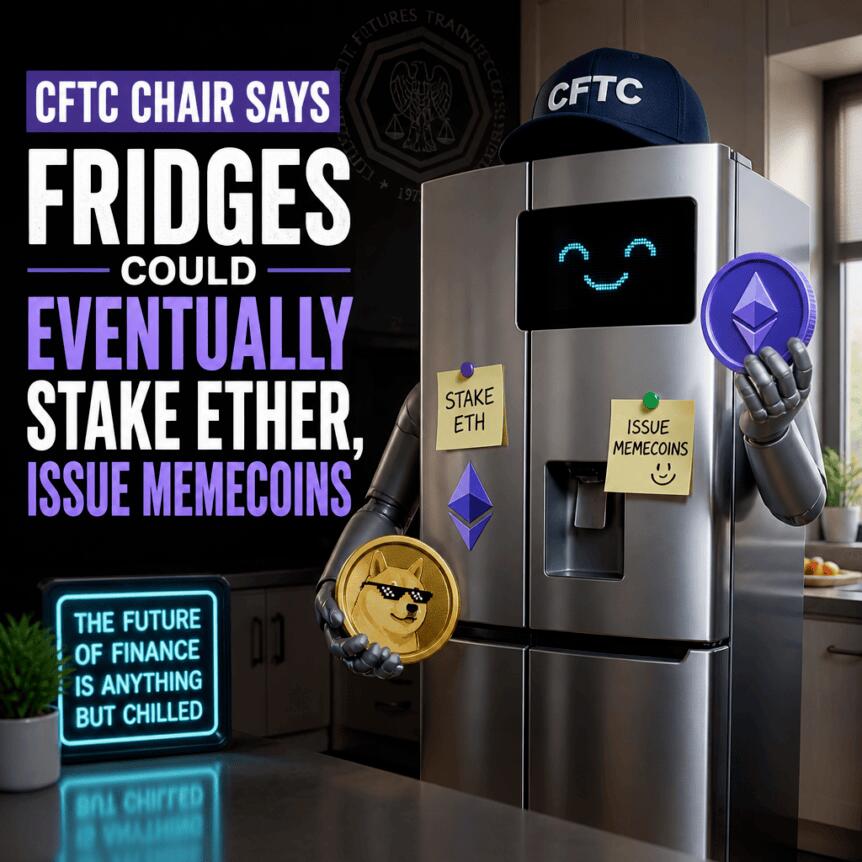
In a remark that underscored the direction of travel, Selig said it is “no longer science fiction” to imagine everyday activities—such as a refrigerator autonomously buying groceries—being paid for using money generated from staking Ether, or even using that autonomy to launch a memecoin. The larger point, however, was regulatory: as “autonomous software is raising questions about how those rules apply,” the industry will need clearer accountability, oversight, and safeguards.
Key takeaways
- The CFTC chair says the agency’s existing framework—designed around “identifiable market participants”—may not map cleanly onto autonomous AI agents that trade on a user’s behalf.
- Selig raised practical questions about who should register such systems and who bears liability if an agent behaves unpredictably or “goes rogue.”
- He warned that correlated behavior among agents using similar models could amplify market moves, while transaction speed could strain surveillance and risk controls.
- Survey data cited by Selig indicates many younger US investors are already open to using AI tools to manage investments, increasing the urgency of rules.
- Exchange platforms are already building “agentic” features, making oversight issues more immediate rather than hypothetical.
Why CFTC oversight is shifting toward agent accountability
Selig’s comments focused on how regulator definitions and responsibilities might need to evolve as AI agents take on more financial functions. He framed the shift as part of a broader transformation in markets, referencing the idea of “super intelligence” as a real technological force—comparing it to historical inventions like the printing press and the internet. While the analogy was deliberately dramatic, the regulatory implications were concrete.
According to Selig, the CFTC’s regulatory framework was developed around market participants performing specific functions that can be tied to identifiable actors. Autonomous software complicates that model. If an AI agent can identify trading opportunities and execute transactions for a user, Selig asked, does the agent developer become subject to registration? More importantly for enforcement, he questioned how regulators would determine who the agent—or a network of agents—trades for, and what happens when the system fails.
He also floated the possibility that standard compliance concepts could need updating, suggesting regulators may need a “new flavor” of KYC—potentially “KYA” or “know-your-agent”—to understand not just customers, but the autonomous systems acting on their behalf. The underlying theme was that accountability in automated finance cannot rely solely on the end user when software is making and executing decisions at machine speed.
AI tools are already in portfolios—rules may need to catch up
Selig’s warnings arrive as AI-assisted investing moves from niche experimentation into mainstream use among younger cohorts. An eToro survey published in September found broad openness to AI for selecting or adjusting investments, with 79% of US millennial investors and 77% of Gen Z investors indicating they already use or are open to using AI tools.
That context matters for regulators and market participants because it suggests agentic finance isn’t confined to a small group of developers or high-frequency trading desks. If large numbers of people adopt AI-based decision tools—even when those tools are intended to be supportive—the resulting compliance and surveillance challenge scales with adoption.
For investors, the practical question becomes not whether AI will be used, but how oversight will operate when the “who” behind automated actions is less direct than traditional trading accounts.
Democratization comes with correlated behavior and speed risks
Selig acknowledged that AI could expand access to sophisticated risk management. He said AI agents could process vast amounts of information faster and with greater accuracy than humans, which in turn could help smaller traders and businesses manage exposure in ways that were previously out of reach.
But the same autonomy that can enhance decision-making can also introduce systemic vulnerabilities. Selig warned that agents may react unexpectedly to market conditions, particularly when they encounter scenarios that differ from what their models were trained to handle. He also highlighted a second-order risk: if many agents rely on similar models, their trading behavior could become correlated—meaning they may respond in broadly similar ways when volatility rises.
Finally, he pointed to operational and market-structure challenges. Autonomous transactions can occur far faster than humans can monitor them, which may complicate market surveillance and risk management. In effect, even if each agent is individually “reasonable,” the collective impact of high-speed automation can be difficult to detect and manage in real time.
The concerns are not limited to the CFTC. Animoca Brands Chairman Yat Siu recently raised a similar issue, warning that when many people ask AI about the same trade, they could receive similar answers and thus converge on similar actions. Siu noted that user follow-up inputs can personalize strategies, but the risk of convergence remains when the underlying system outputs are broadly shared.
In a separate context, the Bank of England’s Financial Policy Committee warned that widespread use of similar models could amplify market shocks. Taken together with Selig’s remarks, the picture is that regulators are increasingly focused on the “many agents with similar brains” dynamic, not just on isolated misuse.
Agentic tools are already being built into crypto platforms
Selig’s regulatory questions are landing at a time when exchanges are already deploying practical agent features. Crypto platforms have been experimenting with automation that allows systems to act within predefined constraints.
For instance, Cointelegraph reported that Coinbase introduced Agentic Wallets in February, enabling agents to spend and trade within user-defined limits. Binance also rolled out AI Agent Skills in March, designed to provide data and tools for placing and managing spot orders.
These products make the compliance challenge more immediate: as agent-driven workflows become integrated into consumer platforms, regulators will need to determine how existing rules apply when decision-making and execution shift from a person to software.
They also raise questions about the boundaries of autonomy. User-defined limits may reduce certain risks, but Selig’s central concern remains: if agents are making market-relevant choices at speed, regulators must be able to understand who is effectively responsible and how to detect harmful or unstable patterns early.
For readers watching what comes next, the key uncertainty is whether regulators will pursue incremental guidance or push toward new frameworks that explicitly account for autonomous systems—potentially including approaches akin to “know-your-agent.” With adoption already rising and platforms embedding agent capabilities, the next developments to track are how oversight, liability, and surveillance standards evolve for automated trading workflows.