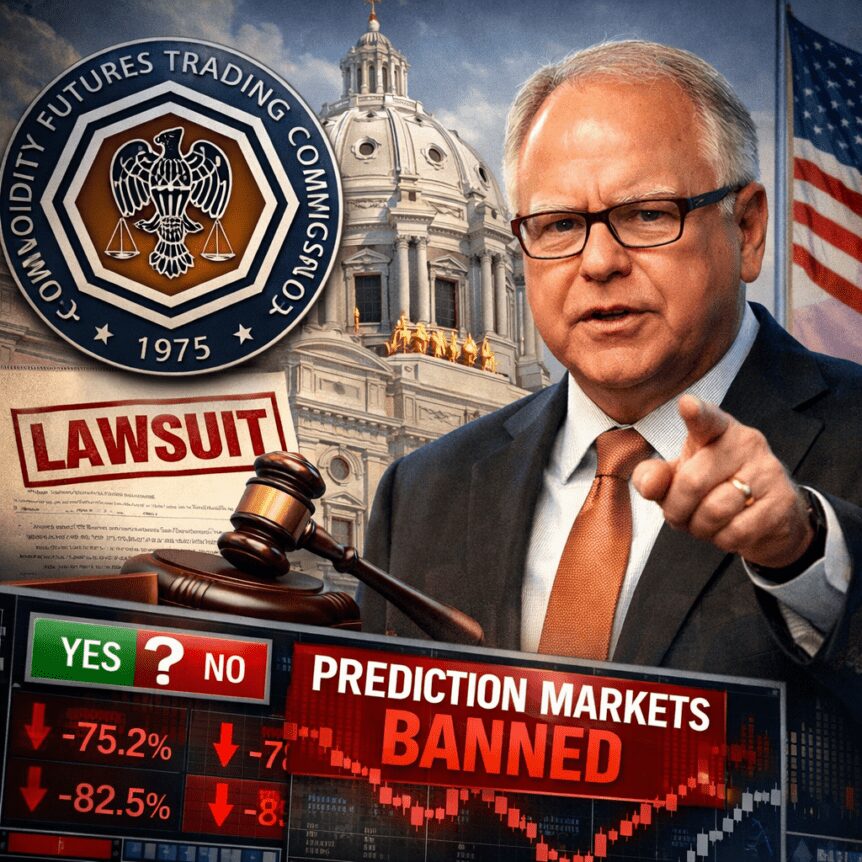
The U.S. Commodity Futures Trading Commission (CFTC) has moved to block Minnesota’s new restriction on prediction markets, filing a lawsuit in the District of Minnesota that challenges Senate File (SF) 4760 as an overreach of state authority. The suit centers on the state’s prohibition of advertising, creating, operating, or otherwise facilitating prediction-market platforms, with a specific focus on event contracts tied to sporting events, military conflicts, and weather—essentially banning platforms such as Kalshi and Polymarket from listing these products within Minnesota’s borders.
In its filing, the CFTC argues that Minnesota’s law conflicts with federal regulation of derivatives and event contracts under the Commodity Exchange Act (CEA), asserting exclusive federal jurisdiction over such products. The agency seeks to block the Minnesota statute on both preliminary and permanent grounds, asserting that Minnesota’s law would criminalize exchanges the CFTC has approved and event contracts that have been self-certified to the Commission. The filing frames the state action as prejudicing the federal government’s ability to enforce federal law.
The Minnesota bill was signed into law by Governor Tim Walz and is slated to take effect on August 1. It amended state statutes to ban the advertising, creation, operation, or facilitation of prediction-market platforms, effectively constraining the listing of event contracts on platforms like Kalshi and Polymarket. The law’s text specifies that event contracts tied to various categories, including sports outcomes and other contingencies, would be treated as wagers under Minnesota law.
The CFTC’s position is that it holds “exclusive jurisdiction” to regulate prediction markets under the CEA, and it argues that Minnesota’s ban would interfere with the federal framework for these products. The agency asked the court to issue both a preliminary injunction and a permanent injunction to prevent the law from taking effect, emphasizing that the state action would undermine the federal government’s enforcement of federal law.
According to Cointelegraph, the CFTC has, in recent episodes, aligned with Kalshi in multiple state-level challenges to prediction-market constraints and has pursued similar actions against authorities in states such as Connecticut, Illinois, New York, and Ohio. The current Minnesota case is presented as the first outright state legislative ban in the United States, contrasting with prior regulatory-focused actions at the state level. The Commission’s stance has been supported by statements from the agency’s leadership, who have signaled that state restrictions on prediction markets would be challenged in court. In response to Minnesota’s move, Kalshi described the law as unenforceable and constitutionally and federally unlawful, while Polymarket did not immediately respond to inquiries for comment.
Key takeaways
- Federal overreach argument: The CFTC asserts exclusive federal jurisdiction over event contracts under the Commodity Exchange Act, challenging Minnesota’s outright ban on prediction-market activities.
- State law and effective date: Minnesota’s SF 4760, signed by the governor, will prohibit advertising, creation, operation, or facilitation of prediction-market platforms when it takes effect on August 1.
- Judicial remedy sought: The CFTC requests both preliminary and permanent injunctions to halt the Minnesota law from taking effect and to prevent enforcement actions against exchanges listing event contracts.
- Affected entities and responses: The suit directly implicates platform operators such as Kalshi and Polymarket; Kalshi has argued the law is unenforceable, while Polymarket has not issued an immediate public statement.
- Broader crypto policy context in Minnesota: Separately, Minnesota enacted a crypto custody services bill for banks and credit unions, set to take effect August 1, and also passed a ban on crypto kiosks and ATMs in a bid to curb scams—reflecting a broader regulatory approach to crypto activity within the state.
Legal framework and the Minnesota challenge
The CFTC’s legal argument rests on the premise that event contracts—for example, contractual bets on sports results or other future contingencies—fall under the purview of regulated derivatives and swaps, which the federal regulator oversees. By labeling Minnesota’s prohibition on listing or facilitating these contracts as incompatible with federal law, the CFTC contends that the state cannot criminalize exchanges that have received federal approval or the contracts that have been self-certified under federal oversight. The complaint emphasizes the risk that Minnesota’s statute would interfere with the federal government’s ability to enforce federal law governing these markets.
State action and institutional implications for markets
Minnesota’s SF 4760 marks a notable instance of state lawmakers choosing to curtail prediction-market activity outright, moving beyond regulatory restrictions or licensing frameworks seen in other jurisdictions. The CFTC’s challenge highlights a core tension in the U.S. market structure: whether state capitals may expand restrictions on a federally regulated derivative product, potentially creating a patchwork of compliance requirements for exchanges that aspire to operate nationwide. This legal dynamic has immediate implications for platform operators seeking to serve multiple states and for banks or custodians that may consider exposure to or integration with these markets.
From an enforcement and compliance perspective, the case underscores several practical considerations for exchanges and financial institutions:
- Licensing and registration: If the CFTC prevails on jurisdictional grounds, platforms may need to reassess multi-state listing strategies and ensure alignment with federal registration requirements to avoid inadvertent violations.
- Compliance program design: Firms must ensure KYC/AML controls, contract disclosures, and listing procedures meet federal standards for traded products and that cross-border or cross-state listings do not create legal exposure.
- Cross-state regulatory risk: The Minnesota action illustrates how state-level action can complicate a platform’s risk and compliance posture, even when federal preemption is invoked, potentially affecting regulatory anticipation and capital planning.
- Operational certainty: The outcome could influence the timing of product launches, self-certifications, and listing decisions, particularly for platforms seeking to operate with broad access across the United States.
Commentary from platform representatives indicates divergent views on the enforceability and legality of Minnesota’s approach. Kalshi described the law as unenforceable and a constitutional overstep, while Polymarket did not immediately provide a public reaction to the lawsuit. The CFTC’s broader stance in related cases—where it has supported Kalshi in other state actions—adds a layer of strategic tension between federal and state authorities over the governance of prediction markets. These dynamics are being tracked not only by market participants but also by compliance and legal teams evaluating the risk landscape for regulated financial products tied to real-world outcomes.
Regulatory context and policy implications
The Minnesota dispute arrives amid ongoing national and global debates about how prediction markets should be treated within financial regulatory frameworks. The CFTC’s aggressive posture toward state restrictions aligns with a broader trend of asserting federal authority over novel derivatives markets, especially those that could intersect with commodities and securities laws. The case also sits within a larger policy dialogue about how such markets should be regulated in light of anti-fraud, consumer protection, and risk-management concerns.
On the international side, policy makers frequently contrast U.S. approaches with evolving European frameworks, such as MiCA, to illustrate different model outcomes for market integrity, licensing, and cross-border service provision. While MiCA governs crypto-asset service providers within the European Union, cases like Minnesota’s SF 4760 serve as a reminder that cross-jurisdictional coherence remains a critical objective for global market participants seeking to minimize legal and operational risk. For U.S. market participants, the current litigation could influence legislative debates about preemption, federal licensing norms, and the boundaries of state intervention in federally regulated product categories.
Overall, the dispute signals potential near-term attention for exchanges, banks, and investors as courts weigh the balance between state policy experimentation and federal regulatory prerogatives. The court’s ruling will have immediate relevance for the status of prediction-market platforms in Minnesota and could set a precedent for similar challenges in other states that may consider restrictive measures or outright bans. Analysts and compliance teams will be watching for how the court addresses the CFTC’s allegations of exclusive jurisdiction and what that implies for the governance of event contracts in a federated regulatory environment.
Looking ahead, the August 1 effective date of Minnesota’s law remains a critical milestone. The court’s decision on the CFTC’s injunction request will shape the practical viability of prediction-market platforms within Minnesota’s borders and illuminate the broader legal framework governing the intersection of federal derivatives regulation and state policy. As enforcement actions unfold, a clearer picture should emerge on how the federal government will enforce preemptive authority in this space and how state legislators might approach similar issues in the future.
As coverage continues, observers should monitor filings for any narrowing of claims, potential settlements, or interim court orders that could affect product listings, platform operations, or custody arrangements tied to prediction-market activities. In the near term, the Minnesota development reinforces the need for robust regulatory reporting, comprehensive compliance controls, and strategic risk assessments for entities operating or considering entry into federally regulated prediction markets.
Source notes: The CFTC’s press materials and related regulatory filings are publicly accessible, and Minnesotan legislative text can be reviewed through the state’s official repository. For context on related rulings and positions, Cointelegraph has reported on the CFTC’s stance in other state actions, including Kalshi-related matters referenced in this coverage.