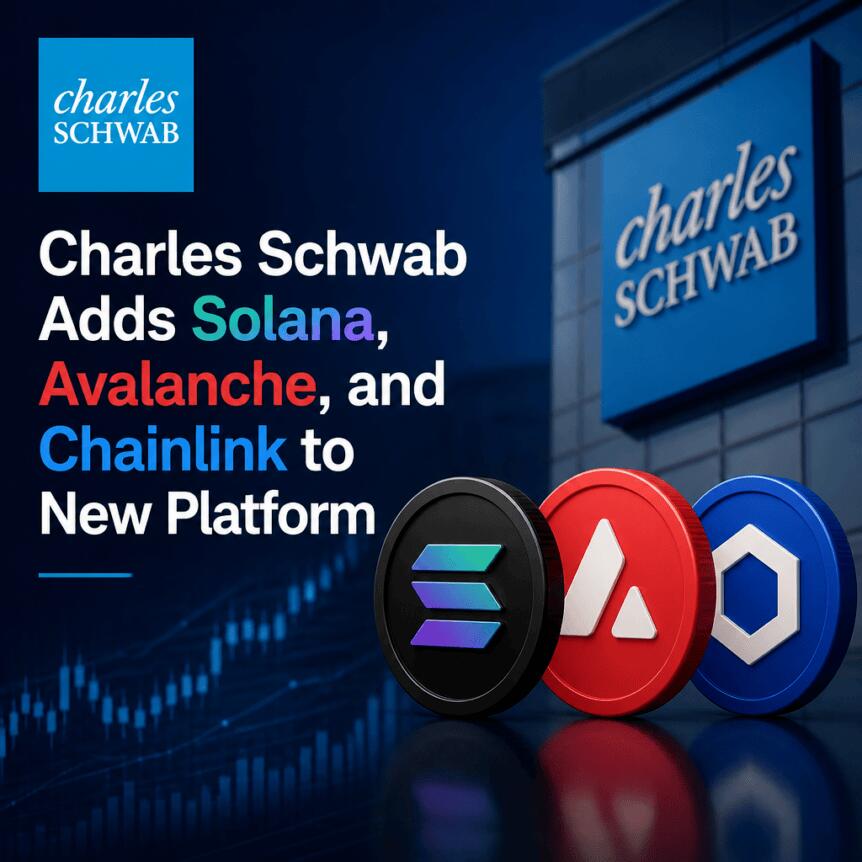
Charles Schwab is set to expand the range of cryptocurrencies it offers to retail clients, adding Solana (SOL), Avalanche (AVAX) and Chainlink (LINK) to its Schwab Crypto platform in the coming months. The move broadens Schwab’s direct crypto trading beyond its initial support for Bitcoin (BTC) and Ether (ETH).
Schwab Crypto began rolling out to retail clients in May, allowing customers to trade BTC and ETH through Schwab’s website, mobile app and thinkorswim platform. Schwab has said it intends to add additional digital assets over time, but—beyond naming the three new tokens—it has not provided further details on what else may follow or a more specific schedule.
Key takeaways
- Schwab Crypto will add Solana (SOL), Avalanche (AVAX) and Chainlink (LINK), expanding beyond BTC and ETH.
- The brokerage started its retail rollout in May, initially offering direct trading for Bitcoin and Ether via Schwab’s existing platforms.
- Schwab charges 0.75% (75 basis points) on the dollar value of each crypto trade.
- Schwab Crypto availability is limited to U.S. states excluding New York and Louisiana, with no offering in territories or internationally.
- The firm’s crypto expansion aligns with a broader push into new trading products, including prediction-style contracts tied to the S&P 500.
Beyond BTC and ETH: Schwab’s next crypto batch
Schwab’s announcement marks another step in the firm’s efforts to integrate digital assets into mainstream brokerage workflows. When the initial rollout began in May, Schwab positioned its service as a direct trading option—bringing crypto into the same environment retail investors use for traditional market exposure.
With SOL, AVAX and LINK now on the roadmap, Schwab is effectively moving from a “two-asset” entry point to a wider selection of widely followed networks and token ecosystems. However, the company has not described any broader framework for how it chooses future listings, nor has it outlined whether additional assets could be added after these three.
For investors, the practical impact is twofold. First, it increases the range of coins that can be traded directly through a familiar brokerage interface rather than via separate exchanges. Second, it potentially changes portfolio construction, because tokens like SOL and AVAX represent different market dynamics compared with BTC and ETH—particularly in terms of sector exposure tied to smart-contract and decentralized application ecosystems.
How Schwab Crypto works—and what it costs
Schwab Crypto operates as a direct crypto trading service offered through Schwab’s banking and brokerage structure. The accounts are provided through Charles Schwab Premier Bank, while affiliated brokerage Charles Schwab & Co. performs certain operational functions on the bank’s behalf.
Pricing is set at 75 basis points, or 0.75%, on the dollar value of each crypto trade. Schwab has also defined geographic limits for customers: the service is available in all U.S. states except New York and Louisiana, and it is not offered in U.S. territories or internationally.
Those restrictions matter because they define who can actually access the expanded token list. Even as Schwab adds new assets, participation will remain constrained by the company’s current regulatory and compliance footprint.
Retail rollout in motion since May
Schwab Crypto’s initial retail availability began with BTC and ETH as Schwab started rolling out the product to customers. According to earlier coverage from Cointelegraph, the exchange-enabled experience was introduced through Schwab’s website, mobile app and thinkorswim platform for a first group of retail clients.
Schwab has continued to describe the crypto offering as something that will grow over time. The inclusion of SOL, AVAX and LINK therefore fits within that stated plan, but the company’s public communications still leave key questions unanswered for traders—especially around whether it will expand to additional tokens beyond those three and when.
Schwab’s parallel push into prediction markets
Schwab’s crypto expansion arrives as the broker prepares additional trading-related offerings. In June, The Wall Street Journal reported that Schwab plans to offer prediction contracts tied to the S&P 500 index in partnership with Cboe Global Markets. Those contracts would let clients wager whether the index will close above or below a specified level, with the product reportedly expected to launch within months.
Importantly, Schwab’s reported plan differs from platforms such as Kalshi and Polymarket, which are known for broader prediction markets. The Journal report suggested that Schwab’s initial contracts would be limited to index outcomes rather than expanding immediately into other event categories.
From an industry standpoint, the connection is less about crypto specifically and more about how traditional brokerage firms are expanding beyond standard asset classes. If Schwab follows through on both the multi-asset crypto trading roadmap and prediction-style contracts, it signals a broader effort to develop new “trading products” that can sit alongside conventional investments—potentially drawing investor attention to alternative ways of positioning risk and expectations.
What to watch next
Schwab hasn’t provided a precise timetable for when SOL, AVAX and LINK will go live, so investors should watch for official platform updates and client notifications once trading availability is enabled. More broadly, the bigger question is whether Schwab will continue expanding its crypto roster after these three tokens—and how its evolving product menu (from crypto to prediction contracts) reshapes participation for retail traders in the U.S.