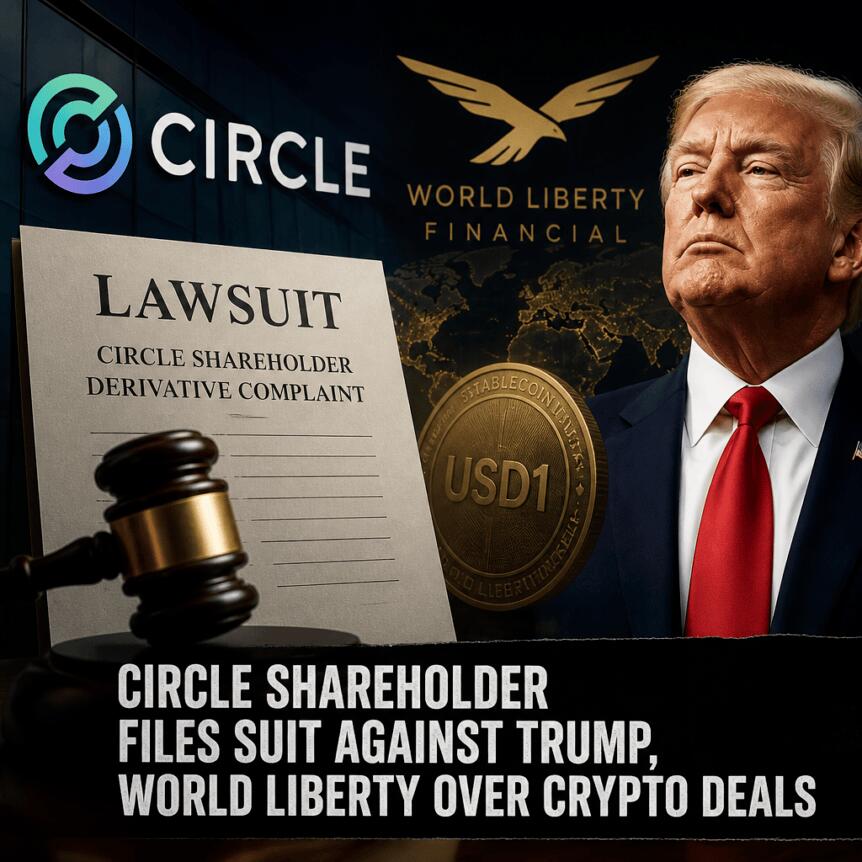
A Circle Internet Financial shareholder has filed a lawsuit in the US District Court for the District of Columbia accusing President Donald Trump, his family’s crypto venture World Liberty Financial, and related entities of driving billions of dollars in allegedly foreign government-linked payments into the stablecoin ecosystem—at Circle’s expense.
According to the Thursday filing, J. Benjamin Greenberg argues that Trump and those associated with him created a pathway for foreign governments to move value using a Trump-linked stablecoin, USD1, undermining Circle’s ability to compete with USDC. Greenberg is seeking constitutional declarations, injunctions, and damages, while Circle says it did not initiate or participate in the case.
Key takeaways
- Circle shareholder J. Benjamin Greenberg filed suit alleging Trump and World Liberty Financial enabled a foreign-government-linked flow of funds via the USD1 stablecoin.
- The complaint centers on a reported $2 billion Binance investment conducted in 2025 using USD1 by an Abu Dhabi-linked entity, MGX.
- Greenberg claims the conduct violates the US Constitution’s Foreign Emoluments Clause and asks the court to halt similar activities without congressional consent.
- Circle says it did not initiate, direct, authorize, or participate in the filing and declined to comment on the pending litigation.
- The dispute is unfolding amid US election pressure on Trump’s crypto-related business ties, with Democrats using those allegations as campaign messaging.
The lawsuit’s core allegation: stablecoin-linked access for foreign money
Greenberg’s lawsuit targets Trump, US Special Envoy to the Middle East Steve Witkoff, World Liberty Financial, and affiliate entities connected to the World Liberty initiative. The plaintiff says that by accepting “hundreds of millions of dollars from a foreign government,” Trump and his businesses diverted business from Circle.
The legal theory, as presented in the filing, is framed around constitutional restrictions on federal officials receiving foreign emoluments. Greenberg argues that the USD1 stablecoin—marketed as part of the Trump family’s crypto efforts—has been used to create business opportunities for foreign-linked actors, contributing to harm to Circle’s position in the stablecoin market.
Greenberg also asks the court to declare the challenged conduct unconstitutional and to issue injunctions. The complaint further seeks an accounting of billions in alleged payments from foreign states to Trump and related businesses, alongside disgorgement and compensatory and punitive damages.
MGX, Binance, and the USD1 payments trail
A central element of the lawsuit involves an Abu Dhabi entity tied to the United Arab Emirates royalty, referred to in the filing as MGX. The complaint points to reporting that MGX invested $2 billion into cryptocurrency exchange Binance in 2025 using the USD1 stablecoin.
Greenberg’s argument is that these stablecoin-enabled transactions are not merely commercial activity, but part of a broader pattern that disadvantages Circle and exposes constitutional and ethical concerns. The filing highlights how USD1 can serve as a mechanism for value transfer in deals where foreign government-associated capital is involved.
In February, The Wall Street Journal reported on another investment structure tied to World Liberty: an investment vehicle backed by Sheikh Tahnoon bin Zayed Al Nahyan was said to agree to purchase a 49% stake in World Liberty for $500 million. That earlier reporting is referenced in the current filing context as part of the overall picture of foreign-linked involvement.
Who is suing, and how Circle responded
The plaintiff, Greenberg, says he holds 10,000 ordinary shares of Circle. He is requesting that the court declare Trump violated the Foreign Emoluments Clause and impose injunctions designed to prevent the president and Witkoff from pursuing similar financial interests without congressional approval.
World Liberty co-founders are also implicated. The lawsuit notes that Zach Witkoff—Witkoff’s son—is a World Liberty co-founder, and that Trump and his three sons are also co-founders of the crypto venture.
Circle’s position, delivered through a spokesperson, is that the company did not initiate, direct, authorize, or participate in the filing. The spokesperson also declined to comment on the pending litigation. The lawsuit has not yet drawn public comment from World Liberty or the White House, according to the report.
Elections amplify the political stakes around Trump’s crypto business
Beyond the courtroom, the dispute appears to land in a politically sensitive period for Trump’s crypto ties. The article notes that the US president and his family are associated with multiple crypto ventures, and that reporting has alleged significant financial impacts on investors in connection with those projects.
With the 2026 midterm elections approaching and early voting already started in some states, Democrats running for re-election are reportedly using Trump’s crypto activities as a wedge issue. The reporting cites Senator Mark Warner’s campaign ad released last week, which highlights that Trump made “more than $600 million” from a crypto memecoin.
The broader environment underscores why the lawsuit’s framing matters for more than just USDC and stablecoin competition. Allegations about constitutional violations and foreign influence are likely to resonate with voters and regulators alike, especially when they intersect with high-profile crypto ventures tied to senior political figures.
What to watch next for Circle, USDC users, and the stablecoin market
For stablecoin market participants, the immediate uncertainty is legal rather than technical: whether the court will accept the constitutional claims and whether injunctions or damages are ultimately ordered. Readers should also watch for how World Liberty and the White House respond in filings, and whether the underlying factual allegations—particularly the alleged USD1-linked foreign-government payments—are disputed with evidence as the case progresses.