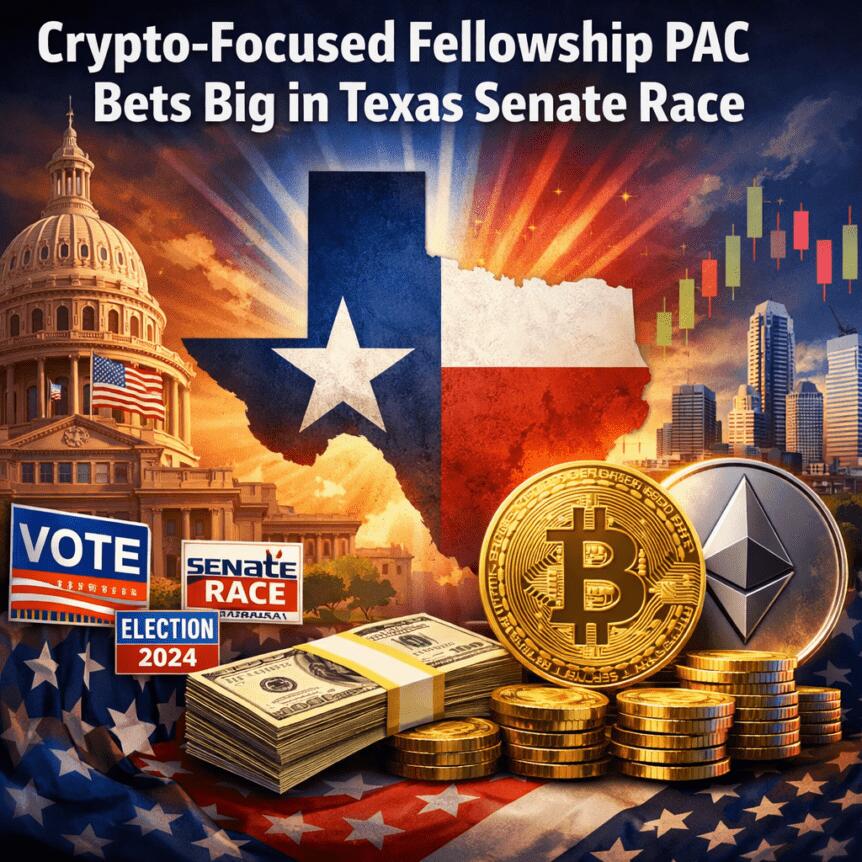
In a fresh disclosure to the U.S. Federal Election Commission, Fellowship PAC—the crypto-aligned political action committee led by Bo Hines, the head of government affairs for Tether US—reported spending more than $3 million on advertising tied to U.S. Senate and House races. The majority of the outlay appears aimed at backing a Texas Republican candidate in a runoff that could shape the GOP’s midterm strategy.
According to the FEC filing, Fellowship disclosed $1.75 million backing Texas Attorney General Ken Paxton, who is contending with incumbent Sen. John Cornyn in a May 26 runoff to determine the Republican nominee for the 2026 Senate race. The committee also reported advertising spend of $350,000 for Mike Collins in Georgia’s Senate race, $350,000 for Barry Moore in Alabama’s Senate race, and either $250,000 for Blake Miguez or $350,000 for Julia Letlow in Louisiana races, with all purchases routed through the Nxum Group. The marketing firm is co-founded by Bo Hines, described as a former White House crypto adviser and the CEO of Tether US.
The Fellowship PAC’s filing underscores a broader pattern in which crypto-aligned political committees seek to shape messaging and candidate support through targeted media buys. Fellowship launched last September, claiming to have more than $100 million from undisclosed investors aligned with the crypto industry. While the PAC has since reported $11 million in contributions to the FEC, public records to date do not show other backers publicly tied to crypto in the filings. The balance of funding and the ultimate sources remain unclear, a detail that has become a point of scrutiny as crypto-faithful donors pursue influence ahead of the 2026 midterms. For reference, coverage from Cointelegraph noted the $11 million in reported contributions and the lack of corroborating backers in other filings.
Beyond Fellowship, other crypto-connected political committees, such as Fairshake, are active in mobilizing voters through media campaigns in 2024 and anticipated activity in 2026. Analysts note that the spending cadence and donor profiles could offer a window into how crypto interests seek to shape public policy and the regulatory environment as the political cycle intensifies.
Kalshi penalties highlight ethics in prediction-market activity
As primaries advance and general elections loom, participants in prediction markets have increasingly intersected with political campaigns—sometimes triggering compliance actions. Kalshi, the regulated prediction-market platform, announced penalties and restrictions on three candidates in Minnesota, Texas and Virginia after they placed bets related to their own races. In the Texas case, Ezekiel Enriquez reportedly purchased less than $100 worth of contracts tied to his candidacy for Texas’ 21st Congressional District. Kalshi described the settlement as imposing a five-year suspension from direct or indirect access to Kalshi and a financial penalty of $784.20.
The enforcement move, including the public settlement notice on Kalshi’s site, underscores the ongoing tension between candidate involvement in prediction markets and established rules around insider trading and conflicts of interest. The settlement notice linked to Enriquez’s case provides a concrete example of how regulators and platforms are policing self-betting and related activities in the growing ecosystem of crypto-adjacent markets.
These developments arrive at a moment when political actors are increasingly engaging with crypto-native funds, media campaigns, and prediction-market platforms to influence electoral outcomes. The frontier between fundraising, political advocacy, and market-based engagement remains murky, inviting closer regulatory scrutiny and greater transparency for all participants.
As the 2026 midterm cycle unfolds, observers will be watching not only which candidates gain the party’s nomination but also how crypto-linked money flows, PAC disclosures, and market-based political tools evolve under tightening governance and potential legislative changes. The next disclosures from Fellowship and related entities will help clarify the scale of crypto-backed political activity and its implications for investors, voters, and policymakers alike.
Sources: Federal Election Commission filings cited by Fellowship PAC; note on the Kalshi settlement from Kalshi’s regulatory notices, including the Enriquez case and the linked settlement document.