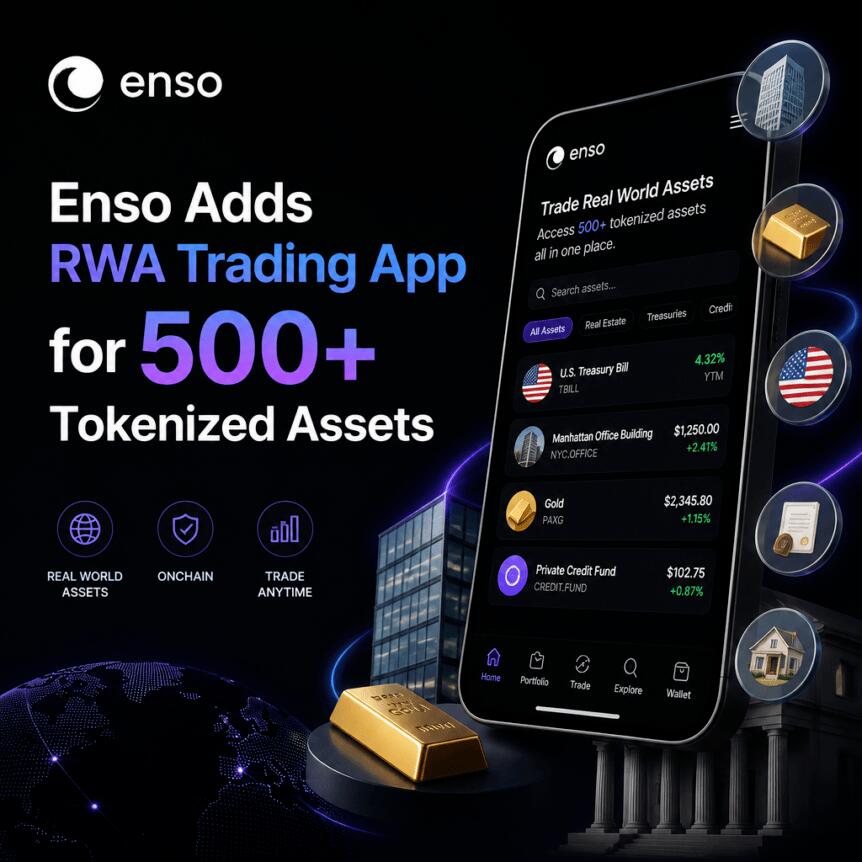
Enso, a Switzerland-based Web3 development platform, has rolled out an RWA (real-world asset) application designed to give users a single interface to more than 500 tokenized assets. The announcement, shared with Cointelegraph on Monday, ties Enso’s offering to integrations with xStocks, Ondo Finance and Anchorage Digital’s Porto, aiming to streamline access across multiple tokenization venues.
Enso’s execution layer supports tokenized stocks, ETFs, Treasurys, commodities and stablecoins. Ondo is set to supply tokenized equities, treasury products and related capital markets infrastructure, while xStocks will focus on tokenized equities and ETFs.
Key takeaways
- Enso’s new application aggregates access to 500+ tokenized assets via integrations with xStocks, Ondo Finance and Anchorage Digital’s Porto.
- The platform’s execution layer is positioned to reduce friction for users moving between tokenized asset issuers and distribution venues.
- Enso cites strong investor interest in tokenized US market access and yield-bearing dollar-denominated assets.
- RWA.xyz data shows tokenized asset holders grew 13.4% in 30 days to 930,612, even as total onchain value declined slightly.
A unified execution layer for tokenized US markets
Tokenization has increasingly shifted from isolated experiments toward infrastructure aimed at improving usability—especially for investors outside the United States. Enso’s pitch is that consolidating tokenized assets under one distribution and execution layer can make the experience smoother, particularly when users want exposure to assets that trade on different systems or through different providers.
The application brings a range of asset types under one roof, including tokenized Treasurys, commodities and stablecoins alongside tokenized equities and ETFs. Enso said the goal is to simplify access across multiple venues, rather than requiring users to interact separately with each tokenized product provider.
The asset catalog includes major US company names such as Apple, Microsoft, Nvidia, Amazon, Alphabet, Meta, Tesla and SpaceX, reflecting Enso’s focus on widely followed equities and the broader set of traditional assets tokenized onchain.
Why European demand is driving product design
Enso’s rollout lands in a market where demand for tokenized US exposure is not limited to US-based participants. Enso co-founder and CEO Connor Howe told Cointelegraph that the strongest interest concentrates in two themes: tokenized access to US markets and yield-bearing dollar assets.
The demand concentrates in two places: tokenized access to US markets, with the around-the-clock trading traditional venues can’t match, and yield-bearing dollar assets.
That framing matters for how investors evaluate tokenized products. Tokenized equities and ETFs often appeal to users who want more frequent or flexible trading windows than traditional venues offer, as well as those looking for dollar-denominated exposure with yield components. Enso’s execution-layer approach suggests it believes better aggregation can reduce the practical barriers that can otherwise slow adoption.
Holder growth continues as total value eases
The Enso launch arrives as tokenized asset participation continues to expand. According to RWA.xyz data shared by Cointelegraph, the number of tokenized asset holders rose 13.4% over the past 30 days to 930,612. Over the same period, the total value of tokenized assets onchain fell 0.9%.
That combination—more holders but slightly lower total value—can be read as a sign that distribution is spreading, even if not everyone is increasing size at the same pace. For traders and investors, it can also hint at a broader shift from concentrated exposure toward smaller or more diversified positions.
By category, US Treasury debt was the largest tokenized segment with $15 billion in onchain value. Tokenized commodities followed with $4.6 billion, while asset-backed credit stood at $2.2 billion. Tokenized stocks ranked fifth among categories at $1.6 billion in total onchain value.
In the same broader context, Cointelegraph previously reported that tokenized stocks passed $1 billion in total onchain value on March 10, with Ondo contributing about 58% of the market and xStocks about 24% at the time—illustrating how concentrated leadership can be within specific tokenized sectors even as more participants enter.
Enso’s integration plan—bringing together an equities provider (Ondo), an equities/ETF provider (xStocks) and Anchorage Digital’s Porto—fits the idea that the next step for tokenized assets is improved distribution and execution, not just additional asset issuances.
Competitive pressure in Europe’s RWA push
Enso’s move adds to a growing trend of European firms expanding beyond pure crypto-native products into tokenized traditional assets. Earlier this year, Austria-based Bitpanda expanded its offering to roughly 10,000 stocks and ETFs across a “universal exchange” model, according to Cointelegraph coverage.
What’s notable about the Enso announcement is the emphasis on orchestration: not merely listing tokenized assets, but combining access and execution across multiple partners. For users, that can reduce the need to understand each issuer’s specific onchain or offchain pathways. For issuers and liquidity providers, it potentially broadens reach by funneling interest through a single application layer.
For builders and investors, the question is what will happen as more “front ends” appear for tokenized assets. Will competition primarily shift toward user experience and multi-venue routing, or will liquidity and compliance constraints continue to shape which products become widely available?
Looking ahead, market participants should watch whether Enso’s aggregated access leads to sustained growth in tokenized equity and Treasury engagement—especially given the recent pattern of holder expansion alongside a modest decline in total onchain value. The next signals to track will be how quickly usage scales after launch and whether tokenized stocks continue to expand their footprint relative to other RWA categories.