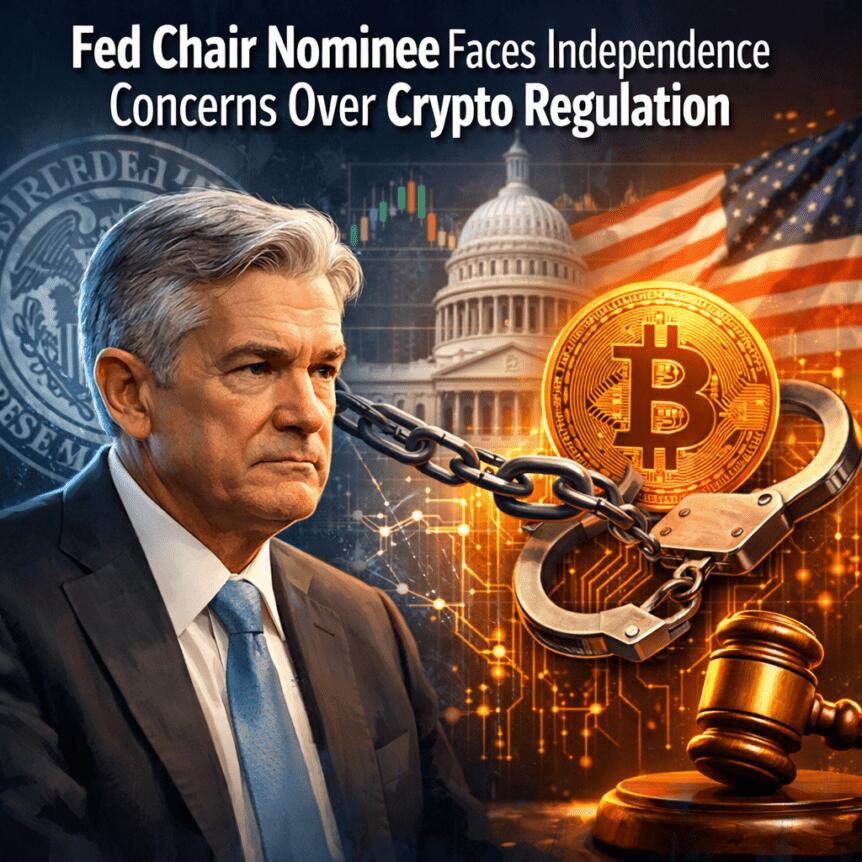
Kevin Warsh’s nomination to lead the U.S. Federal Reserve faced pointed scrutiny at a Senate confirmation hearing on Tuesday, as lawmakers pressed him over financial disclosures and potential conflicts of interest tied to holdings in crypto and other sectors. The exchange illuminated ongoing debates about Fed independence in a political environment shaped by questions about executive influence and the central bank’s future policy trajectory.
With Jerome Powell’s term as Fed chair about to expire, lawmakers are under pressure to consider a successor who can command broad confidence across parties while maintaining insulation from political interference. The hearing underscored the central tension: how to preserve credible monetary policy and regulatory stewardship when the appointment is perceived as falling within presidential prerogative, and how that dynamic could affect the government’s approach to a rapidly evolving digital-asset landscape.
During questioning, Massachusetts Senator Elizabeth Warren, the committee’s ranking member, criticized Warsh for what she described as potential outsized influence from the White House and suggested that confirmation could open the door to policy outcomes favorable to the president’s broader agenda. Warsh, in turn, avoided committing to specific policy positions or rate decisions, stating that no president had ever asked him to promise a particular outcome and that he would not agree to do so if asked. His responses reflected the broader challenge of balancing independence with accountability in a high-stakes policy environment.
Democrats pressed Warsh on concrete concerns about conflicts of interest that could arise if he were confirmed and how they might affect the Fed’s decisions on monetary policy, financial stability, and regulatory oversight. Critics warned that even the appearance of political influence could undermine the Fed’s credibility in times of market stress or when difficult regulatory choices must be made regarding financial institutions and asset markets. The discussion touched on the potential for conflicts to extend into novel areas of policy as digital assets gain prominence within the financial system.
The hearing also included questions on crypto policy, a topic that has moved to the center of congressional debates about broader financial regulation and consumer protection. Wyoming Senator Cynthia Lummis asked Warsh about the role of digital assets within the U.S. financial system. Warsh indicated that digital assets are “part of the fabric of our financial services industry in the United States,” signaling a recognition that the Fed’s stance on digital assets will be increasingly consequential for financial markets and regulatory frameworks. According to Cointelegraph, Warsh has indicated a willingness to engage with the evolving regime governing crypto, while also emphasizing the need for clear governance of the central bank’s authority in a rapidly digitizing market.
Warsh has pledged to divest from his financial holdings, including investments in crypto and AI companies, before taking the oath if confirmed. This commitment, noted in coverage by Cointelegraph, is intended to mitigate potential conflicts of interest and reassure lawmakers that the Fed chair’s decisions would be guided by policy considerations rather than personal financial interests. The discussion occurred against a backdrop of broader concerns about the independence of the Fed’s decision-making at a time when political dynamics have elevated scrutiny of central-bank independence as a global policy issue.
The committee’s chair, Tim Scott, speaking to CNBC, framed the independence objective within the Fed’s dual mandate. He argued that while collaboration among the administration, Congress, and the central bank is essential, the core function of the Fed remains to deliver monetary policy and financial stability in a manner that does not compromise its autonomy. This framing aligns with longstanding institutional expectations that the Fed’s policy actions should be insulated from short-term political incentives, even as lawmakers seek greater transparency and accountability through the appointment process.
Key takeaways
- The nomination process highlighted enduring questions about Federal Reserve independence amid executive-branch influence concerns, particularly in the context of a presidential transition and a looming leadership shift.
- Warsh’s disclosed holdings, including crypto-related investments, drew scrutiny regarding potential conflicts of interest; he committed to divesting prior to taking office to mitigate perceived bias in policy decisions.
- Crypto assets occupied a substantive role in the hearing, with Warsh acknowledging their place in the U.S. financial services ecosystem, a signal that the Fed’s regulatory approach to digital assets could intersect with congressional oversight and market developments.
- The timing of a final Fed chair appointment remains uncertain, with Powell’s term ending mid-May and market instruments projecting potential delays in confirmation, affecting regulatory planning and policy signaling.
- The proceedings sit within a broader regulatory context that includes ongoing debates over crypto legislation, international alignment, and U.S. agency coordination on supervision, licensing, AML/KYC, and market integrity standards.
Fed leadership, independence, and the policy horizon
From a governance perspective, Warsh’s confirmation hearing placed a spotlight on how the Fed maintains independence when its leadership is explicitly connected to an administration’s agenda. Critics argue that swift turnover or a chair perceived as tethered to political interests could introduce discomfort among markets and financial institutions that rely on a predictable, rule-based framework for monetary policy and regulatory oversight. In this context, the confirmation process is not simply about one individual but about institutional design and the resilience of the policy framework that underpins the U.S. financial system.
Supporters of the nominee emphasize the need for steady stewardship and a measured approach to risk management, especially in an era of heightened financial-market complexity and rapid innovation. The discussion reflects a broader historical cycle in which central banks operate at the intersection of macroeconomic management and financial regulation, balancing the goals of price stability, full employment, and systemic resilience. The outcome of Warsh’s confirmation will likely influence how forthcoming communications from the Fed are interpreted by markets and how the central bank coordinates with other agencies on policy matters affecting the digital-asset sector.
Crypto disclosures and the regulatory context
The disclosure issue remains central to governance expectations for high-level public office in the financial domain. The pledge to divest from crypto- and AI-related holdings is a concrete step toward reducing perceived conflicts and ensuring decision-making is driven by policy merit rather than personal investments. This aligns with compliance practices observed in institutions that prioritize robust governance, robust disclosure regimes, and risk management protocols to address potential conflicts of interest.
From a regulatory standpoint, the matter sits at the confluence of monetary policy, financial stability, and digital-asset regulation. As policymakers seek greater clarity on how the Fed will engage with digital assets, observers note that the central bank’s stance could influence liquidity considerations, banking relationships with crypto-exposed institutions, and the pace of regulatory alignment across jurisdictions. In parallel, U.S. lawmakers are advancing broader debates around crypto oversight, including licensing regimes, consumer protection, anti-money-laundering standards, and cross-border cooperation—areas where the Fed’s policy framework will interact with agencies such as the Securities and Exchange Commission, the Commodity Futures Trading Commission, and the Department of Justice.
Cointelegraph’s coverage underscores that the nomination process is intertwined with ongoing policy discussions about how the United States will address digital assets within established regulatory architectures, including potential implications for the CLARITY Act and related legislative efforts. The cross-cutting nature of these issues means that the Fed’s leadership choice could influence, or be influenced by, a broader policy stance on asset classification, financial-market structure, and regulatory reach across the crypto economy.
Timeline, markets, and the political calculus
Powell’s term as chair is set to expire on May 15, creating a narrow window for a confirmation vote. Depending on the Senate’s pace, Warsh could serve in a temporary capacity at the Fed Board while the confirmation process unfolds, continuing to study and decide on policy directions until a final appointment is secured. This transitional dynamic is particularly relevant for financial institutions seeking policy clarity and for market participants evaluating the regulatory path for digital assets and related financial products.
Market observers have started to reflect the uncertainty in the timing of any confirmation. Prediction markets have captured this ambivalence; for example, one active event contract tracked by Polymarket indicates a substantial portion of participants expect confirmation to occur after mid-May, with a smaller fraction betting on a May confirmation. The same market activity shows a consensus leaning toward a June or later timeline. While not predictive of policy outcomes, these instruments illustrate the degree to which stakeholders are calibrating expectations around leadership, policy signaling, and regulatory evolution at a sensitive juncture.
Beyond the confirmation timeline, the intersection of regulatory oversight and digital-asset policy continues to shape the institutional environment. The debate touches on licensing, cross-border enforcement, AML/KYC standards, and the harmonization—or at least the acknowledgement—of international approaches to crypto regulation. As U.S. policymakers weigh internal governance with external policy requirements, the Fed’s approach to digital assets will likely interact with broader regulatory shifts, including potential updates to domestic and international financial infrastructure, central-bank digital currency considerations, and the evolving stance of major financial institutions toward crypto exposure.
Closing perspective
As the confirmation process advances, observers will watch not only for the outcome of Warsh’s candidacy but also for the signal it sends about the Fed’s posture toward independence, regulatory collaboration, and digital-asset policy. The coming weeks will be pivotal for institutions planning compliance, risk management, and engagement with a regulatory landscape that is increasingly focused on crypto markets, anti-money-laundering controls, and cross-border coordination across financial regulators.
Looking ahead, the central question remains: how will a new Fed leadership balance the imperatives of monetary stability with the fast-evolving realities of digital finance, while maintaining clarity and credibility for markets and for the broader ecosystem of crypto firms, banks, and investors? The answer will shape regulatory dialogue, enforcement priorities, and the architecture of U.S. financial regulation for years to come.