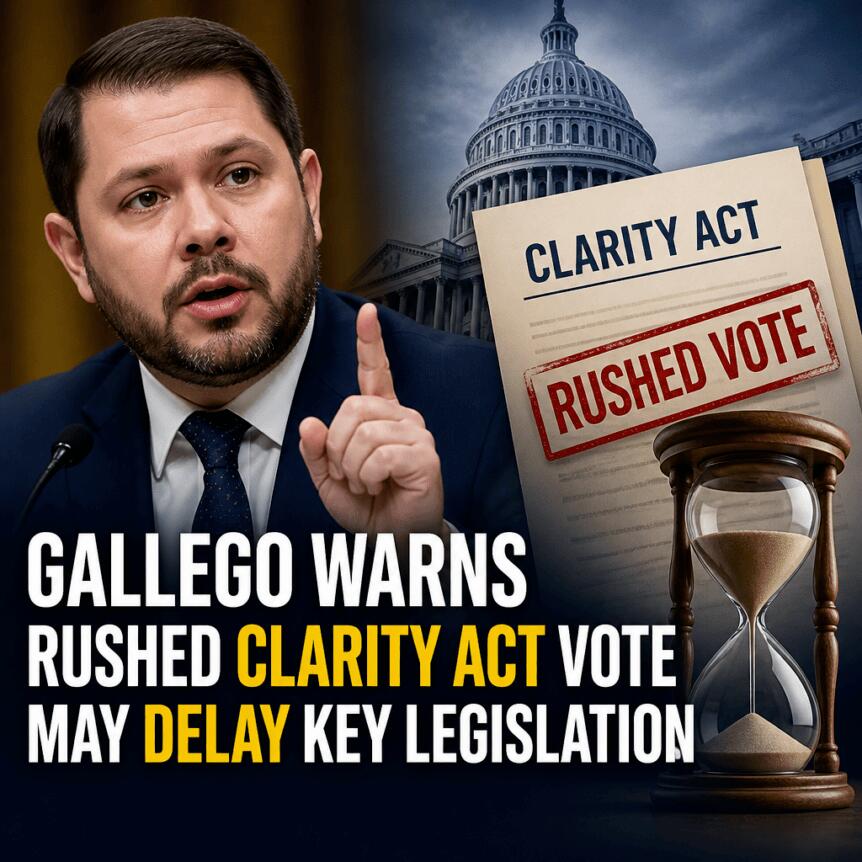
Sen. Ruben Gallego has warned that pushing the proposed CLARITY Act toward an early Senate vote before lawmakers finalize unresolved ethics and stablecoin-yield issues could derail U.S. crypto legislation rather than accelerate it. Speaking at the SALT Wyoming Blockchain Symposium on Wednesday, Gallego said Congress still needs to complete several procedural steps that could determine whether the bill can actually clear the Senate.
His remarks add friction to the Trump administration’s push for faster movement on the legislation, even as Senate leaders have previously signaled they intend to wait until after the August congressional recess. Gallego’s core message was that timing without agreement may produce an outcome lawmakers “don’t want,” potentially forcing the bill to be restarted later with weaker momentum.
Key takeaways
- Sen. Ruben Gallego urged lawmakers to avoid a “fast vote” on the CLARITY Act until disputes—particularly around ethics and stablecoin yield—are resolved.
- Gallego said he and Sen. Thom Tillis submitted compromise ethics language to the White House before the recess but received no clear, point-by-point response.
- The warning suggests procedural action in the Senate could arrive before a bipartisan coalition is in place, risking failure at the 60-vote threshold.
- While the White House has pressed for a “fair version” of the bill, Senate leaders have already indicated the vote could be deferred to September.
Why Gallego says rushing the process could backfire
Gallego framed his concern around how complex the legislative package still is. In his view, the Senate cannot simply move forward to voting if the bill’s components haven’t been fully coordinated and assembled into a final package capable of winning the votes needed for passage.
He specifically noted that lawmakers still have work to do, including addressing the bill’s Agriculture Committee portion, consolidating the broader package, and determining how to route it to the House. Gallego argued that these steps matter because an early vote could lock lawmakers into a timeline that doesn’t match negotiation progress.
“Don’t go for a fast vote,” Gallego said. “A fast vote gets you a fast result, but I’m not sure it’s the result you want.” He added that Congress still had “a lot of steps to complete,” and that “any premature movement is going to set it back further.”
The practical implication for investors and market participants is straightforward: if the bill is advanced before the coalition is ready, the probability of a legislative stall increases. That can prolong uncertainty around U.S. crypto market structure even if the bill ultimately returns later with stronger terms.
Ethics negotiations appear to be the sticking point
Gallego’s criticism also focused on the bill’s ethics framework. He said he and Republican Sen. Thom Tillis had submitted compromise ethics language to the White House before the congressional recess. However, he told the symposium he had not received a detailed response addressing the proposal point-by-point.
According to Gallego, the lack of feedback has made it difficult to close the gap needed for Democratic lawmakers to support the bill. He argued that “sufficiently strong ethics restrictions” were important to earn Democratic support and move the legislation forward.
“We’ve been sending offers over and over again to the White House, and they’ve been coming back either blank, or they’ve come back even slightly further back, or we’ve heard nothing,” Gallego said.
Cointelegraph reached out to the White House for comment but did not receive a response before publication, leaving Gallego’s characterization of stalled negotiations unaddressed in the reporting.
Administration push for speed vs. Senate procedural timing
Gallego’s warning complicates the broader push for swift passage coming from the White House. Earlier coverage from Cointelegraph described the administration’s push for moving toward passage, and on Wednesday Trump urged Congress to pass a “fair version” of the CLARITY Act during a White House appearance with crypto executives.
However, Senate timelines have already suggested that immediate action may not be available. In a report discussed by Cointelegraph, Senate Majority Leader John Thune confirmed on Aug. 7 that the chamber was “punting” the vote and that CLARITY would be queued up “first thing” after lawmakers returned from recess—positioning September as the likely window for consideration.
Patrick Witt, a White House crypto adviser, had previously said the administration would negotiate with Democrats until the September vote, while also stating the administration “can’t afford to wait forever.” That tension—between negotiating leverage and deadline pressure—is now colliding with Gallego’s insistence that substantive ethics resolution must come first.
In other words, even with a September target already on the table, Gallego’s comments suggest the real question is whether negotiations are likely to produce a version strong enough to build a bipartisan coalition—particularly given the Senate’s 60-vote threshold.
What lawmakers still need to finalize before any Senate vote
Beyond ethics language, Gallego indicated multiple procedural and substantive hurdles remain before the bill can be ready for the next legislative stage. He mentioned the need to resolve the bill’s Agriculture Committee component, then assemble the broader package, and finally determine the correct path for sending the finalized measure to the House.
He also linked these remaining tasks to timing and negotiating discipline. For Gallego, the key risk is that procedural momentum—such as a vote being placed on the calendar—could outpace the actual work of building consensus. If that happens, the Senate could be forced into action on a version that lacks enough support, turning a negotiation problem into a legislative failure that makes future compromise harder.
The larger takeaway is that U.S. crypto regulation is still being shaped by how these bills navigate both policy disputes and legislative mechanics. Even when political actors want speed, the Senate’s structure and voting math reward coalitions that are assembled deliberately rather than rushed.
Readers should watch whether the White House provides the detailed ethics feedback Gallego says it has not yet delivered, and whether negotiators converge on a version of the CLARITY Act capable of clearing the Senate—particularly as September approaches.