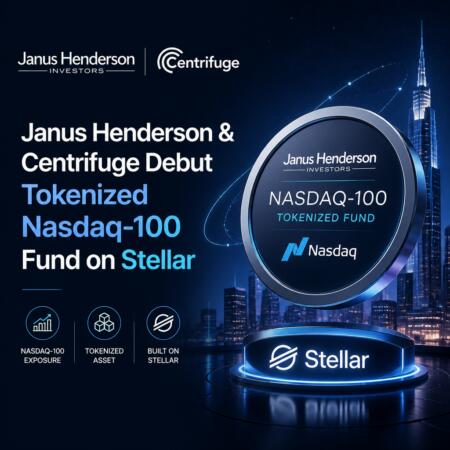
Asset manager Janus Henderson and tokenization platform Centrifuge have launched a blockchain-based fund designed to track the Nasdaq-100 Index, issuing it on Stellar under a Nasdaq licensing arrangement. The product, called JQQQ, is aimed at eligible professional investors outside the United States, according to announcements reported by the Wall Street Journal.
For investors seeking equity-index exposure without direct ownership of the underlying stocks, JQQQ offers an onchain route to benchmark returns. Janus Henderson said the move expands its institutional onchain strategies beyond US Treasurys and structured credit, adding a new channel for index-style exposure. The firm also stated its institutional onchain strategies now exceed $1 billion.
Key takeaways
- Janus Henderson and Centrifuge have launched JQQQ, a tokenized fund intended to track the Nasdaq-100 Index on Stellar.
- The fund is structured as a segregated portfolio of a British Virgin Islands investment company and provides indirect exposure to the Nasdaq-100.
- JQQQ targets eligible professional investors outside the U.S., with the reported minimum investment of $100,000.
- The launch follows Nasdaq’s April decision to expand Nasdaq-100 Index licensing to additional asset managers beyond its existing arrangement with Invesco.
- Stellar’s broader tokenization ecosystem continues to expand, including initiatives tied to DTCC and additional real-world asset token issuers.
Why JQQQ matters for index-style exposure
Tokenized funds have increasingly focused on credit and government securities, where issuance and settlement workflows can align more directly with existing market infrastructure. JQQQ represents a step toward onchain equity-index exposure by tying the product to the Nasdaq-100 benchmark.
According to the Tuesday announcement, the fund is built using Centrifuge’s tokenization infrastructure and is intended to track the Nasdaq-100 “under a licensing agreement with the exchange.” That licensing element matters: index tracking products typically require formal authorization to reference benchmark methodologies and branding, and it also signals growing comfort from legacy index providers with distributed-technology distribution.
Structurally, JQQQ is described as a segregated portfolio within a British Virgin Islands investment company. The product provides indirect exposure to the Nasdaq-100 rather than direct ownership of the underlying stocks. That distinction is relevant for investors evaluating how closely the fund’s token mechanics mirror traditional fund structures, and how operational and legal wrappers differ from conventional exchange-traded vehicles.
Nasdaq widens its licensing footprint
JQQQ’s arrival comes after a broader shift at Nasdaq. In April, Nasdaq expanded licensing of the Nasdaq-100 Index to additional asset managers, including BlackRock and State Street—while continuing its longstanding partnership with Invesco, which operates the $499 billion market cap Invesco QQQ Trust exchange-traded fund.
In practical terms, expanded licensing increases the number of potential products that can reference the benchmark, which can translate into more distribution channels and different vehicle designs—ranging from traditional funds to tokenized structures.
It also helps explain the timing: tokenized investment products often depend on access to licensed indices and benchmarks. Without that permission layer, issuers cannot simply replicate an index strategy onchain.
Stellar’s tokenization push continues to broaden
Beyond the fund itself, the launch further strengthens Stellar’s position in real-world asset tokenization. RWA.xyz data cited in the source places Stellar among the leading chains by distributed real-world asset value, ranking fourth with approximately $3.8 billion in tokenized assets—behind Ethereum, BNB Chain and Solana.
The network already hosts tokenized offerings from major issuers including Spiko, Franklin Templeton and Ondo, illustrating that Stellar’s institutional narrative is not limited to a single use case. In July, tokenization platform Tradable announced plans to bring up to $1 billion in private credit assets to Stellar, with $500 million expected at launch—another example of how private market exposure is being packaged for onchain distribution.
Stellar is also connected to a larger institutional effort involving the Depository Trust & Clearing Corporation (DTCC). Earlier reporting noted that DTCC planned to connect its tokenization service to Stellar, with tokenized assets expected to become available in the first half of 2027. If that timeline holds, the list of potential assets could include US Treasurys, major index ETFs and Russell 1000 stocks.
Taken together, JQQQ fits a pattern: rather than treating tokenization as a niche experiment, multiple market participants appear to be targeting institutional-grade distribution and settlement pathways—using tokenized infrastructure that can eventually support broader asset categories.
What to watch as onchain equity/index products roll out
Even as tokenized assets expand on networks like Stellar, token performance in the market can diverge from adoption narratives. The source notes that Stellar’s native token, XLM, has fallen about 16% year to date, trading near $0.17 on Tuesday, based on CoinGecko data.
For investors, the near-term questions are less about the price of the token and more about how tokenized index products behave operationally. Readers should monitor whether the fund’s tracking approach and redemption mechanics remain consistent under market volatility, and whether regulatory and eligibility constraints—such as the U.S. exclusion and professional investor targeting—persist as these offerings scale.
Next, attention will likely shift to how quickly tokenized index exposure spreads across other asset managers and chains following Nasdaq’s expanded licensing, and whether institutional settlement partners like DTCC can accelerate the availability of additional tokenized categories on Stellar.