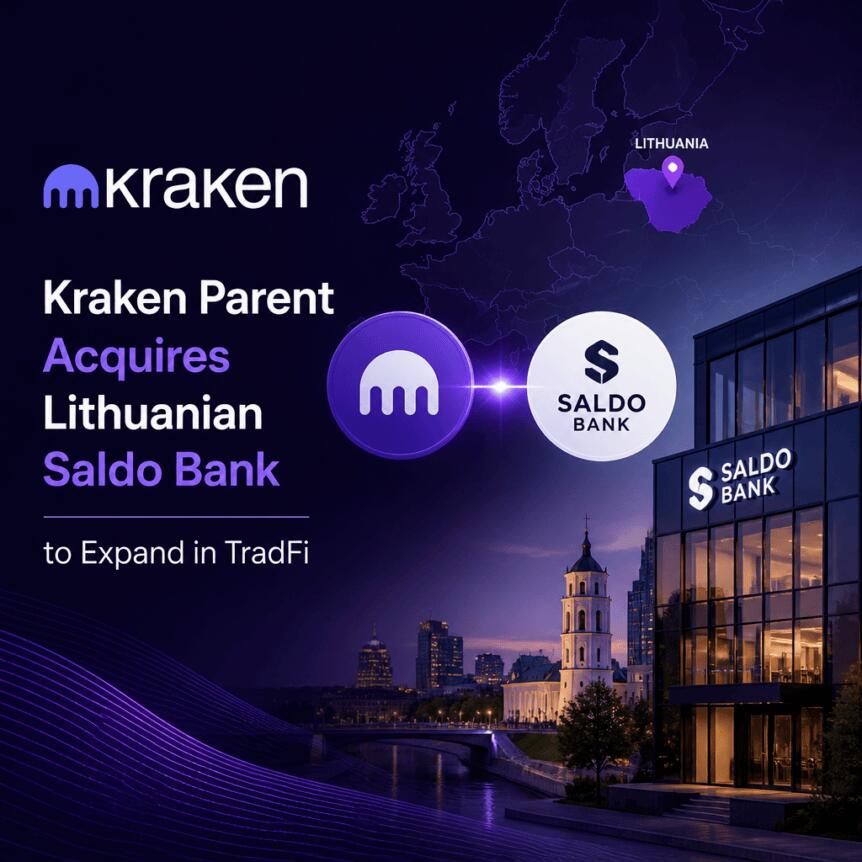
Kraken’s parent company, Payward, is moving further into traditional finance with a planned acquisition of Saldo Bank, a digitally focused lender based in Lithuania. The deal is framed as part of Payward’s longer-term effort to build regulated infrastructure for serving clients across Europe.
Payward says it has signed a definitive agreement to acquire Saldo Finance Oy, a Finnish holding company. Its main asset is Saldo Bank UAB, a digital bank licensed in Lithuania, as described in a Wednesday announcement on Payward’s website: https://www.payward.com/press-release/payward-acquires-saldo-bank.
Key takeaways
- Payward will acquire Saldo Finance Oy, whose subsidiary Saldo Bank UAB holds a Lithuanian digital banking license.
- The acquisition is expected to support expansion across Lithuania, Finland, Sweden, Germany, and a passported authorization into the Netherlands.
- Payward expects the deal to close in 2027, pending regulatory approvals.
- The banking platform would allow Payward Banking to offer services such as deposit interest, lending, and banking-as-a-service capabilities.
A regulated bank as Payward’s next expansion step
While crypto firms have increasingly pursued banking relationships to improve settlement, custody, and fiat on-ramps, Payward’s strategy takes a more direct route: ownership of a regulated EU bank. In its announcement, the company linked the purchase of Saldo Bank to its “infrastructure strategy,” emphasizing how a licensed banking entity can provide core financial services under EU regulation.
Payward also highlighted that Saldo Bank’s authorization can be used beyond its home jurisdiction through EU “passporting” rules. According to the company, the bank’s license and footprint enable operations across four markets: Lithuania, Finland, Sweden, and Germany, where it already offers retail term deposits. Payward further states that the authorization is passported into the Netherlands.
What Payward Banking says it will offer
The acquisition is not described as a standalone banking product rollout; rather, Payward positions it as a foundation for Payward Banking’s broader service catalog. Payward says the bank would support offerings such as interest on deposits, lending products, and banking-as-a-service features including card issuance, passporting, and lending capabilities aimed at small and medium-sized enterprises.
For investors and customers, the significance is less about a single product and more about whether Payward can connect crypto-facing services with conventional financial rails. A regulated bank can change how quickly and cleanly clients access fiat services, especially when those services need to sit inside compliance frameworks designed for retail and business activity.
Payward co-CEO Arjun Sethi described the rationale in the announcement, saying that “a regulated EU bank is the piece that lets us serve European clients the way a primary financial institution should: one place to hold assets, move them freely, and put them to work.”
Timeline and regulatory dependencies
Payward expects the transaction to close in 2027, subject to customary regulatory approvals. As with many cross-border and regulated-financial acquisitions, the completion date depends on approvals that can take time, particularly when banking supervision and ownership fit within local and EU frameworks.
That uncertainty matters for readers tracking Payward’s roadmap. Even if the agreement is already signed, the pace of product expansion—particularly anything involving lending, card operations, or broader retail deposits—will likely hinge on regulator comfort with the combined structure and the bank’s operating plan once ownership changes.
How the move fits Payward’s broader payments push
This banking bid comes as Payward continues to expand its payment and fiat capabilities connected to Kraken and its consumer payment app. In August, Payward launched a multi-asset debit card in the US through Kraken’s payments app, Krak. The card allows customers to spend both crypto and fiat while earning up to 2% cashback, denominated in dollars or Bitcoin, according to earlier coverage from Cointelegraph: https://cointelegraph.com/news/krakens-krak-launches-us-debit-card-as-payward-broadens-financial-services-push.
Payward’s approach appears to blend product expansion (debit cards and spending) with deeper institutional capability (a bank license that can support deposits and lending). While the US product is tied to a different regulatory environment than EU banking, the common theme is the same: building pathways for users to hold and use value across crypto and fiat without having to switch between unrelated providers.
Still, readers should note that the acquisition focuses on EU markets and banking operations, not on an immediate change to Kraken’s trading services. If Payward’s plans materialize, the most direct near-term effects are likely to show up in the development of deposit and lending offerings and in the availability of banking-as-a-service features that can be reused across client segments.
Investors and users will want to watch for regulatory updates as the 2027 close approaches, along with any public milestones from Payward Banking on how Saldo Bank’s existing deposit business and EU passporting footprint will be integrated into its larger financial-services roadmap.