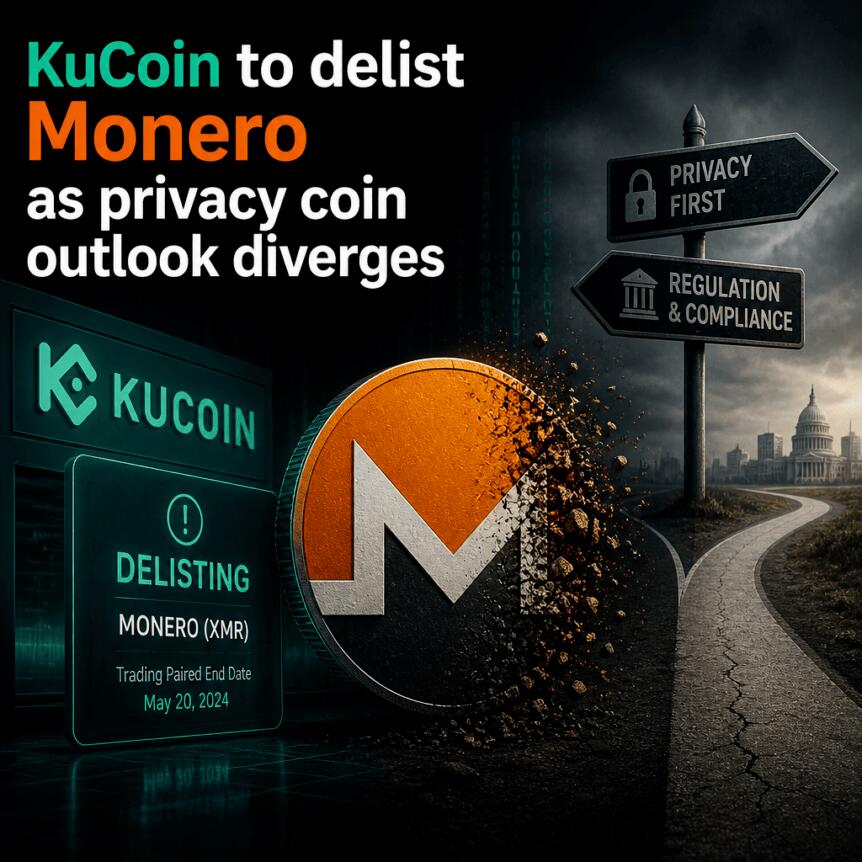
KuCoin has announced it will delist Monero (XMR) on Nov. 30, following earlier action by MEXC, which stopped XMR spot trading and removed its perpetual futures contracts earlier in November. KuCoin said it has already suspended XMR deposits and plans to close withdrawals on Dec. 31, effectively removing the privacy-focused coin from trading while allowing existing holders a limited window to exit.
The announcement arrives as European regulators move toward tighter restrictions on privacy coins through the EU’s Anti-Money Laundering Regulation. XMR reportedly fell 10.5% to $449.98 as of 7:00 p.m. UTC on Thursday, extending a broader pullback from roughly $625 on Nov. 3.
Key takeaways
- KuCoin will delist Monero (XMR) on Nov. 30, with deposits already paused and withdrawals scheduled to end Dec. 31.
- MEXC previously suspended XMR spot trading and delisted XMR perpetual futures earlier in November, making KuCoin the second major exchange to remove XMR this month.
- XMR’s decline to about $450 reflects market sensitivity to exchange access as regulation tightens around privacy features.
- The EU’s planned AML rules—starting July 10, 2027—aim to restrict regulated firms from using “anonymity-enhancing coins,” though individuals can still self-custody them.
- Grayscale’s research head argues Zcash’s approach (shielding via zero-knowledge proofs) may fit more easily with compliance needs than Monero’s privacy model.
Another exchange exits Monero amid mounting pressure
KuCoin’s decision adds to a growing list of venue-level restrictions on privacy coins as regulatory scrutiny expands. Earlier this month, MEXC suspended XMR spot trading and delisted its perpetual futures contracts—an action now echoed by KuCoin’s planned removal of XMR from its platform.
KuCoin’s timeline is particularly important for traders who may rely on liquidity and short-term positioning. With deposits already suspended and withdrawals set to close on Dec. 31, holders have a finite period to manage exposure before the asset becomes harder to access on the exchange.
That access dynamic is showing up in price. XMR’s reported 10.5% drop to $449.98 late Thursday extends a decline that started earlier in the month. The market’s reaction underscores how quickly exchange policy shifts can translate into volatility for assets that depend on continuous venue support.
What the EU’s AML plan could mean for privacy tokens
The delistings are linked to the EU’s broader regulatory direction. Cointelegraph previously reported that the EU intends to restrict privacy coins on regulated platforms. Under the EU’s Anti-Money Laundering Regulation, financial firms—including crypto asset service providers—will be barred from maintaining anonymous accounts or accounts that obscure transactions using “anonymity-enhancing coins.” The rule is set to take effect on July 10, 2027.
The regulation does not ban individuals from holding privacy coins in self-custody wallets. However, the compliance implications for exchanges and custodians are more complex: platforms typically operate within regulated account frameworks, and the EU’s definition targets coins with built-in transaction anonymization, either enabled systematically or optionally.
Because the regulation could cover privacy assets with opt-in features—not only those where privacy is enabled by default—exchanges face a wider scope of risk. The same category could plausibly include assets beyond Monero, even if their privacy mechanisms differ.
That distinction matters when comparing how different privacy technologies handle disclosure and auditing. The debate is not simply whether a coin is “private,” but how its privacy design interacts with regulatory expectations.
Zcash’s “viewing keys” and Grayscale’s tech argument
Zcash (ZEC), launched in 2016, differs from Monero in how privacy is applied. While Monero conceals transaction amounts and wallet addresses by default, Zcash offers a choice between transparent transactions and shielded ones. The article highlights Zcash’s built-in “viewing keys,” which allow holders to disclose transaction details to auditors, regulators, or law enforcement when necessary.
Grayscale’s Zach Pandl—head of research at the firm behind a US spot Zcash exchange-traded fund (ETF) launched in August—said this feature strengthens user control by enabling selective disclosure to the appropriate authority. He also suggested the current system already relies on delegating visibility to trusted parties, but with the difference that individuals hold that authority rather than institutions.
At the same time, the article notes that it remains debated whether viewing keys alone would satisfy regulatory requirements for compliance on regulated platforms. In other words, even if a user can selectively reveal information, the exchange’s ability to operate within anonymization restrictions may still depend on how the broader regulatory framework is interpreted.
Grayscale’s broader stance connects to underlying cryptography. Pandl argued that shielding via zero-knowledge proofs offers a stronger fit for mainstream financial adoption than “obfuscation” methods. He pointed to Monero’s ring signatures—intended to obscure transaction sources among multiple possible signers—as potentially vulnerable as blockchain analytics improve. Monero developers, meanwhile, are reportedly working on an upgrade that would replace ring signatures with a zero-knowledge proof system, aiming to enhance privacy with a different cryptographic approach.
For investors and builders, the practical takeaway is that privacy design is increasingly being evaluated not only by technologists, but by compliance teams and risk frameworks. The market question becomes: which privacy mechanisms can coexist with governance, auditing, and regulatory access controls?
Privacy-coin debate inside the ETF trade
The regulatory conversation is also playing out in investment products. Grayscale launched the first US spot Zcash ETF after converting its Zcash Trust, with trading beginning on NYSE Arca on Aug. 25. Pandl said that while investors seeking Zcash’s privacy features would still need to hold the cryptocurrency directly, the ETF can support a “store of value” thesis for privacy technologies.
Still, flows into the product have been volatile. According to figures cited from Grayscale’s ETF performance, assets under management reportedly reached $1 billion on Sept. 24 before falling to $406 million by Wednesday. Market performance data also showed large swings in ZEC: Token Terminal data cited in the article indicates Zcash rose from $524 at the start of the year to $1,653 on Sept. 26, then later retreated to about $770, leaving it up roughly 50% year to date.
Pandl compared Zcash’s surge over the past year to “Bitcoin’s Solana moment,” framing the ETF-driven spotlight and growth as an emerging challenge to incumbency—though he did not provide price targets for ZEC. His broader point was that, even after significant gains, Zcash’s valuation remains comparatively low relative to Bitcoin’s market cap.
For traders, these details matter because they separate “access through regulated wrappers” from direct privacy usage. Even if an ETF exists, exchange delistings for privacy coins can still change liquidity and operational exposure across the broader market.
Looking ahead, readers should watch how EU regulators interpret “anonymity-enhancing coins” in practice—especially for assets with opt-in privacy—and whether exchanges treat “viewing keys” as sufficient for compliance. The next test will likely be how platform policies evolve as the 2027 AML deadline approaches and as more venues respond to enforcement expectations.