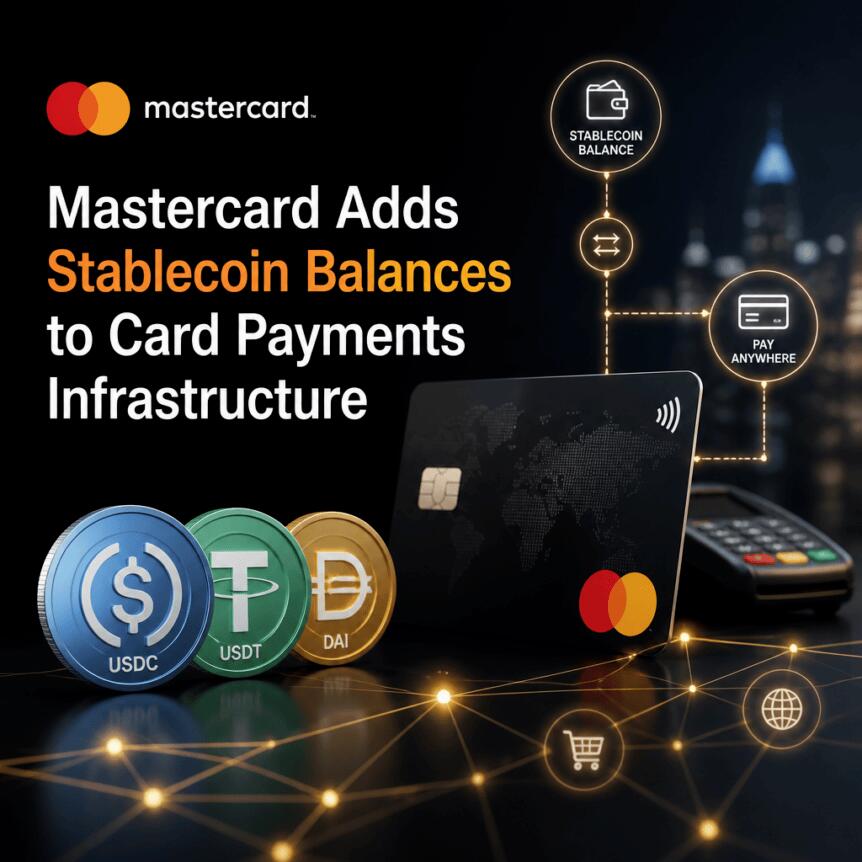
Mastercard has introduced a new platform aimed at making stablecoin payments easier for businesses and financial institutions to deploy through familiar banking and card rails. Announced Thursday, the “Global Money Platform” is positioned as Mastercard’s first major integration with BVNK, the stablecoin infrastructure provider Mastercard acquired in August.
Instead of requiring companies to build their own stablecoin custody, conversion, and payment routing systems, Mastercard says the platform enables businesses to hold and convert both fiat currencies and stablecoins, issue stablecoin-linked cards, and pay recipients’ local bank accounts using stablecoin balances.
Key takeaways
- Mastercard’s Global Money Platform is built to let businesses use fiat and stablecoin balances across card payments and local bank transfers.
- The launch follows Mastercard’s August acquisition of BVNK and represents its first major integration with BVNK’s stablecoin infrastructure.
- Payments are routed through Mastercard Move, while stablecoin balances can be connected to Mastercard’s merchant network for card spending.
- Nuvei and Marqeta are named among early integration partners.
- The move places Mastercard more directly in the stablecoin platform competition, including against Visa’s earlier stablecoin platform launch.
Mastercard’s “Global Money Platform” targets stablecoin-to-bank and card payments
According to Mastercard’s announcement, businesses using the Global Money Platform can manage both fiat and stablecoin holdings and perform conversions within the same setup. The platform is designed to support two practical payment paths: stablecoin-linked card usage and direct payments into recipients’ local bank accounts.
That matters because stablecoin payments often get stuck at the “last mile”—moving value from a digital ledger into the banking and card systems that businesses and consumers already rely on. By tying stablecoin balances to Mastercard’s existing network capabilities, Mastercard is effectively packaging the integration work into a service layer for other companies rather than positioning stablecoins as a standalone payment rail.
Integration with Mastercard Move and the merchant network
Mastercard says the Global Money Platform connects to Mastercard Move, its global money transfer network. The company describes Move as capable of routing payments to more than 17 billion destinations, covering recipients through bank accounts and cards.
For card payments, Mastercard also states that stablecoin balances can be connected to its merchant network, enabling customers to spend stablecoin balances using payment cards. In effect, the platform is designed to cover both outbound settlement to banks and everyday spending through card payments—two areas where businesses typically need separate integrations.
Mastercard’s announcement also lists integration partners among the early adopters, including Nuvei and Marqeta, alongside “several other fintech companies.” While Mastercard does not spell out commercial terms in the announcement excerpt provided, the presence of multiple fintech partners suggests the company is aiming for a broad ecosystem deployment rather than limiting use to a narrow set of enterprise customers.
BVNK acquisition becomes visible: stablecoin infrastructure plus Mastercard distribution
The Global Money Platform is described as Mastercard’s first major integration with BVNK after the acquisition in August. The timing is notable: the purchase created an internal stablecoin capability, and this platform announcement frames how that capability will be repackaged for third parties.
For investors and builders, the key question is whether this shift accelerates real-world adoption beyond pilot projects. Stablecoins have been moving into the mainstream conversation for corporate treasury and cross-border payments, but productization—particularly the “plumbing” between stablecoins and existing regulated rails—has been a recurring barrier. By offering a branded integration layer, Mastercard is signaling that it intends to reduce the friction for institutions that want stablecoin functionality without assembling custody, conversion logic, and payment routing from scratch.
Competitive pressure: Visa’s stablecoin platform and the broader stablecoin outlook
Mastercard’s launch arrives as competitive dynamics in stablecoin payments intensify. The company notes that Visa launched a stablecoin platform in July that enables financial institutions to hold, mint, and transfer stablecoins.
The contrast is important for readers tracking infrastructure competition: both Visa and Mastercard are moving from being pure payment processors toward providing platforms that financial institutions can use to offer stablecoin services under their own brands. That means distribution and partnership reach may become as consequential as underlying blockchain or custody technology.
Meanwhile, broader market research points to rising stablecoin payment activity. The article references research from Standard Chartered stating that stablecoin transaction activity continues to grow, even though the circulating supplies of major tokens such as USDt and USDC have remained relatively flat this year. Taken together, that combination—steady supplies paired with increased transaction flow—can be interpreted as demand for payment usage that doesn’t necessarily require new issuance at the same pace.
Even with growth in activity, the pace of adoption by banks, fintechs, and corporate treasuries still depends on regulatory clarity and operational readiness. Platforms like Mastercard’s are designed to help institutions bridge that gap, but the market will likely watch for how quickly integration partners convert these capabilities into live products and recurring transaction volume.
What comes next for businesses considering stablecoin integrations
As Mastercard’s Global Money Platform begins rolling into partner ecosystems, the most relevant open questions are implementation details (how quickly institutions can launch card and bank-transfer use cases) and the scope of supported jurisdictions and rails through Mastercard Move. Readers should monitor early partner deployments and any follow-on announcements that indicate how soon stablecoin-linked products move from integration to measurable consumer or merchant usage.