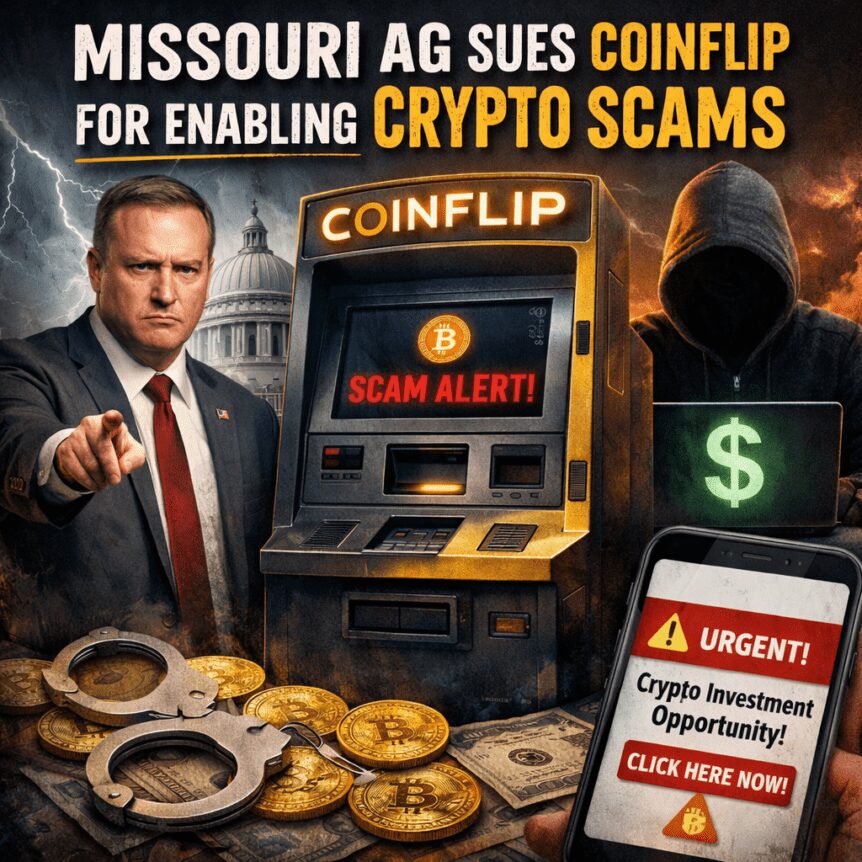
Missouri has filed a civil lawsuit against GPD Holdings, the operator behind CoinFlip’s network of crypto ATMs, accusing the company of knowingly facilitating fraudulent transactions and profiting from them. The action represents one of the most prominent state-level efforts to police crypto kiosks as regulators widen scrutiny over how digital-asset services interact with everyday consumers, including seniors and veterans who may be particularly vulnerable to scams.
The Missouri Attorney General’s Office, in a filing disclosed this week, seeks a wide-ranging remedy under the Missouri Merchandising Practices Act. The petition asks the court to declare CoinFlip’s practices unlawful, to enjoin the company from operating within Missouri, to impose civil penalties of $1,000 per violation for the past five years (potentially up to $1.826 million), and to award restitution to affected consumers. The office framed the case as part of a broader concern about the integrity of crypto kiosks and the protection of Missouri residents from fraudulent activity.
CoinFlip’s footprint in Missouri, according to the company’s own disclosures, includes 136 crypto kiosks in the state and a national network of 4,229 kiosks across the United States. The Missouri action comes amid a wider wave of regulatory interest in crypto ATM operators that has included investigations and local ordinances aimed at restricting or banning kiosk activity in several jurisdictions. The state’s inquiry first emerged last December as part of a broader probe into multiple crypto ATM operators, including Bitcoin Depot, which has faced its own regulatory and financial pressures in recent months.
Key takeaways
- The Missouri Attorney General filed a civil lawsuit against CoinFlip’s operator, alleging violations of the Missouri Merchandising Practices Act and seeking a court order to halt operations in Missouri, plus civil penalties and consumer restitution.
- CoinFlip reports 136 kiosks in Missouri and more than 4,200 nationwide, illustrating the scale of crypto ATM access in the United States and the potential exposure for consumers to fraud if operators fail to comply with consumer protections.
- The case is part of a broader regulatory push in the United States, where multiple states have scrutinized crypto kiosks and passed or considered laws restricting their use amid concerns about scams and fraudulent activity.
- In a related development, Bitcoin Depot disclosed material going-concern risk in an SEC filing ahead of its Chapter 11 filing, underscoring rising financial and legal pressures on major kiosk operators.
Broader regulatory momentum and the cited concerns
The Missouri action does not stand alone. The attorney general’s filing notes that the enforcement action is tied to a broader investigation launched in December into several crypto ATM operators. While the Missouri case centers on CoinFlip, it sits within a pattern of local and state authorities moving to constrain or regulate crypto kiosks as cases of alleged fraud or consumer harm come to light. This pattern has included other operators and, in some cases, actions aimed at specific practices or business models within the sector.
Meanwhile, Bitcoin Depot—another major crypto ATM operator—has faced a separate set of challenges. In a May filing with the U.S. Securities and Exchange Commission, Bitcoin Depot warned that substantial doubt existed about the company’s ability to continue as a going concern. The filing highlighted looming legal judgments and ongoing litigation as part of a broader risk profile. Days later, Bitcoin Depot proceeded with a voluntary Chapter 11 filing in Texas, underscoring how even the largest kiosk networks are navigating a high-stakes legal and financial environment.
These developments come as municipalities and states weigh concrete regulatory measures. Earlier reporting documented efforts in several jurisdictions to restrict or ban crypto kiosks, with Minnesota cited as considering a ban in the wake of scam-related incidents. The cumulative effect is a climate in which operators must contend with evolving compliance requirements, potential consumer redress obligations, and the financial strain that litigation and reorganizations can place on business models built around high-volume, low-margin ATM operations.
For investors and users, the implications extend beyond individual lawsuits. The Missouri action underscores the ongoing risk that state-level regulators will deploy consumer-protection tools to shape how crypto services operate at the kiosk level. As regulators demand higher standards for disclosures, transaction disclosures, and possibly Know-Your-Customer (KYC) controls, operators may need to accelerate compliance investments. In parallel, high-profile bankruptcies and insolvency risk among large operators remind the market that the sector remains exposed to liquidity pressures and legal headwinds even as demand for easy crypto access persists.
Operational and market implications for the crypto ATM sector
From an operator’s perspective, the Missouri suit serves as a practical case study in how consumer protection statutes can be leveraged to challenge business practices perceived as deceptive or unfair. The Missouri filing emphasizes the act at issue—the Missouri Merchandising Practices Act—as the vehicle for relief, signaling that consumer protection frameworks will be a major battleground as states refine their oversight of crypto kiosks. Operators may need to reassess marketing claims, fee structures, and the clarity of disclosures to avoid dispute over what constitutes deceptive practices.
For users, the proceedings highlight the ongoing need for diligence when using crypto kiosks. While these machines offer convenient on-ramps to digital assets, they carry risks related to scams, chargebacks, and potential misrepresentation of fees or operational limits. Consumer protection actions (and the potential for restitution) may become more common if regulators perceive that kiosk operators are not meeting established standards for safe, transparent transactions.
From a market dynamics standpoint, the regulatory actions could influence the pace and pattern of kiosk deployment. If states pursue stricter enforcement or impose additional operating constraints, operators might slow expansion plans or shift toward jurisdictions with clearer compliance pathways. Conversely, a more predictable regulatory framework could support broader consumer adoption by reducing scam-related incidents and building trust in crypto-enabled cash-in and cash-out channels.
The contrast between ongoing enforcement actions and the sector’s growth trajectory also feeds into an important question for the market: how sustainable is a model that relies heavily on quick, low-friction access to digital assets through physical kiosks? The answer may hinge on how effectively operators implement robust fraud-detection tools, user protections, and transparent fee structures, all of which regulators are likely to scrutinize closely in the months ahead.
As for the Missouri case specifically, observers will be watching how the court handles the arguments about deceptive practices, the scope of the relief requested, and what this could mean for other operators facing similar inquiries. The outcome could set a precedent for whether consumer protection statutes will play a decisive role in shaping the day-to-day realities of crypto kiosks across the country.
CoinFlip did not provide an immediate comment in response to the filing. The company’s disclosures show a national footprint that dwarfs its Missouri presence, but the case illustrates how state-level actions can affect even widely adopted platforms. In parallel, the sector’s consolidation and legal scrutiny continue to unfold, with major operators forced to navigate both courtroom risk and market volatility.
Readers should monitor further developments from the Missouri case as well as the broader regulatory responses across states. As more courts weigh questions of consumer protection versus innovation, the next steps will reveal not only how these kiosks operate within law but also how accessible and trustworthy they remain to the general public.
Looking ahead, the sector’s trajectory will depend on the balance between enforcement actions, corporate compliance upgrades, and consumer demand for easy on-ramps to digital assets. The Missouri suit is a reminder that regulatory clarity—and the willingness of courts to enforce it—will shape the practical accessibility of crypto services at the street level in the coming months.