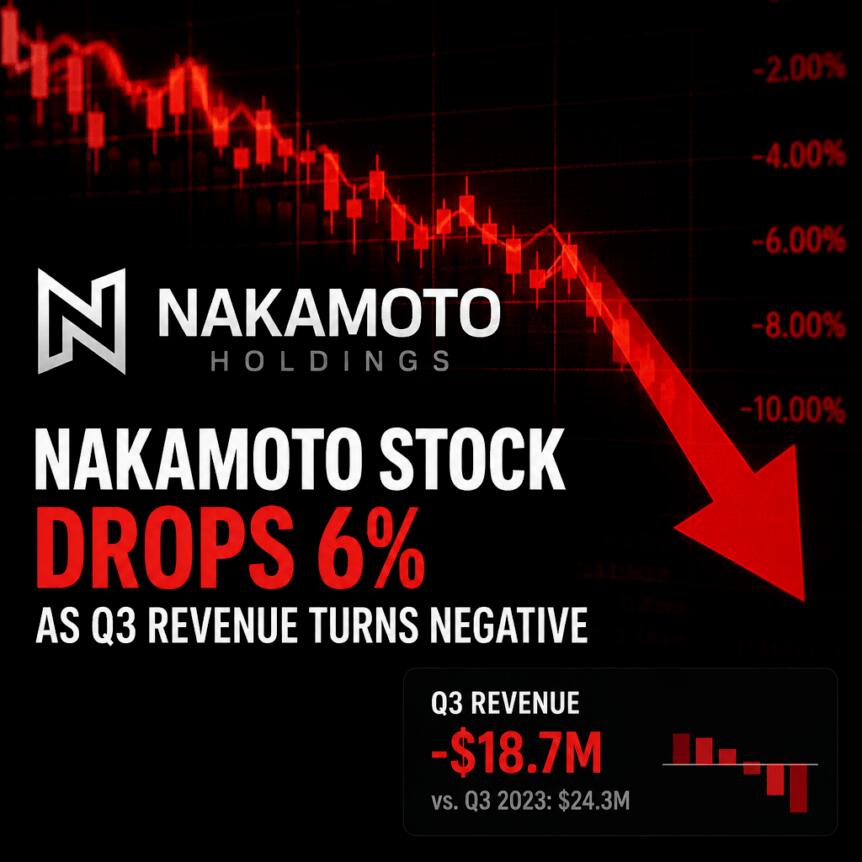
Nakamoto, a Nasdaq-listed company that holds Bitcoin as part of its treasury strategy, saw its shares slide sharply in premarket trading after it disclosed third-quarter results marred by losses tied to Bitcoin options. The stock dropped 6.5% in early Friday trading, reflecting investor focus on how derivative hedging activity can swing quarterly performance—even when the company’s underlying digital-asset holdings are revalued.
According to Yahoo Finance, Nakamoto’s shares were trading at $5.40 at 12:02 pm UTC on Friday. That level implied a decline of roughly 62% year to date. The move followed results released after market close on Thursday, as detailed in the company’s filings with the US Securities and Exchange Commission (SEC).
Key takeaways
- Nakamoto reported third-quarter operating revenue of negative $1.9 million, after a $5.8 million loss on Bitcoin options.
- Analysts expected about $17.4 million in revenue, per estimates compiled by Yahoo Finance.
- The company recorded a $110.4 million gain from revaluing its digital assets, chiefly Bitcoin, which helped drive an overall net profit.
- Bitcoin holdings declined to 4,283 BTC as of Sept. 30 from 4,467 BTC at the end of June.
Options losses weigh on quarterly operating performance
Nakamoto’s SEC filing shows that while the company generated $3.9 million in revenue from its operating businesses during the third quarter, the outcome was pulled below zero by its options activity. The filing states that a $5.8 million loss on Bitcoin options resulted in total operating revenue of negative $1.9 million.
The difference between operating performance and headline profitability is central to understanding the reaction in the stock. Investors often look for consistency in the way treasury strategies and hedging programs affect results across quarters. Here, the company’s derivatives-related losses were large enough to flip operating revenue to a loss position, even though the company also benefited from later-stage revaluation effects.
For context, Yahoo Finance compiled analyst expectations of roughly $17.4 million in revenue for the quarter. Nakamoto’s reported operating revenue missed that benchmark by a wide margin, which likely contributed to the early selling pressure in the stock.
Why the quarter still produced net income
Even with negative operating revenue, Nakamoto reported strong net income for the period. The company posted $85.5 million in net income for the quarter, alongside a $15.8 million adjusted operating loss.
That apparent contradiction comes down to how digital-asset revaluations were reflected in its financials. According to the filing, Nakamoto recorded a $110.4 million gain from revaluing its digital assets, chiefly Bitcoin. The company’s adjusted operating loss excludes that gain—helping explain why operating revenue fell below zero while the overall net figure remained positive.
For investors, the takeaway is that the economic drivers appear split: performance tied to revaluation of existing Bitcoin holdings supported profits, while the cost or payoff of its options program weighed on the operating line. Traders and analysts typically monitor both components separately because they can behave differently as market conditions change.
Bitcoin exposure and shrinking holdings
Nakamoto’s balance sheet detail also shows a modest reduction in its Bitcoin exposure over the quarter. The company reported holding 4,283 BTC as of Sept. 30, valued at $357.9 million. That compares with 4,467 BTC at the end of June.
While the filing does not outline the reasons for the decline in the excerpted figures above, investors generally watch changes in the size of a company’s Bitcoin treasury position because it can influence both potential upside from BTC price moves and the sensitivity of derivatives hedges. A smaller holding can reduce the dollar value of revaluation gains in future quarters, though it may also change how costly hedging becomes depending on the structure and market volatility.
Still, the latest figures underscore that Nakamoto’s results are not driven solely by spot price movements. Derivatives outcomes—such as the $5.8 million options loss—can materially affect the company’s reported operating revenue, making the hedging program a key variable rather than a background detail.
What to watch next for Nakamoto’s hedge-driven results
The market reaction to Nakamoto’s disclosure highlights the challenge for Bitcoin treasury firms that rely on options-based risk management: hedging can reduce certain exposures, but it can also introduce recurring costs or episodic losses that show up quickly in financial statements.
Looking ahead, investors may want to track whether the company’s next quarters show a return to more stable operating revenue—or whether losses from options continue to outweigh operating business gains even when revaluation provides offsetting profit. With Bitcoin holdings also down quarter over quarter, the magnitude of revaluation impacts could be less supportive unless the market value of the remaining assets increases or the hedging strategy evolves.
Nakamoto’s next reporting cycle should clarify whether the third-quarter outcome was unusual relative to prior periods or indicative of a broader pattern in how its Bitcoin options program behaves under shifting volatility—an issue that may remain central for traders assessing the company’s risk-managed treasury model.