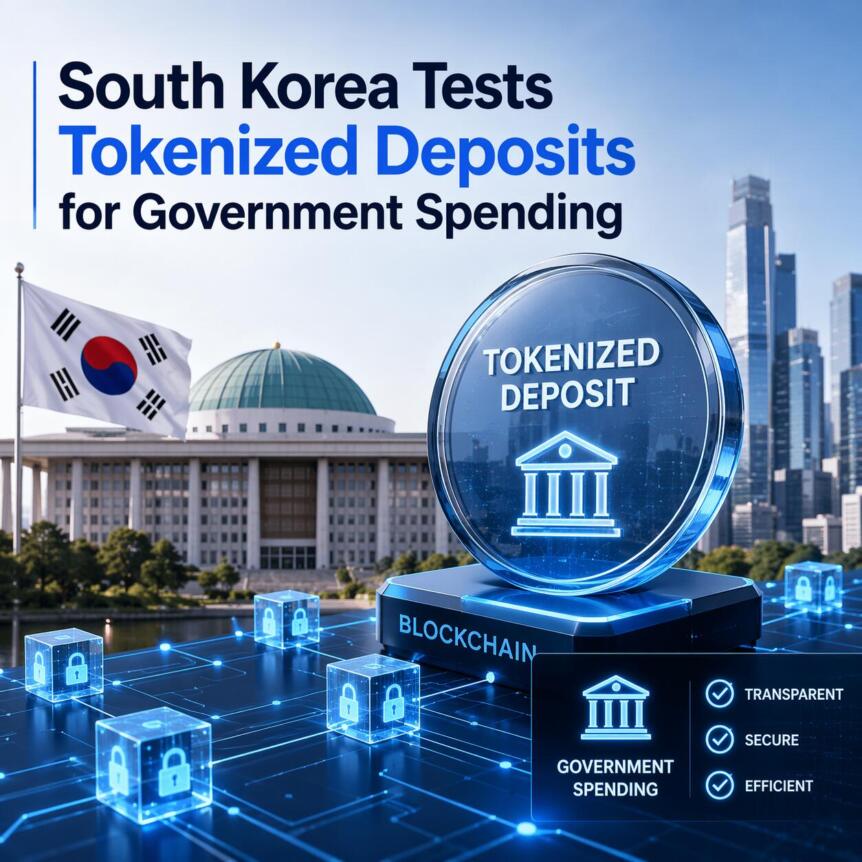
South Korea’s Ministry of Economy and Finance (MOEF) is advancing a blockchain-based payments experiment for government operating expenses within a regulatory sandbox focused on distributed ledger technology (DLT). In a Thursday announcement, the MOEF said it had selected a pilot that will use tokenized deposits to execute government spending, with a full rollout planned for the fourth quarter of 2026. The program will begin in Sejong City and will test predefined spending conditions, including limits on timing and usage categories.
Tokenized deposits are digital representations of traditional bank deposits that sit on blockchain or other DLT infrastructure. They are designed to function as bank liabilities within the existing financial system, rather than as independent stablecoins or new money. By moving government payments onto a tokenized layer, Seoul aims to investigate whether programmable, bank-backed money can improve traceability, reduce misuse, and streamline public-finance processes while staying anchored to the conventional banking system.
The MOEF’s pilot signals a shift from subsidy-focused experiments toward day-to-day public spending. If successful, the tokenized-deposit framework could become a tested backbone for more transparent and auditable government payments, potentially expanding to broader fiscal operations beyond the initial operational expenses.
Key takeaways
- The Ministry of Economy and Finance has chosen a pilot to test tokenized deposits for government operational spending, with a staged rollout targeting Q4 2026 in Sejong City.
- Tokenized deposits represent bank liabilities issued on blockchain technology, offering a way to digitize government spending while remaining within the conventional financial system.
- The sandbox will define spending scope through predefined time windows and permitted categories, aiming to improve oversight and curb fund misuse.
- South Korea has previously explored tokenized deposits for other public-finance use cases, and the MOEF has signaled broader ambitions to digitalize treasury fund execution in the coming years.
- If the program proves viable, authorities will consider regulatory and legal changes to accommodate larger-scale, programmable government payments.
From subsidies to daily government spending: what changes with tokenized payments
The MOEF described the pilot as a move beyond subsidies toward implementing tokenized deposits in routine public-finance operations. The trial will involve collaboration with participating institutions to delineate the project’s scope, including how spending windows and category permissions are defined. The controlled environment is meant to test both the practicalities of tokenized settlement and the governance mechanisms required to monitor and audit such transactions.
Under the framework, government operational expenses—currently processed through government-issued cards and subsequent reporting—will be reimagined within a tokenized-deposit rails environment. The test is designed to demonstrate whether programmable, bank-backed digital money can enhance oversight and reduce the risk of misuse, all while preserving compatibility with the existing financial ecosystem.
Crucially, the ministry underscored that the tokenized deposits used in this pilot are still bank liabilities. The objective is not to replace conventional payment rails but to explore whether an additional, auditable channel can improve efficiency and transparency in public spending without disrupting traditional financial relationships.
Broader policy arc: past milestones and future implications
South Korea’s approach to tokenized deposits isn’t new. The MOEF has referenced earlier efforts to pilot tokenized deposits for policy objectives, including a March initiative with the Environment Ministry and the Bank of Korea to fund electric-vehicle charging infrastructure subsidies. Those programs reflect a broader ambition to integrate tokenized payment rails into public finance, with the MOEF signaling a goal of converting a significant portion of treasury fund execution to digital instruments by 2030. The current Sejong pilot appears to be a natural extension of that strategy, moving from subsidy-specific pilots toward more routine public-spending workflows.
The evolution of these pilots sits within a wider regulatory and financial landscape in which central banks, ministries, and financial institutions are testing how tokenized, bank-backed money could coexist with traditional currency and payments. If the Sejong test succeeds, it could provide a concrete blueprint for how government agencies implement programmable money in a controlled, auditable manner before expanding to other departments or broader categories of spending.
Implications for investors, builders, and public governance
For the crypto and fintech communities, the MOEF’s sandbox demonstrates a growing appetite for studying how tokenized financial instruments can operate within a regulated government-finance context. Success would offer several potential benefits: enhanced visibility into government disbursements, tighter controls over spending categories and timing, and the opportunity to build interoperable rails that connect banks, public agencies, and private-sector contractors in a traceable, programmable framework.
From an investment and development perspective, the project highlights a potential market for public-sector digital-finance tooling that blends conventional liability structures with modern distributed-ledger infrastructure. Companies and platforms that can demonstrate robust security, compliance with existing financial regulations, and interoperability with public procurement and accounting systems could see demand grow as governments pursue similar pilots domestically and abroad.
However, the path forward is contingent on regulatory clarity and the outcomes of the Sejong trial. Key questions include how the government will govern access to tokenized deposits, how to ensure robust auditability and privacy, and how to manage potential cyber risks inherent in new digital-money rails. Observers will also watch how the experience translates into policy decisions—whether to scale the program, adjust spending rules, or adopt new legal frameworks that explicitly accommodate tokenized, programmable government payments.
In the near term, the MOEF’s announcement underscores a measured, evidence-driven approach to digital finance in the public sector. The focus on predefined parameters—timing, categories, and oversight mechanisms—reflects a cautious but purposeful experiment aimed at extracting concrete lessons before expanding beyond Sejong and beyond operational expenses.
Readers should monitor how the sandbox defines success metrics, how the pilot interfaces with banks and public agencies, and what regulatory changes ministries may pursue as a result. The coming months will reveal whether tokenized deposits can practically streamline public spending while maintaining the governance standards required for public funds.
As South Korea charts this course, the broader question for the market is whether this model can scale, what institutional partners will be involved, and how quickly such technology can translate into tangible improvements in transparency, efficiency, and accountability in government payments.
Ultimately, the Sejong pilot marks a notable milestone in the ongoing exploration of programmable public money—an initiative that could reshape how governments transact, how contractors get paid, and how citizens experience the accountability of public finance.