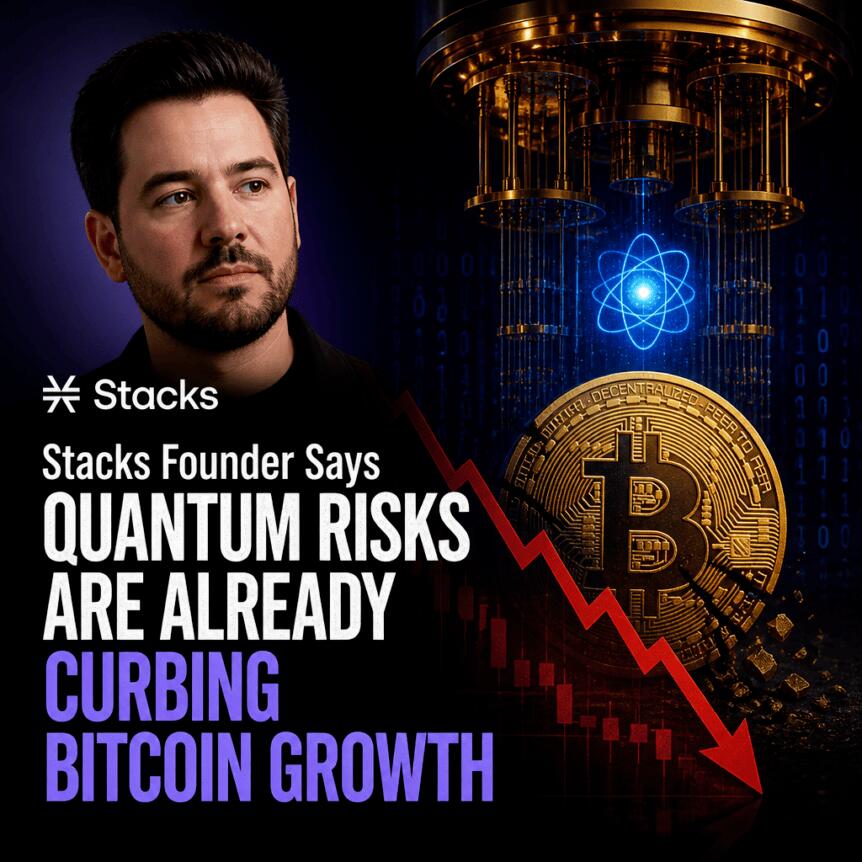
Bitcoin’s long-running “quantum threat” debate is increasingly moving from theoretical risk to a potential headwind for institutional capital, according to Muneeb Ali, co-founder of the Bitcoin layer-2 network Stacks. In an interview on Cointelegraph’s Chain Reaction podcast, Ali argued that uncertainty around when and how Bitcoin will transition to quantum-resistant security could discourage risk-averse investors from committing large sums.
Ali’s core message was that investor confidence depends not only on technical feasibility, but also on having a credible, time-aware roadmap for upgrades. He warned that if meaningful progress toward quantum-resistant protection is not demonstrated by 2028, Bitcoin could enter a more fragile period for sentiment—particularly if stakeholders perceive the timeline as too slow for a world where quantum capabilities may advance faster than expected.
Key takeaways
- Muneeb Ali says uncertainty about quantum security is contributing to a “ceiling” on Bitcoin’s growth by delaying institutional purchases.
- He argues Bitcoin needs a clear upgrade pathway, because institutional investors may wait until developers show consistent, credible progress.
- Ali points to NIST guidance for a broader transition target around 2030, with AI potentially accelerating timelines.
- Developers are also pursuing quantum-attack mitigations; StarkWare has reported major reductions in the estimated cost of an experimental quantum-resistant transaction method.
Why quantum uncertainty may matter to institutional investors
Ali’s remarks focus less on whether quantum attacks are imminent and more on how uncertainty itself affects capital allocation. He suggested that even if the probability of a near-term attack is debated, institutional investors can still respond by delaying large positions when they lack confidence in the upgrade plan.
On the Chain Reaction podcast, Ali said the market may treat quantum-related risk as a hard constraint if the industry cannot articulate a convincing sequence for security improvements. In his view, that credibility gap is especially important for institutions that face internal risk controls and prefer clear evidence of mitigation rather than open-ended discussions.
He added that disagreements over the urgency of quantum computing could become problematic even if the threat ultimately proves less immediate than some fear. Without a roadmap, he argued, the debate can itself weaken confidence—again, particularly among investors who want to see operational progress rather than speculative timelines.
Timelines: 2028 milestones, 2030 targets, and a potential acceleration
Ali warned that the timeline for implementing security changes could be a major factor. He noted that upgrades usually take years to develop and deploy, and that additional time may be required for users to migrate holdings to new addresses if address-level changes become necessary.
For a sense of urgency, Ali flagged 2028 as a point by which “meaningful progress” should be evident. He then cited 2030 as a transition target for quantum-resistant security, referencing guidance from the US National Institute of Standards and Technology (NIST). Ali also argued that emerging advances in artificial intelligence could accelerate quantum research, potentially moving the effective timeline earlier—he suggested a scenario closer to 2029.
At the same time, he acknowledged that some Bitcoin advocates believe quantum risks are exaggerated or distant. Ali’s response was that the disagreement doesn’t remove the need for clarity; instead, it can heighten uncertainty for observers outside the technical community—precisely the group that institutions often represent.
What Ali says could happen if quantum attacks become real
Ali made a distinction between a clear, funded research race and a surprise, opportunistic attacker. He argued that if a sufficiently powerful quantum computer is built, it would more likely come from a major research lab rather than an unknown actor. He also suggested that large technology companies—he specifically named examples such as Google or Microsoft—would face strong legal and regulatory barriers against using such capabilities for theft.
However, Ali emphasized that the risk would not be isolated to Bitcoin alone. In his framing, if Bitcoin were successfully compromised, the damage would cascade across the broader crypto ecosystem, since many downstream systems depend on trust assumptions tied to Bitcoin’s security. “If Bitcoin gets hit, everyone gets hit downstream as well,” he said, pointing to a broader systemic exposure beyond any single protocol.
Developers explore mitigations while debating protocol-level upgrades
While Ali pushed for a credible long-term upgrade pathway, he also pointed to ongoing work by developers to reduce quantum-related exposure. A notable example mentioned in the discussion comes from StarkWare: in September, StarkWare reported that researchers had reduced the estimated computing cost of preparing an experimental quantum-resistant Bitcoin transaction by 79% after a weeklong optimization challenge.
According to that coverage, the approach is designed so that it does not require changes to Bitcoin’s consensus rules, but the reported savings were demonstrated in benchmark tests rather than as a widely deployed capability. StarkWare has described the method as a “last-resort” measure, while continuing to advocate for a protocol-level upgrade as the more durable long-term solution.
This distinction—between experimental work that can mitigate risk without consensus changes and larger upgrades that require coordination—reflects the tension at the center of Ali’s argument. Institutions may not need perfect certainty, but they do need a plausible route from research experiments to production-grade security.
Beyond StarkWare’s efforts, Ali’s broader message implies that readers should watch for signals that bridge this gap: clearer milestones, consistent engineering progress, and communication that turns theoretical quantum readiness into an actionable plan for users and exchanges.
As the industry moves toward quantum-era planning, the most important unanswered question is not only how quickly technology advances, but whether Bitcoin’s development community can translate that uncertainty into a concrete, verifiable roadmap—one institutions can assess and act on before the window for upgrades closes.