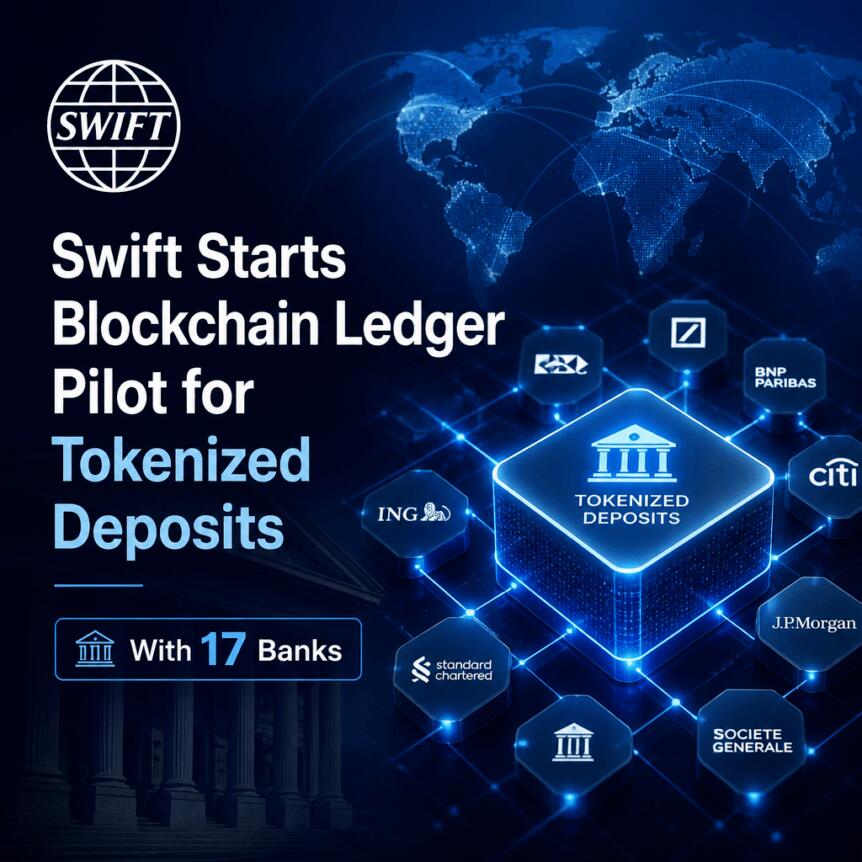
SWIFT says its blockchain-based ledger for financial messaging is now ready for initial use, marking a meaningful step toward giving banks a more clock-agnostic way to move value across borders. After nine months of development, SWIFT announced that 17 major institutions are preparing to pilot cross-border payments using tokenized bank deposits on the platform, with an initial controlled go-live phase expected to follow.
According to SWIFT, participating banks—including HSBC, Citigroup, BNP Paribas, UBS, ANZ, DBS, and Standard Chartered—will test how tokenized deposits can support 24/7 cross-border payments, including overnight and weekend transactions, while keeping the compliance, credit, risk, and control standards built into existing payment processes.
Key takeaways
- SWIFT’s blockchain ledger is reported as ready for initial use after nine months of development.
- 17 banks plan to pilot cross-border transfers using tokenized bank deposits on the SWIFT platform.
- The initiative targets 24/7 settlement behavior, extending payment availability beyond traditional banking hours.
- SWIFT emphasizes that the approach aims to preserve existing compliance, credit, risk, and control requirements.
- SWIFT indicated further expansion of the ledger’s functionality and availability after the first limited rollout.
From messaging to tokenized deposits
SWIFT’s role in global finance is largely about connectivity: its interbank messaging network links more than 11,500 banks and financial institutions across over 200 countries and territories. While SWIFT already supports rapid message delivery on its existing rails—SWIFT said 75% of payments reach the beneficiary bank within 10 minutes, often in seconds—the new effort focuses on what happens when settlement needs to operate regardless of the time of day.
The company’s announcement frames the ledger as an extension of SWIFT’s “resilient global platform,” intended to help “regulated digital assets” move across borders with greater velocity and flexibility. In remarks shared in the announcement, Thierry Chilosi, SWIFT’s chief business officer, said the ledger allows tokenized value to move internationally while maintaining the same levels of resiliency, security, and compliance that global finance expects.
For market participants, the practical significance is not just the use of blockchain, but the target operational outcome: keeping established governance structures while enabling payment flows that are less dependent on bank working hours.
Why the pilot matters for cross-border payments
In SWIFT’s description, the pilots are designed to test cross-border payment capabilities using tokenized deposits, without discarding the compliance and risk frameworks embedded in current processes. That emphasis is important because many tokenization efforts struggle with the same central question: how to integrate new settlement mechanics into existing regulatory and institutional controls.
SWIFT said the ledger will allow participating banks to support 24/7 cross-border payments, explicitly including overnight and weekend activity. That directly addresses a longstanding operational bottleneck in traditional payment infrastructure, where cut-off times and settlement windows can constrain responsiveness—especially for time-sensitive transfers.
It also places SWIFT in the middle of a broader shift in financial infrastructure: banks are increasingly exploring tokenized assets and settlement, but they want that evolution to happen within trusted, regulated systems rather than as isolated experiments.
Part of a wider push toward tokenized settlement
SWIFT’s move lands amid a series of parallel developments from major financial players that point to renewed momentum in tokenized deposits and securities infrastructure.
Earlier, a consortium of banks—including JPMorgan Chase, Bank of America, Citibank, Barclays, BNY, and Wells Fargo—announced plans to launch a tokenized deposit network in the first half of 2027. The Clearing House would operate the network and connect traditional payment rails with digital asset infrastructure to enable 24/7 settlement.
In the markets sphere, the New York Stock Exchange previously partnered with tokenization platform Securitize to build blockchain-based infrastructure for tokenized stocks and exchange-traded funds. Separately, the parent company of the NYSE, Intercontinental Exchange (ICE), has also shared plans for a tokenized securities venue aimed at 24/7 trading, instant settlement, stablecoin-based funding, and onchain settlement.
Taken together, these efforts suggest a sector-wide attempt to reduce the friction between “tokenized” workflows and the operational realities of regulated financial institutions. SWIFT’s pilot is another data point in that transition, particularly because SWIFT is not an issuer or a single-venue market—it is the messaging backbone for interbank communication globally.
What to watch next after initial go-live
SWIFT said it plans to expand the ledger’s functionality and availability after the initial controlled go-live phase. That sequencing matters: a controlled rollout typically helps institutions validate technical performance and governance requirements before scaling participation or expanding use cases.
For users ranging from treasury teams to payments operators, the next milestones will likely center on practical interoperability—how efficiently tokenized deposit transfers work across participating institutions and how smoothly the ledger integrates into existing operational and compliance routines. Investors and builders in digital asset infrastructure will also want to monitor whether SWIFT’s ledger becomes a repeatable baseline for cross-border settlement beyond the pilot group, or whether it remains a narrow-use experiment before wider adoption.
In the near term, the most important question is whether the pilots can demonstrate that 24/7 tokenized cross-border payments can coexist with established financial controls at scale. If SWIFT’s expansion follows the same logic, the ledger could become a significant bridge between traditional messaging standards and the settlement expectations of modern commerce.