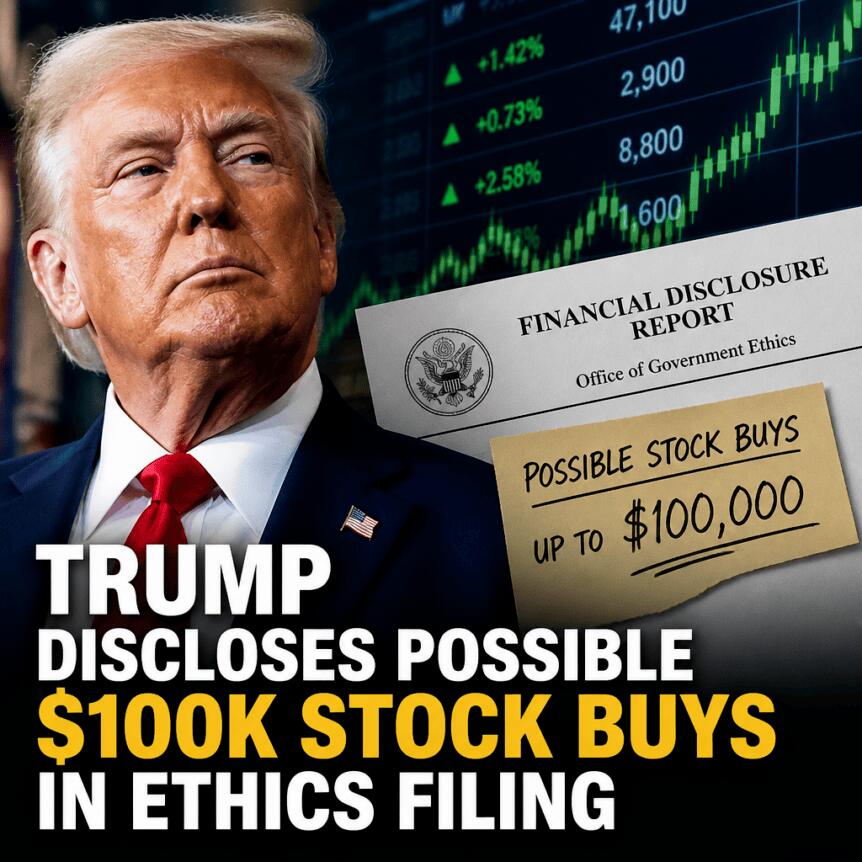
U.S. President Donald Trump disclosed purchases of Strategy shares worth between $50,001 and $100,000 in July, according to a filing published by the U.S. Office of Government Ethics on Tuesday. The disclosure adds to a pattern of reported holdings in several crypto-adjacent companies, as Trump’s administration continues to push for parts of a broader pro-crypto agenda.
The latest report indicates that Trump bought Strategy shares on July 27 for $50,001 to $100,000, after a smaller purchase three days earlier. The filing also lists other crypto-related transactions during July, including activity involving Coinbase and sales of shares in Bitcoin mining companies MARA Holdings and CleanSpark.
Key takeaways
- According to the Office of Government Ethics filing, Trump bought Strategy shares worth $50,001 to $100,000 on July 27.
- A prior Strategy purchase reported in the same filing covered $1,001 to $15,000 made three days earlier.
- The July 27 Strategy purchase is the largest crypto-linked transaction described in the filing, and Trump previously disclosed a similar $50,001 to $100,000 Strategy buy on Feb. 12.
- The filing reports transaction values in ranges, so it does not reveal how many Strategy shares remain in Trump’s portfolio.
- The disclosures come as regulators have advanced limited crypto-related initiatives even though comprehensive market-structure legislation has stalled in Congress.
What the ethics filing shows about Strategy holdings
The Office of Government Ethics filing reports that Trump’s Strategy transactions in July included two buys: $1,001 to $15,000 on July 24 and $50,001 to $100,000 on July 27. Strategy is widely described as the largest publicly traded corporate holder of Bitcoin; BitcoinTreasuries.net data cited in the filing context places Strategy’s holdings at 846,000 BTC.
The filing’s approach matters for how investors interpret it. Because disclosures are made as dollar value ranges rather than as running share totals, readers cannot determine the number of Strategy shares Trump currently holds after these transactions.
Strategy purchases also appear consistent with earlier disclosures. BitcoinTreasuries.net data referenced in the article notes that Trump previously disclosed a Strategy purchase in the same $50,001 to $100,000 range on Feb. 12. The filing context further indicates that Trump’s accounts have also reported smaller Strategy buys and sells during the year.
Broader portfolio moves and third-party management
While Strategy is the most prominent crypto-linked holding disclosed for July, the filing indicates Trump’s overall portfolio activity was not limited to crypto-adjacent equities. It includes sales of $5 million to $25 million each of Microsoft and Amazon stock on July 20, along with additional purchases and sales in other ranges between $1 million and $5 million.
Separately, the White House told CNBC that Trump’s stock and bond portfolio is independently managed by third-party financial institutions, with no input from Trump or his family. That statement is relevant because the ethics disclosures detail transactions without describing investment decision-making or timing beyond the reported dates.
Strategy stock gains and what traders should watch
Following the July disclosures, Strategy shares have moved higher in the near term. According to Yahoo Finance data referenced in the reporting, Strategy’s stock has gained nearly 30% over the past five trading days and roughly 37% over the past month.
For market participants, the key question is how much these price moves relate to broader corporate and Bitcoin market dynamics rather than to the individual disclosure itself. The filing describes transactions rather than portfolio effects, and the disclosure does not indicate how the trades were executed beyond the reported date and value range. Traders are therefore likely to focus more on Strategy’s underlying Bitcoin exposure and market sentiment than on the specific disclosure as a standalone catalyst.
Disclosure amid stalled legislation and regulatory workarounds
Trump’s Strategy disclosure arrives during an ongoing policy push that targets parts of the U.S. crypto market, even as comprehensive market-structure legislation remains stalled in Congress. The article notes that the Senate did not advance the CLARITY Act on Sept. 15, but that regulators have used existing authorities to move forward on narrower issues.
In the period after the failed advance, the Securities and Exchange Commission cleared a limited form of onchain trading for tokenized U.S. stocks under a temporary exemption, according to earlier coverage cited in the article from Cointelegraph. The Commodity Futures Trading Commission also eased registration requirements for certain software providers that offer access to regulated derivatives markets, again according to Cointelegraph reporting cited in the article.
The CFTC also submitted a broader crypto market rulemaking initiative for White House review on Sept. 17, with the article noting that it remains preliminary rather than a formal proposal. The initiative is described as “Regulation Crypto Asset Transactions and Regulation Crypto Asset Markets.”
Beyond regulatory actions, the administration’s agenda has extended to Bitcoin directly. The article states that the House Financial Services Committee voted 28-21 to advance legislation to codify Trump’s proposed Strategic Bitcoin Reserve and to require any Bitcoin placed into that reserve be held for at least 20 years. The report also references Arkham Intelligence data suggesting the U.S. government holds an estimated 324,527 BTC.
Read together, the disclosures and policy developments point to a consistent theme: even where broad legislative frameworks face delays, regulators and lawmakers have pursued incremental steps that shape how tokenized assets, trading access, and crypto market oversight may evolve.
Closing perspective
Investors and builders should watch whether additional ethics filings continue to show increased exposure to Bitcoin-linked corporate vehicles like Strategy, and whether regulators’ limited pathways for tokenized assets and trading access expand into more comprehensive market-structure rules. The next signal to track is whether stalled legislation such as the CLARITY Act regains traction—or whether further regulatory action fills the gap.