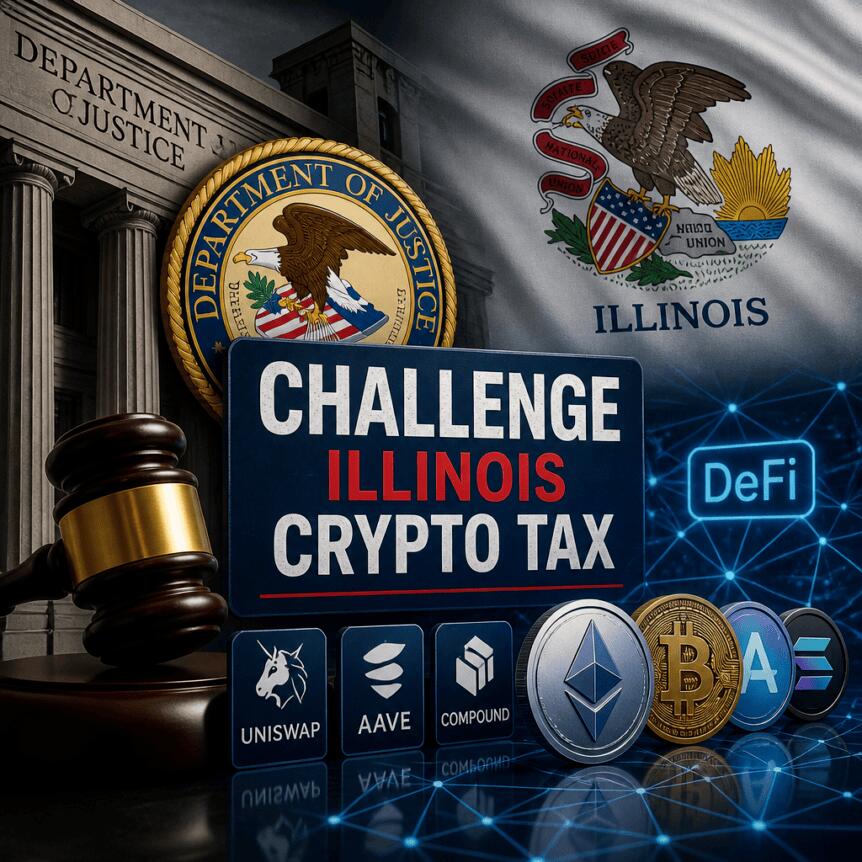
The U.S. Department of Justice, major business and financial industry groups, and a coalition of DeFi firms have urged a court to block Illinois’ newly enacted 0.2% digital asset tax. The measure, passed in June, is designed to levy tax on the value of certain cryptocurrency-related activity even when no profit is generated—an approach the challengers say risks imposing burdens without clear gains for investors.
According to an announcement from the Blockchain Association and the Crypto Council for Innovation, the legal effort includes a Justice Department statement of interest, an amicus brief from the U.S. Chamber of Commerce and SIFMA, and another filing from a DeFi coalition that lists venture firms Andreessen Horowitz and Paradigm alongside protocol teams including Uniswap and Aave Labs. Illinois’ tax authority had originally targeted an implementation date of Jan. 1, 2027, but the start was later delayed to July 1, 2027 to give the lawsuits more time to play out.
Key takeaways
- Challengers argue Illinois’ 0.2% digital asset tax applies regardless of whether a user profits, creating liability even in losing positions.
- SIFMA and the U.S. Chamber of Commerce warn the tax could drive nationwide compliance costs for banks, broker-dealers, custodians, and asset managers.
- The Justice Department says the tax policy could conflict with federal efforts aimed at supporting crypto and stablecoin innovation.
- DeFi participants argue Illinois’ approach risks putting tax-collection obligations on parties—such as developers—who lack custody, customer identity data, or control over funds.
- Illinois projected $60 million in fiscal year 2027 revenue, but court challenges are now positioned to determine whether the tax can take effect at all.
Illinois’ tax targets transactions and transfers, not realized gains
The Illinois law imposes a 0.2% tax on the value of digital assets exchanged, transferred, or stored. Crucially, the tax is framed to apply without regard to whether a transaction results in profit. That feature is at the center of the objections from the DOJ, business groups, and crypto industry challengers.
As the lawsuits develop, opponents argue the tax can reach scenarios that resemble “tax on movement,” not “tax on gains.” In other words, users could face tax obligations tied to transferring assets between accounts or locations even if they have not sold the asset, realized gains, or improved their net position.
The legal battle has unfolded alongside a shifting timetable. After the law’s initial effective date was set for Jan. 1, 2027, it was delayed until July 1, 2027, a change aimed at allowing time for the court process to conclude. The delay effectively extends the runway for challengers to build their arguments and for Illinois to defend the policy.
Business groups: the bill can create taxes for losses and raise broad compliance burdens
In a Nov. 6 court filing, SIFMA and the U.S. Chamber of Commerce argued that Illinois’ tax would ripple beyond crypto-native businesses. They contend it would affect a wide range of traditional financial intermediaries—including banks, broker-dealers, custodians, and asset managers—potentially requiring extensive system changes to comply.
The filing also warns that customers may bear costs without a profit motive. It states that a customer who loses money would owe the same tax as a customer who earns a profit. It adds that a customer moving the same asset between two accounts could face tax at potentially both ends, even without a sale, a gain, or any change in beneficial ownership.
Beyond the tax design itself, the challengers raise an operational concern: firms would need mechanisms to identify Illinois customers, determine asset values, and decide which transactions fall within the tax’s scope. The business groups also allege that violations could expose firms to criminal penalties, heightening the stakes of compliance—even where systems or data are not readily available.
They further argue the tax discriminates against digital asset services because comparable transactions involving traditional assets are not taxed in the same manner. The filing also invokes potential conflicts with federal internet tax protections and constitutional requirements tied to interstate commerce and uniform taxation.
DOJ involvement: potential conflict with federal crypto policy goals
The Justice Department’s statement of interest, filed Nov. 6, argues that Illinois’ approach undermines federal efforts intended to promote innovation and U.S. competitiveness in cryptocurrency markets.
The DOJ filing points to specific U.S. policy steps it says reflect a direction toward supporting key parts of the ecosystem—citing, among other items, the creation of a Strategic Bitcoin Reserve and federal rules for stablecoins under the GENIUS Act. In that framing, the DOJ suggests less favorable tax treatment for digital assets could run counter to broader federal priorities.
For investors and builders, this kind of federal objection matters because it signals the dispute may not be treated as a purely state-level tax question. Instead, it could become a test of whether state tax policy risks interfering with or discouraging initiatives the federal government has actively advanced.
DeFi coalition: unclear collection duties could spill over to developers
While business groups focused on compliance and customer impact, a DeFi coalition highlighted a different risk: who would be responsible for collecting the tax in decentralized contexts.
In a Nov. 11 filing, the coalition argued that Illinois’ framework could impose obligations on software developers and other blockchain participants who may not have the information needed to comply. They contend certain participants lack customer identifying data, do not control user funds, and may not have the ability to collect taxes in the way a centralized intermediary could.
This argument reflects a core structural difference between traditional finance and many DeFi systems: decentralization often limits the extent to which a single actor can determine customer identity, obtain taxable event information, or enforce collection mechanisms across the entire workflow.
The coalition’s involvement—spanning venture firms and named DeFi protocol participants—also suggests the lawsuit’s outcome could influence how legislators and courts think about assigning compliance and liability roles in public, permissionless networks.
Revenue projections and the next questions for courts
Illinois officials projected that the digital asset tax would generate $60 million in fiscal year 2027 revenue, based on estimates from the governor’s budget office. Earlier reporting by the Chicago Tribune described the measure as part of a broader affordability agenda, including language aimed at closing loopholes and raising contributions from large companies and high-wealth participants.
However, court filings from the DOJ, SIFMA, the U.S. Chamber of Commerce, and DeFi-related parties aim squarely at the tax’s mechanics: taxing asset value changes and movements without regard to profits, and extending the compliance footprint in ways that opponents say may be unconstitutional, impractical, or at odds with federal policy goals.
As the legal process continues, readers should watch whether courts focus on the tax’s “no-profit” structure, the breadth of compliance obligations for intermediaries, or the decentralization challenge of assigning responsibility—because those issues could shape not only Illinois’ outcome but also how other jurisdictions design similar crypto taxes.