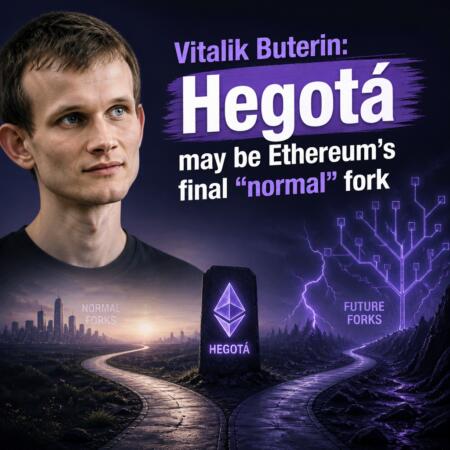
Ethereum co-founder Vitalik Buterin says the upcoming Hegotá upgrade may be the last “normal” fork—one that largely preserves a familiar Ethereum development style—before the network pivots toward more radically different cryptographic and verification technologies. In a post published Sunday, Buterin linked that shift to a broader vision: Ethereum evolving from a blockchain that replays computation to a platform he describes as a “cryptographic world computer.”
Buterin also pointed to earlier milestones that helped Ethereum move along this path, including PeerDAS. He framed these changes as the start of a transition toward architectures that combine blockchains with cryptographic checking, privacy mechanisms, and decentralized components that can operate offchain—while still relying on Ethereum’s base layer to settle and verify outcomes.
Key takeaways
- Buterin argues Hegotá, planned for 2027, could be Ethereum’s final upgrade that feels recognizable to developers from the 2015 era.
- He connects Ethereum’s evolution to a shift toward “cryptographic world computer” designs that verify results rather than re-executing everything.
- PeerDAS is cited as an early step in moving from a plain blockchain model toward one that performs stronger cryptographic data-availability validation.
- Community discussion centers on how much computation and state should move offchain, and what must remain directly onchain for transparency and user interaction.
- Debate continues over whether proof-heavy architectures will be adopted broadly in DeFi compared with trust- and reputation-based systems.
Why Hegotá is framed as a turning point
Buterin’s post focused on the practical meaning of Hegotá—an Ethereum upgrade that, according to his comments, is planned for 2027. He said it is likely to be the last fork where the upgrade’s features and underlying approach would still be familiar to someone who understood Ethereum’s early design principles.
That framing matters because Ethereum’s upgrade cadence is not just about incremental improvements. Buterin’s message suggests that after Hegotá, the ecosystem could increasingly encounter changes that rely on newer cryptographic tooling and verification workflows—such as recursive STARKs, automated formal verification, consensus optimizations, and quantum-safe cryptography—rather than the more traditional cycle of writing and executing smart contracts in ways developers have long understood.
From blockchain re-execution to verified outcomes
At the heart of Buterin’s argument is a change in what Ethereum is “for.” He described Ethereum’s transition into a “cryptographic world computer,” an architecture intended to move beyond a model where nodes simply download data and re-execute transactions. Instead, the network would be used to combine blockchains with cryptographic verification and privacy-preserving mechanisms, alongside decentralized offchain components.
In this model, applications could shift more computation offchain while using the base layer to verify results, settle transactions, and preserve access to shared onchain state. The implication for builders is straightforward: app design may become less about making every step executable on the base layer, and more about generating verifiable proofs of what occurred—so Ethereum can check correctness without redoing the entire workload.
PeerDAS as the earlier step toward lighter, stronger verification
Buterin highlighted PeerDAS as a key transition point. He said PeerDAS enables nodes to verify data availability by sampling portions of data rather than downloading everything. In his view, that capability marks the beginning of Ethereum shifting “from being just a blockchain to being something much more powerful.”
PeerDAS is also relevant to a recurring theme in blockchain scalability discussions: how to support stronger verification while reducing the burden on individual nodes. By verifying availability through sampling, networks can move toward a system where not every participant must handle the full raw dataset—while still maintaining assurances about what the network is doing.
Community debate: offchain computation vs onchain transparency
Following Buterin’s post, discussion quickly turned to a question that affects both decentralization and usability: how much computation and state should remain directly onchain as Ethereum evolves.
Ethereum researcher Barnabé Monnot argued that moving computation offchain while proving results onchain could reduce work required from the network and allow “lighter nodes.” However, he also insisted that a “world computer” should keep important records onchain because applications depend on them. Doing so, in his view, would let users observe what’s happening and interact with decentralized applications directly, without needing to rely on external servers or intermediaries.
Pseudonymous commentator Cryptographic said the approach could expand what decentralized finance can do. The argument was that more complex computation could occur outside smart contracts while Ethereum verifies that resulting transactions comply with protocol rules.
One example raised in that discussion was DeFi lending: collateral analysis, liquidation routing, or matching borrowers and lenders could potentially happen offchain before Ethereum verifies and settles the outcome. The key feature of this setup would be that the base chain acts as a cryptographic enforcer of correctness for the final settlement, rather than as the place where every intermediate step must be executed.
Still, not everyone is convinced that proof-based systems will automatically displace traditional trust models. Crypto lawyer Gabriel Shapiro questioned how much demand exists for cryptographic verification compared with systems built on reputation, regulation, and legal enforcement rather than continuous onchain proof.
The tension in the debate is clear: proof-heavy architectures may reduce onchain workload and potentially enable new application patterns, but they still need to answer practical adoption questions—such as user expectations, integration costs, and whether existing legal and institutional frameworks already solve many problems that decentralized verification is designed to address.
What to watch next
Buterin’s comments don’t provide a new timeline beyond what’s already associated with Hegotá, but they do sharpen the direction of travel: Ethereum’s roadmap could increasingly emphasize verifiable computation, cryptographic checking, and privacy-preserving verification rather than pure re-execution. Investors and builders should watch how the ecosystem treats the balance between onchain records and offchain computation—and whether proof-centric DeFi patterns gain real momentum as technical proposals mature.