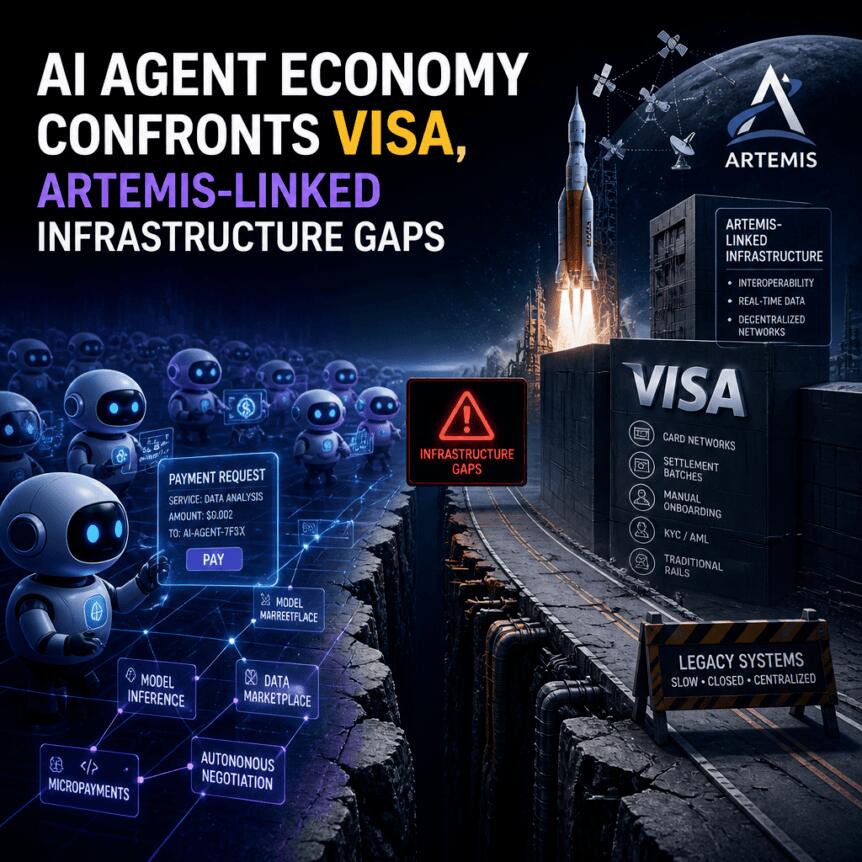
Visa and investment thesis platform Artemis have released a report arguing that the rise of “agentic” AI—software that can discover services, negotiate terms, and execute transactions—may force a rethink of how the world processes payments. The core problem, they say, is that today’s card rails and similar incumbents were designed for human purchasing patterns: relatively infrequent, fee-sensitive transactions settled on timelines that don’t fit high-volume micropayments.
In their view, AI agents reached a practical capability threshold in mid-2025, enabling them to locate unfamiliar APIs, compare pricing, and initiate payments autonomously. That shift makes near-zero friction and fast settlement more important than ever—conditions the report says current infrastructure often cannot meet at scale. The report also frames stablecoins as a potential catalyst for machine-native micropayments while pointing to a convergence model where multiple rails coexist.
Key takeaways
- Visa and Artemis argue traditional card infrastructure struggles with the frequency and fee sensitivity required for AI agents’ micropayments.
- The report links AI agent adoption to a mid-2025 capability jump that lets agents evaluate services and trigger payments autonomously.
- It projects convergence rather than replacement: cards for proxy transactions inside merchant networks, stablecoins for machine-native micropayments, and hybrid workflows.
- Coinbase’s x402 protocol is cited as a developing real-world example, with volume and transaction counts accelerating after its May 2025 launch.
- The paper describes a shared machine-payment framework approach, including Visa work to extend Tempo’s Machine Payment Protocol (MPP) toward card-based agent commerce.
Why AI agents pressure payment rails
The joint report, released Wednesday, centers on the mismatch between human commerce and machine commerce. According to Visa and Artemis, card systems were built around lower-frequency transactions where fee structures and settlement timing are acceptable. AI agents, by contrast, can operate in rapid cycles—discovering new endpoints, running pricing checks, and paying in the background—creating what the report calls a demand for near-zero fees and faster settlement to make micropayments economically viable.
The authors argue this isn’t simply a theoretical upgrade request. They say AI agents crossed a key capability threshold in mid-2025, where they can both navigate unfamiliar APIs and make payment decisions without human intervention. In that context, even modest frictions—fees that scale poorly, settlement delays that reduce automation efficiency, or lack of operational flexibility—can become bottlenecks.
Evidence of adoption: Coinbase’s x402 protocol
The report also points to early market signals from agent-oriented payment standards. One example highlighted is x402, a payment protocol developed by Coinbase. Visa and Artemis say x402 processed $15 million in adjusted volume across more than 109 million adjusted transactions since its launch in May 2025.
More notably, the report describes a sharp acceleration after a period of relatively low activity. It says that in October 2025, the monthly transaction count jumped from 40,000 to 3.8 million, culminating in 38 million transactions processed in October alone. The data is used to suggest that agent-compatible micropayment pathways can see rapid throughput growth when the right operational conditions are met.
Stablecoins as part of a convergence, not a winner-takes-all
A central thesis in the report is convergence across payment types. Visa and Artemis write that the “trajectory points toward convergence rather than competition,” outlining three roles for different rails: cards for proxy purchases within existing merchant networks; stablecoins for machine-native micropayments; and hybrid flows where both types of payments operate within the same workflow.
That framing matters because it avoids a binary story of crypto displacing incumbents. Instead, it suggests that stablecoins may become especially useful where card economics and settlement cadence do not match machine micropayment needs, while card networks could still provide reach inside merchant ecosystems—particularly for transactions where proxy purchasing or familiar merchant integration is beneficial.
The report further argues that a single machine-payments framework could support both stablecoin and card transactions, creating a pathway for agentic flows to extend into card-based commerce networks rather than forcing a full migration.
Shared frameworks and the push to connect card networks to machine payments
To describe how convergence could be implemented, the report discusses Tempo’s Machine Payment Protocol (MPP). It says MPP now spans both onchain crypto payments and fiat payments through shared payment tokens. Visa, in turn, is described as working to extend the protocol into card-based agent commerce.
In practical terms, the report says Tempo’s approach is designed to make it easier for AI actors to send and receive money, while Visa’s tools aim to support agentic payments on card rails. Visa’s crypto division has also been referenced in relation to AI tooling, including functionality for same-day payments by AI agents. Separately, Tempo—which has backing associated with Stripe in the source material—has been described as launching AI-related capabilities alongside its machine payments work in March.
Beyond the product details, the investor-relevant takeaway is structural: instead of treating cards and crypto rails as separate stacks, the report highlights efforts to align them through shared tokenized payment concepts. That alignment is presented as a key step toward enabling agents to execute payments across different networks without the underlying automation logic having to be rebuilt for every rail.
How stablecoins may scale with AI-native microbusiness
The report’s convergence model also intersects with another recent claim in the broader ecosystem: Swyftx earlier this week said AI-enabled microbusinesses could add an estimated $262 billion in stablecoin volume by 2033, assuming roughly 33% adoption. The company’s argument, as presented in the source material, connects AI-native payments settled in stablecoins to growth in machine-driven commercial activity.
While that figure is based on Swyftx’s adoption assumptions rather than Visa/Artemis data, it aligns with the joint report’s emphasis on micropayment economics. The implication for readers is that the stablecoin narrative may increasingly hinge on transaction utility—especially volume at the micro scale—rather than on retail speculation alone.
For investors and builders, the next signal to watch is whether machine-payment standards such as x402 and the broader MPP framework keep showing step-function usage growth, and whether card-network extensions can reduce the friction that the report identifies. The unanswered question is not whether AI agents will create new payment demand, but whether payment rails can adapt fast enough to keep that demand commercially frictionless.