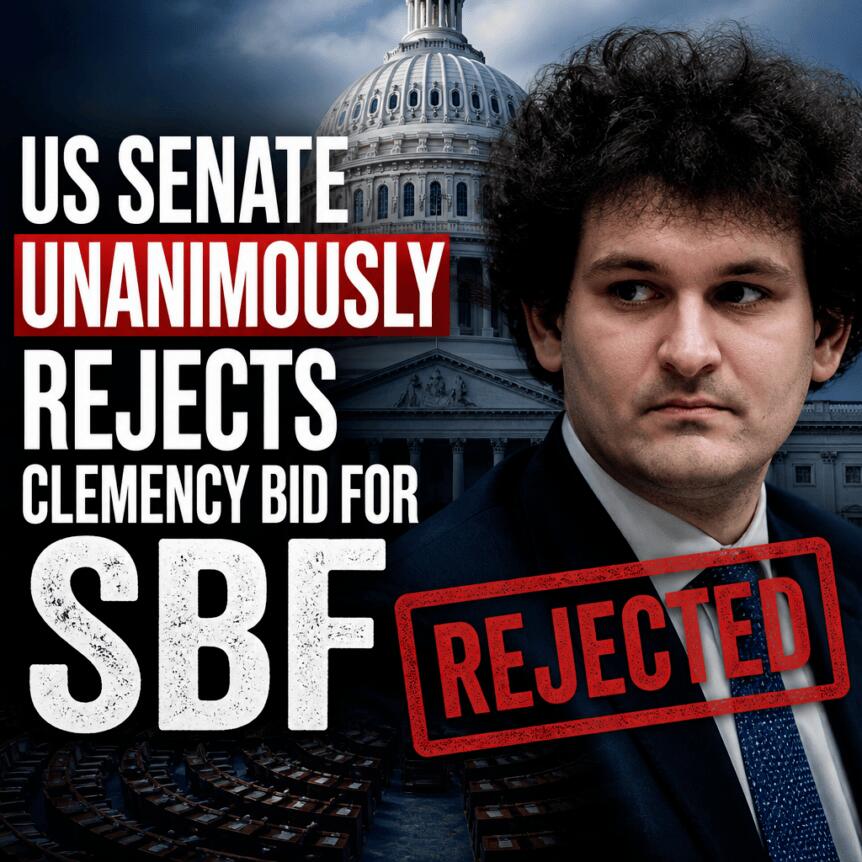
The U.S. Senate has adopted a resolution opposing executive clemency for former FTX CEO Sam Bankman-Fried, underscoring bipartisan political pressure after his fraud conviction connected to the collapse of the crypto exchange.
In a unanimous-consent vote, senators approved a simple, nonbinding measure—S. Res. 772—stating that Bankman-Fried should not receive executive clemency, according to a Wednesday post by the Senate Press Gallery on X.
Key takeaways
- The Senate passed S. Res. 772 by unanimous consent to oppose any federal clemency for Sam Bankman-Fried.
- The resolution is nonbinding and cannot stop a presidential pardon or other executive action.
- The measure follows Bankman-Fried’s request for clemency from President Donald Trump.
- Bipartisan support expanded as additional senators joined as cosponsors, including Bernie Moreno.
- Prediction markets currently price a pardon at less than 1%, despite attracting meaningful trading activity.
Senate resolution signals bipartisan opposition
S. Res. 772 was introduced on June 17 by Senator Ruben Gallego, with Senator Cynthia Lummis listed as a cosponsor. The resolution explicitly opposes any form of federal clemency for Bankman-Fried, including a presidential pardon or a commutation of sentence.
As a simple Senate resolution, it does not require approval from the House or the president and does not carry the force of law. The Senate’s own “Types of Legislation” guide explains that this kind of measure is distinct from legislation and therefore cannot compel or block executive action.
At the time of publication, Congress.gov had not yet reflected the latest floor action for the resolution. However, the Senate Press Gallery’s post indicates that the Senate has now agreed to the measure.
Support for the resolution is also bipartisan. Senator Bernie Moreno of Ohio joined as a cosponsor on Tuesday, adding additional Republican backing to a proposal initially led by a mix of senators from different parties.
Why the Senate’s move matters—and what it can’t do
While S. Res. 772 cannot prevent the president from granting clemency, it functions as a public signal of political resistance inside the legislative branch. The Senate resolution affirms lawmakers’ commitment to “the rule of law” and the integrity of the U.S. financial system in the wake of Bankman-Fried’s conviction.
Bankman-Fried was convicted on fraud and conspiracy charges tied to the 2022 collapse of FTX. He was sentenced to 25 years in federal prison in March 2024.
In June 2026, speculation about a possible pardon intensified after Bankman-Fried sought clemency from President Donald Trump, according to earlier reporting from Cointelegraph on his application. The Department of Justice’s pardon and clemency case-status records also list the clemency request as pending, using the case number shown in the DOJ interface.
For investors and participants in crypto markets, political outcomes like clemency don’t directly change blockchain technology or protocol rules. But they can influence broader regulatory and enforcement expectations—especially in high-profile cases that have become benchmarks for how U.S. authorities treat major exchange failures.
Market pricing suggests a pardon is unlikely
Even as the Senate moved to oppose clemency, prediction markets have largely discounted the probability that Bankman-Fried will receive a pardon. On Polymarket, traders have assigned less than a 1% chance that President Trump will pardon Bankman-Fried by July 31, according to the market listing referenced in the original reporting.
Despite the low odds, the market has pulled in more than $734,000 in trading volume, indicating that while most traders appear skeptical, there is still substantial interest in the possibility of an executive decision.
That split—very low probability on price, but meaningful volume in activity—often points to traders using the market to express scenarios they consider possible but not likely. What remains uncertain is whether clemency processes will advance to a decision and, if so, whether any final action will align with the Senate’s stated position.
What to watch next
Readers should watch the Department of Justice’s clemency case status for any updates and monitor further legislative developments, since S. Res. 772 cannot block a presidential pardon but may affect political pressure around any eventual executive decision.