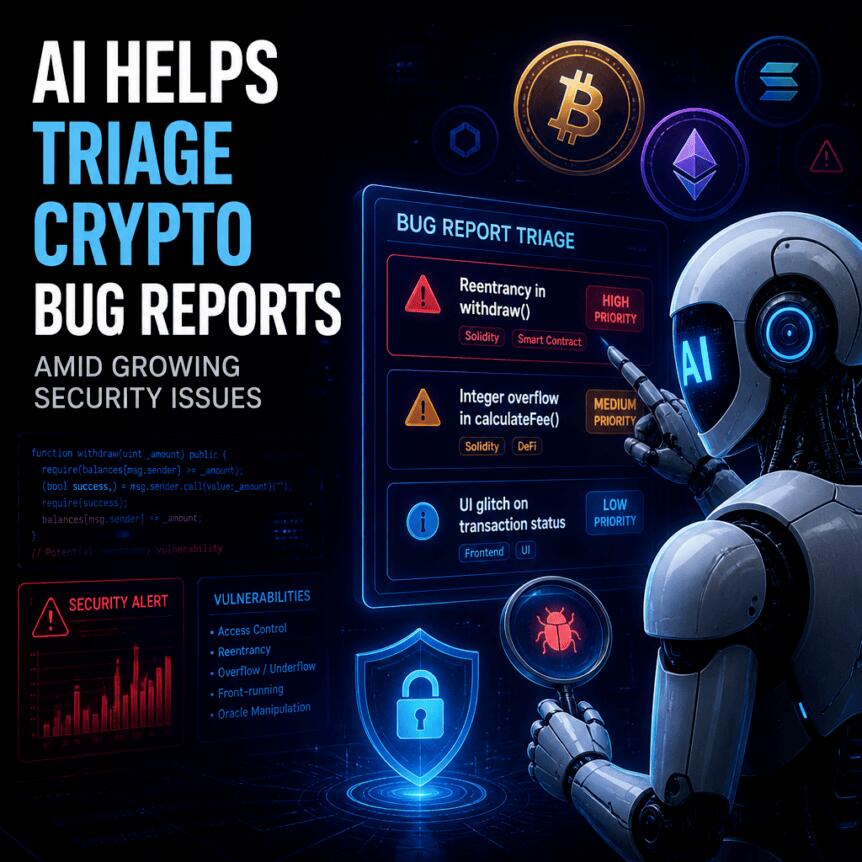
Crypto-focused bug bounty platforms are increasingly leaning on artificial intelligence to handle an explosion of AI-assisted vulnerability reports. But the shift isn’t simply “more security fixes”—it’s also brought higher noise levels, forcing program operators to rethink how they triage submissions and prioritize real threats.
HackenProof said in October that it was using AI to triage 70% of submissions fully autonomously, with a target of reaching 85% by the end of 2026. It reported receiving an average of about 6,100 bug reports per month in the third quarter—about 2.4 times the volume recorded in December last year. Rival platform Immunefi reported that submissions rose 136% year-over-year in the first nine months of 2026 after introducing a tool intended to flag duplicates before researchers submit a report.
Key takeaways
- AI triage is becoming central for crypto bug bounty platforms as report volumes surge and security teams struggle to keep up.
- Duplicate and low-quality submissions are a growing operational cost, making automation and pre-submission controls more important.
- “More reports” doesn’t automatically mean “more risk fixed”; platforms are using incentives and verification to reduce spam.
- Industry players expect both higher report volumes and more disruptive incidents ahead, driven in part by the “industrialization of AI.”
- Security strategy is shifting toward impact analysis, not just the count of attacks or submissions.
Why AI bug triage is moving from optional to necessary
Bug bounty programs pay independent researchers to find and report potential security flaws. As AI tools have become more accessible, researchers have increasingly used AI-assisted workflows—helping them identify genuine weaknesses faster. However, the same dynamic has also contributed to a flood of invalid, irrelevant, or duplicated reports, which can clog review queues and delay attention to the most urgent issues.
In this context, platforms say automation is necessary not only to increase throughput, but to reduce the time analysts spend on low-value work. HackenProof’s October update emphasized this operational shift, describing an AI triage approach designed to automatically process the majority of incoming submissions, with further scaling planned.
Immunefi’s response shows another angle: controlling redundancy before a report enters the system. By introducing functionality that flags duplicates prior to submission, Immunefi said it was able to reduce the repeat submissions that often result when multiple researchers independently use similar AI workflows.
Even where AI improves the discovery process, security teams still need a way to separate what matters from what merely “exists.” Dmitry Tokarev, founder of crypto wallet provider Bron, told Cointelegraph that security teams that have not already adopted AI to filter submissions risk being overwhelmed—adding that the situation can feel like bringing a sword to a gunfight.
February marked a shift in AI-assisted vulnerability reporting
Several platforms singled out February as a turning point for the surge in AI-assisted vulnerability reports. According to the coverage, the change coincided with the release and broader availability of more capable AI models, including Anthropic’s Claude Opus 4.6.
HackenProof said Claude Opus 4.6 could work through larger codebases and sustain tasks for longer. HackerOne similarly pointed to improvements in AI models and tooling arriving in that period, describing a move away from a “human-only submission environment.” The implication for program operators is clear: when AI can handle bigger codebases and produce more complete outputs, it can also produce more reports—regardless of whether they are actionable.
The practical result is that platforms must automate not only initial screening, but also classification. Otherwise, security teams can end up reviewing an overwhelming volume of cases that take little time to reject yet consume analyst attention.
Incentives, identity checks, and automated closure
Some crypto infrastructure teams are experimenting with disincentives to manage the quality of submissions. In October, the team behind Firedancer—a Solana validator client developed by Jump Crypto—introduced a requirement that researchers burn 1 SOL for each bug report they want considered for a bounty. The token is permanently destroyed even if the report turns out to be a duplicate.
This is a notable departure from typical bounty designs that focus on rewarding good-faith research alone. The Firedancer approach effectively adds a cost to low-effort or spam-like behavior, aiming to ensure researchers think twice before submitting borderline or duplicative findings.
Meanwhile, HackerOne said it began requiring researchers to verify their identities before submitting reports in the third quarter, according to a November update shared with Cointelegraph. The platform also said it expanded its triage team and started using AI agents to automatically close clear-cut cases such as spam and duplicate reports.
In October, HackerOne also reported giving customers more control over how many reports their public programs receive, suggesting that program owners may be able to tune intake to match their capacity.
What comes next: more volume, but watch the damage
HackerOne’s vice president of operations, Tony Lee, told Cointelegraph he expects vulnerability reports to continue rising “for the foreseeable future.” Lee cited a 22% increase in report volume in Q3 compared with the prior quarter, reinforcing the idea that today’s operational bottlenecks are likely to persist rather than quickly fade.
At the same time, broader risk forecasts suggest the problem will not be confined to bug bounty ecosystems. QBE and risk consultancy Control Risks forecast more disruptive cyber incidents in 2027 across 14 markets they studied, pointing to the “industrialization of AI” as one factor behind changing threat dynamics. While that projection is not crypto-specific, it helps explain why crypto security teams are treating AI-related risk as a structural shift, not a temporary anomaly.
Mike Blank, chief product officer at blockchain infrastructure firm R3, also said he expects hacks to rise sharply in 2027. However, he emphasized that teams should focus on how much damage a single breach can do rather than the sheer number of attacks. In his framing, the key distinction is whether a stolen key can “drain everything” or only pause operations.
That perspective matters for investors and builders because it reframes what “better security” means in an AI-driven environment. When report volumes and attempted exploit attempts both scale, systems still need to minimize blast radius: preventing total loss, segmenting access, and ensuring incident response can contain the impact.
Beyond triage: the compliance and tooling gap
The current cycle of AI-assisted reporting highlights a tension between capability and governance. AI can generate faster outputs—sometimes useful, sometimes not—but platforms and security teams are forced to build around the resulting noise with automation, identity verification, pre-submission filtering, and even financial disincentives.
As these measures roll out, the next question for the ecosystem is how effectively they translate into faster remediation of real vulnerabilities. Platforms can reduce duplicate volume, but they still must ensure that the remaining backlog—whether from sophisticated reports or genuinely novel issues—does not overwhelm the teams responsible for patching.
Readers should watch whether AI triage improves not just throughput, but also accuracy and turnaround times for confirmed vulnerabilities. The ongoing uncertainty is whether the security industry can keep pace with expanding AI-assisted activity without sacrificing the speed and quality of response where it matters most.