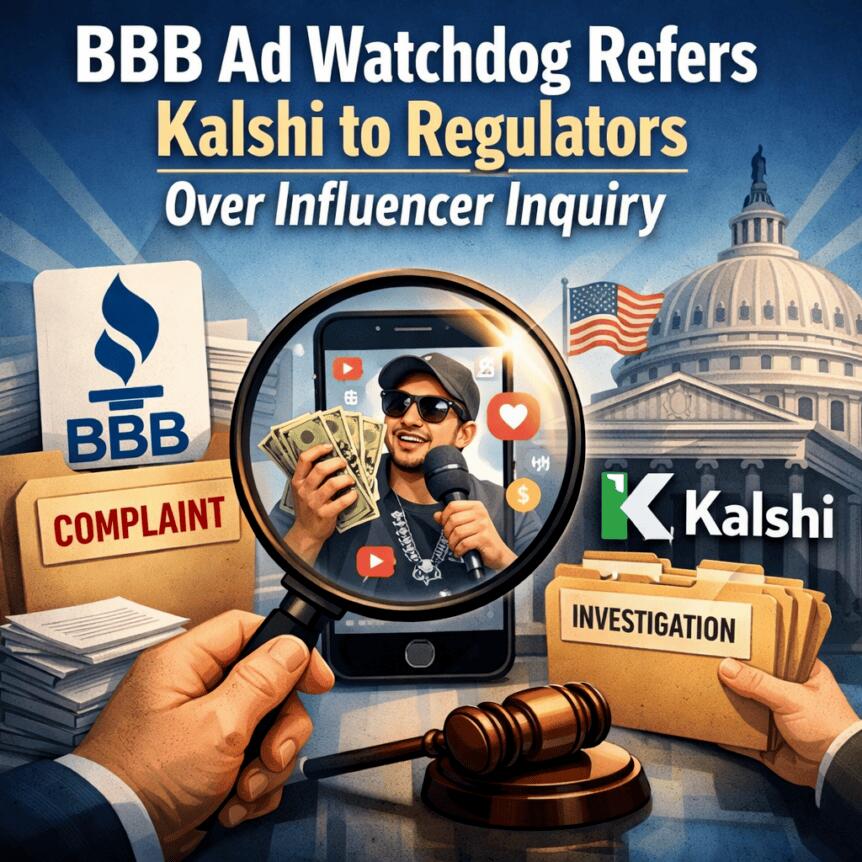
The BBB’s National Advertising Division (NAD) has escalated its scrutiny of Kalshi, the centralized event-prediction platform, by referring the matter to regulatory authorities after Kalshi declined to participate in NAD’s voluntary review of its social media advertising practices. The referral, which names applicable state Attorneys General for potential enforcement action, underscores growing regulatory focus on how prediction-market platforms market themselves to retail users and disclose paid promotions in influencer-driven campaigns.
In its statement, NAD explained that the inquiry assessed whether influencers and affiliates clearly disclosed paid relationships in social media promotions and whether Kalshi adhered to Federal Trade Commission endorsement guidelines. The division noted that Kalshi chose not to participate in the voluntary review, and as a result, NAD will inform the social media platforms where Kalshi ads appeared. The central issue, according to NAD, was whether material connections between Kalshi and influencers or affiliates were disclosed in a clear and conspicuous manner in social media advertising.
The development adds to existing scrutiny surrounding Kalshi’s marketing approach. Media Matters for America, a nonprofit watchdog, has also highlighted the platform’s social media campaigns on TikTok and Instagram that portrayed prediction trading as a “side hustle.” The attention comes amid a broader push within several regulatory and watchdog circles to scrutinize the endorsement practices of crypto and fintech firms that use influencer networks to reach younger audiences.
Kalshi’s exposure to attention from oversight bodies is not occurring in isolation. In related coverage, Kalshi has been noted for joining a wave of platforms expanding through viral marketing while confronting ongoing debates about the regulatory status of prediction markets and the adequacy of anti-insider-trading controls. A separate note from industry coverage highlights Kalshi’s broader market activity, including recent fundraising and a high-valuation round that has drawn attention from institutional observers.
Kalshi’s promotional dynamics have become a focal point in the context of rapid growth for prediction markets. The company has publicly disclosed that its business momentum is translating into strong revenue trajectories, with a Kalshi spokesperson telling Bloomberg that the firm is on track to reach a $1.5 billion annualized revenue run rate. That momentum coincided with a recent funding round reported to be valued around $22 billion, a milestone that positions Kalshi as a leading player in a sector that combines real-world event outcomes with blockchain-native or centralized trading venues. The reporting underscores how marketing efficacy—especially through social platforms—has become a critical driver of user acquisition and liquidity in event-based markets.
Despite regulatory headwinds, the sector continues to grow. Kalshi sits alongside its decentralized peers and other centralized marketplaces as retail and institutional participants increasingly engage with event-driven trading. Industry observers have pointed to a broader transition toward more formalized market structures within prediction markets, including the introduction of block trading and bespoke contracts as mechanisms to deepen liquidity and improve price discovery. A May research note from Bernstein, cited by market watchers, framed the development of prediction markets as entering an “institutional era,” arguing that new trading formats could attract portfolio managers seeking targeted exposure to event risk and potentially enhance market efficiency. The report also highlighted that large trades and more sophisticated contract designs could broaden institutional participation, while raising questions about risk controls and regulatory oversight.
Key takeaways
- Regulatory referral and enforcement risk: NAD has referred Kalshi to appropriate authorities, including state Attorneys General, for possible enforcement action based on the inquiry into advertising disclosures and FTC endorsement compliance.
- Participation and disclosure posture: Kalshi declined to participate in NAD’s voluntary self-regulatory review of its advertising practices, triggering a formal referral process that includes notifying social media platforms involved in Kalshi’s campaigns.
- FTC endorsement framework in focus: The investigation centers on whether material connections between Kalshi and influencers or affiliates were clearly and conspicuously disclosed in social media promotions, in line with FTC guidelines.
- Independent scrutiny broadens: Media Matters for America has raised concerns about Kalshi’s viral campaigns on TikTok and Instagram that framed prediction trading as a supplemental “side hustle,” contributing to reputational and regulatory risk.
- Industry momentum amid scrutiny: Kalshi’s growth trajectory—bolstered by social media marketing and high-profile fundraising—continues to attract attention from institutional and regulatory circles as the sector contends with jurisdictional questions and enforcement risk.
Regulatory landscape and strategic implications for Kalshi and peers
The NAD referral sits within a broader regulatory frame that encompasses multiple agencies and jurisdictions. The FTC’s endorsement guidelines require transparent disclosure of material relationships between advertisers and endorsers, a standard that applies to paid promotions across social media platforms. In the context of Kalshi, the inquiry examines whether such disclosures appeared in user-facing posts and promotions and whether the platform undertook appropriate steps to ensure compliance with the guidelines. For institutions, the outcome could influence how risk teams assess marketing disclosures, influencer partnerships, and platform-embedded compliance controls across marketing channels.
Beyond the FTC framework, the action touches on ongoing tensions between federal and state-level regulators over the oversight of event contracts and prediction-market structures. The original coverage notes a jurisdictional dispute between state regulators and the Commodity Futures Trading Commission (CFTC) over event contracts, compounded by earlier allegations of insider trading activity. As enforcement posture tightens, firms operating prediction markets—both centralized and decentralized—face heightened expectations around Know Your Customer (KYC) and anti-money-laundering (AML) controls, clear disclosure of conflicts of interest, and robust surveillance measures to detect improper market manipulation or information leakage.
The Bernstein analysis referenced in market commentary argues that the sector may be transitioning into a more institutional-friendly phase, with evidence such as sizeable block trades and bespoke contracts suggesting improving liquidity and price discovery. If institutional participation continues to expand, operators like Kalshi may need to strengthen governance and compliance frameworks to satisfy both existing regulatory regimes and potential future policy developments. In parallel, cross-border considerations—such as potential alignment with MiCA-like regimes in European markets and disparate state-by-state approaches in the United States—could shape licensing, oversight, and product design decisions for prediction-market platforms.
From a practical standpoint, the referral raises questions for compliance teams within crypto and fintech firms. How should marketing teams document paid partnerships with influencers? What cadence and format of disclosures satisfy evolving regulatory expectations? And how can platforms provide auditable evidence of disclosures to regulators and platforms alike? For exchanges and banks that integrate with crypto-focused platforms, the developments stress the importance of calibrated risk controls, clear policy statements on endorsements, and robust AML/KYC programs integrated with marketing and operations.
On the industry level, the Kalshi case may influence best practices around influencer marketing in the crypto space. The attention from NAD, combined with watchdog scrutiny and ongoing legal debates, could push platforms to adopt standardized disclosures, pre-approval for promotional content, and consistent enforcement of conflict-of-interest policies. The result could be a more conservative but legally compliant expansion path that prioritizes long-term integrity over rapid user growth driven by viral campaigns alone.
Closing perspective
As authorities delineate the boundaries between persuasive marketing and compliant endorsements, Kalshi and similar operators may experience a recalibration of their advertising strategies and governance frameworks. The next steps—whether regulators pursue enforcement actions, require remedial disclosures, or clarify guidance for endorsement practices—will shape how prediction-market platforms navigate compliance requirements while continuing to grow their user bases and liquidity in a regulated environment.