Bitcoin’s bid in the United States is showing signs of strain after the Senate failed to advance the CLARITY Act, a key piece of U.S. crypto legislation. Onchain and exchange-linked indicators from major analytics providers suggest that selling pressure has been concentrated on U.S.-facing venues rather than being evenly distributed across global markets.
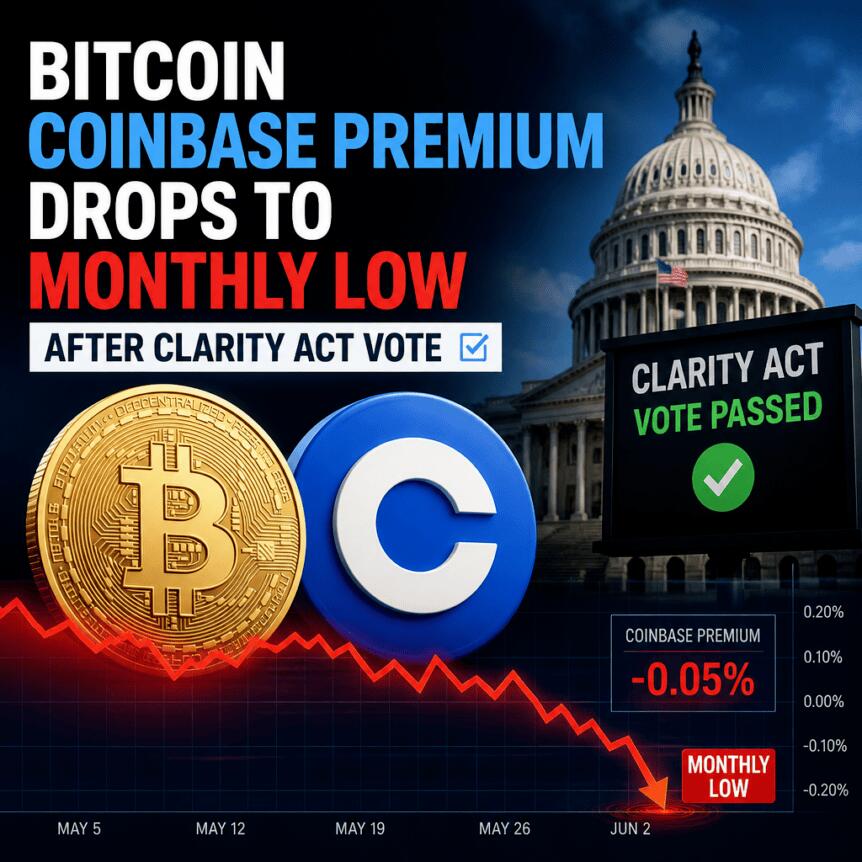
According to CryptoQuant data, the Coinbase Premium Index fell to -0.079 on Tuesday—its lowest level since Aug. 16. At the same time, an onchain look at flows indicates that short-term holders have been moving meaningful volumes of BTC to exchanges, potentially to sell at prices below where those coins last moved onchain.
Key takeaways
- Coinbase Premium Index dropped to -0.079, a one-month low, signaling weaker relative demand on Coinbase versus Binance.
- The CLARITY Act failure appears to have intensified exchange-level divergence, with U.S. sell-side behavior moving opposite global offshore accumulation.
- Up to 34,000 BTC moved from short-term holder wallets to exchanges on a rolling 24-hour basis, with a large portion sold at an unrealized loss.
- Analyst Willy Woo described the divergence—U.S. selling on Coinbase while Binance continues accumulating—as a “bullish” setup.
Regulatory setback hits U.S. demand more than global flows
Senators failed to give the CLARITY Act the necessary 60 votes on Tuesday, according to earlier reporting referenced by Cointelegraph. With that outcome, the legislation’s path back to the Senate floor before 2027 appears limited to a small number of procedural options.
Bitcoin responded with downside pressure, and the impact is visible in how demand compares between U.S. and non-U.S. exchanges. CryptoQuant’s Coinbase Premium Index—which tracks the price spread between Coinbase’s BTC/USDT market and Binance’s BTC/USDT pair—fell to one-month lows after briefly turning positive earlier in the week.
That index reached 0.004 at the start of the week, before sliding deeper as Monday progressed. The reading at -0.079 marks the lowest point since Aug. 16, when BTC/USD was trading around $63,000, based on the same dataset context cited in the original coverage.
A negative premium generally indicates that traders on Coinbase are showing comparatively less willingness to pay versus traders on Binance. The measure has spent much of 2026 below zero, reflecting a broader pattern of capital rotation away from U.S. venues during parts of the year—an interpretation aligned with the original analysis noting Bitcoin’s retreat from its latest all-time high of $126,200 seen in October 2025.
Coinbase selling diverges from Binance, and an analyst calls it “bullish”
While regulatory headlines can affect all markets, the more interesting signal for traders and investors may be where the pressure is showing up. Onchain analyst Willy Woo pointed to a widening split in net order-flow dynamics between Coinbase and non-U.S. exchanges around the time of the CLARITY Act vote.
Woo referenced cumulative volume delta (CVD) by exchange. In general terms, CVD tracks whether net trading activity in a specified period is leaning toward buyers or sellers, by measuring the gap between buy-side and sell-side volume and then accumulating that difference over successive candles.
Using CVD data denominated in BTC since Sept. 6, Woo highlighted that around Sept. 11, Binance’s CVD began to rise, while Coinbase continued to decline—consistent with persistent seller control on the Coinbase side.
“I see the US selling with the failed Clarity Act (on Coinbase) Meanwhile the more dominant global offshore continues accumulating (on Binance),” Woo wrote on X, describing the scenario as “bullish.”
The key implication here is not that price will automatically rebound, but that the market’s internal plumbing is behaving unevenly. If offshore demand is indeed continuing to absorb supply more effectively than the U.S. market, U.S.-based weakness may prove more temporary than a broad, market-wide bearish regime.
Short-term holders capitulate into exchanges after the vote
Beyond exchange spreads, CryptoQuant’s analysis focused on who is supplying liquidity. The firm’s data attributes much of the reactive selling after the CLARITY failure to short-term holders (STH)—wallets holding BTC for less than six months.
CryptoQuant reports that STHs sent up to 34,000 BTC to exchanges on a rolling 24-hour basis. Importantly, the majority of those transfers were made at prices lower than when the coins last moved onchain, suggesting holders may be realizing losses rather than waiting for a better exit.
In CryptoQuant’s blog post, the firm singled out an STH capitulation event: 23,200 BTC were sent to exchanges “at a loss,” which it characterized as the largest recorded over the past month.
This distinction matters. When selling comes from short-horizon holders who may be less committed to long-term exposure, the near-term market narrative can shift quickly—especially if those investors continue to rotate into exchanges whenever price dips. On the other hand, capitulation flows can also clear out marginal sellers, leaving more room for longer-term participants to accumulate if demand holds.
The original coverage also noted that Cointelegraph previously reported STH unrealized profitability reaching a key milestone for 2026, which was framed as potentially improving the odds of a long-term bullish shift in BTC’s trend. In this new episode, that progress appears to be meeting a stress test: a regulatory disappointment that coincides with renewed loss-taking behavior.
What to watch next for U.S. crypto markets
The immediate question is whether the Coinbase-underperforming pattern persists after the CLARITY Act setback—or whether U.S. demand stabilizes as uncertainty fades. For investors, the most practical signals to track are whether the Coinbase Premium Index continues to hover near recent lows and whether exchange flow divergence (Coinbase selling versus Binance accumulation) narrows or strengthens in the days ahead.