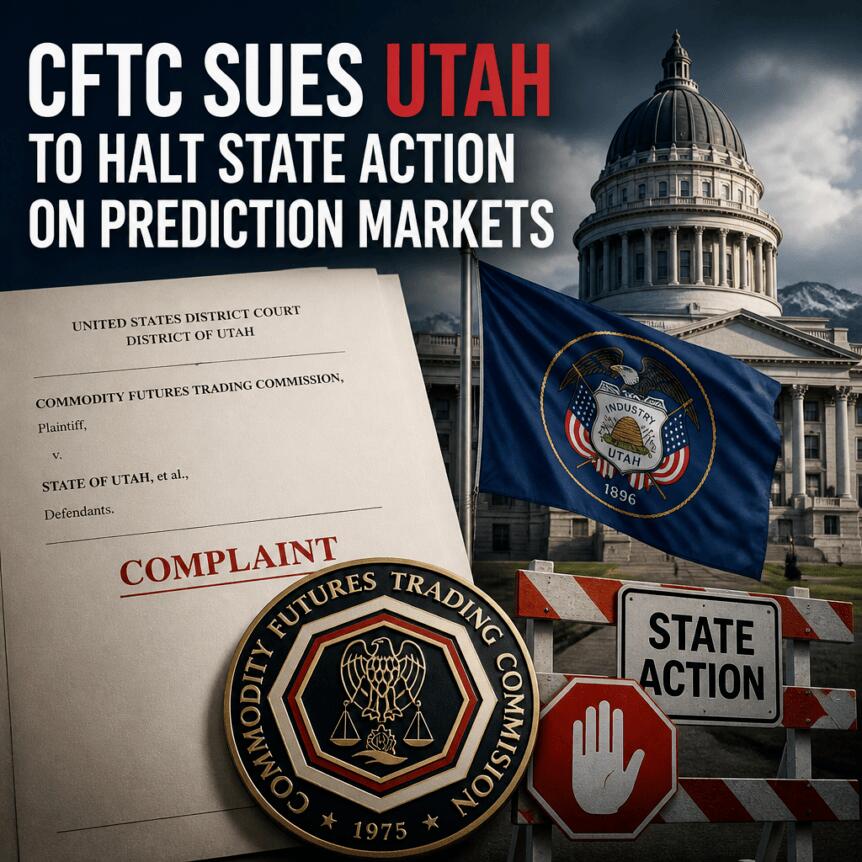
The U.S. Commodity Futures Trading Commission (CFTC) has filed suit against the State of Utah and its Attorney General Derek Brown, escalating a high-stakes legal battle over prediction markets and whether state authorities can restrict them. The action comes after Utah’s attorney general said he would pursue Kalshi and affiliated entities over allegations that they generated as much as $60 million in profits through illegal event-betting.
In a Monday filing in the U.S. District Court for the District of Utah, the CFTC’s lawyers challenged Utah’s approach as an attempt to sidestep Congress’s intent to establish a single federal framework for commodity derivatives—arguing that state restrictions intrude on markets that the CFTC regulates.
Key takeaways
- The CFTC is suing Utah and Derek Brown, arguing the state is interfering with CFTC-regulated exchanges and federally approved products.
- Utah’s case centers on predictions markets and claims Kalshi and affiliates obtained up to $60 million in profits illegally.
- CFTC Chair Michael Selig has argued the regulator holds “exclusive jurisdiction” over prediction markets, fueling repeated federal-versus-state disputes.
- Courts, and possibly the U.S. Supreme Court, may ultimately decide how far states can go versus federal oversight of event-contract trading.
Utah’s bid to stop Kalshi, and the CFTC’s response
The new federal lawsuit follows a week of escalating actions after Utah officials announced they would pursue legal action against Kalshi and related entities. According to the CFTC, Utah’s strategy is designed to “federally preempt state law” by targeting the functioning of exchanges that fall under the CFTC’s regulatory umbrella.
At the center of the dispute is the classification of certain “event contracts” offered through exchanges registered with the CFTC. The regulator argues these contracts meet the federal definition of “swaps” under the Commodity Exchange Act.
What the CFTC says Utah is doing wrong
In its filing, the CFTC states that the event contracts Utah targeted are “swaps” within the federal Commodity Exchange Act and that the venues offering them are CFTC-regulated Designated Contract Markets (DCMs). The CFTC’s position is that Utah is attempting to limit activities that Congress intended to be governed exclusively at the federal level.
As the lawsuit puts it, Utah’s efforts “intrude on the exclusive federal scheme Congress designed to oversee United States commodity derivatives markets.” The regulator frames the case as more than a disagreement over market conduct—characterizing it as a jurisdictional conflict over whether federal approval and supervision are subject to state veto.
Kalshi’s stance and the wider jurisdiction fight
Kalshi has denied wrongdoing in the face of Utah’s move. In an emailed response to Cointelegraph, Kalshi spokesperson Jacki McGavick said that the platform answers to federal oversight and that “no single state should have a veto over it.”
This dispute fits into a broader pattern: multiple states have challenged prediction markets, while the CFTC maintains that it has the authority to regulate these markets under federal law. CFTC Chair Michael Selig has been making a standing argument for months that the regulator has “exclusive jurisdiction” over prediction markets, and this case represents another test of that claim.
Critically for market participants, these jurisdictional battles create uncertainty about where platforms can operate cleanly. Even if a product is cleared under federal supervision, the possibility of state-level actions can increase legal risk and operational friction—especially for platforms that rely on interstate participation.
Could the Supreme Court be the referee?
The CFTC’s lawsuit adds to an expanding list of federal and state cases targeting prediction market activity and oversight responsibilities. The legal questions may ultimately require a Supreme Court resolution because they hinge on the boundary between state authority and federal regulation.
Last September, New Jersey officials petitioned the Supreme Court to weigh in on their dispute involving Kalshi, describing a conflict similar to cases pending elsewhere. According to the reporting included in the original coverage, additional state-level efforts have been brought in Michigan, Ohio, Kentucky, Nevada, Massachusetts, Wisconsin and New York.
As of Tuesday, the Supreme Court had not announced whether it would hear the New Jersey matter. That decision could shape how lower courts treat the continuing wave of state suits and clarify whether the federal regulatory scheme fully displaces state restrictions in this space.
Until then, platforms like Kalshi face the possibility of inconsistent rulings across jurisdictions, even as the underlying market structure remains subject to federal oversight. Investors and users should watch not only for court outcomes, but also for how judges interpret the CFTC’s “exclusive jurisdiction” theory and whether they view state actions as compatible with federal law.
With the CFTC now directly challenging Utah’s authority in federal court, the next key development will be how the District of Utah handles the jurisdictional issues—especially whether the case is treated as an obstacle to the CFTC’s regulatory scheme or as a legitimate state enforcement effort. The Supreme Court’s willingness to intervene remains the biggest wildcard for determining whether these conflicts ultimately converge into a single national rule.