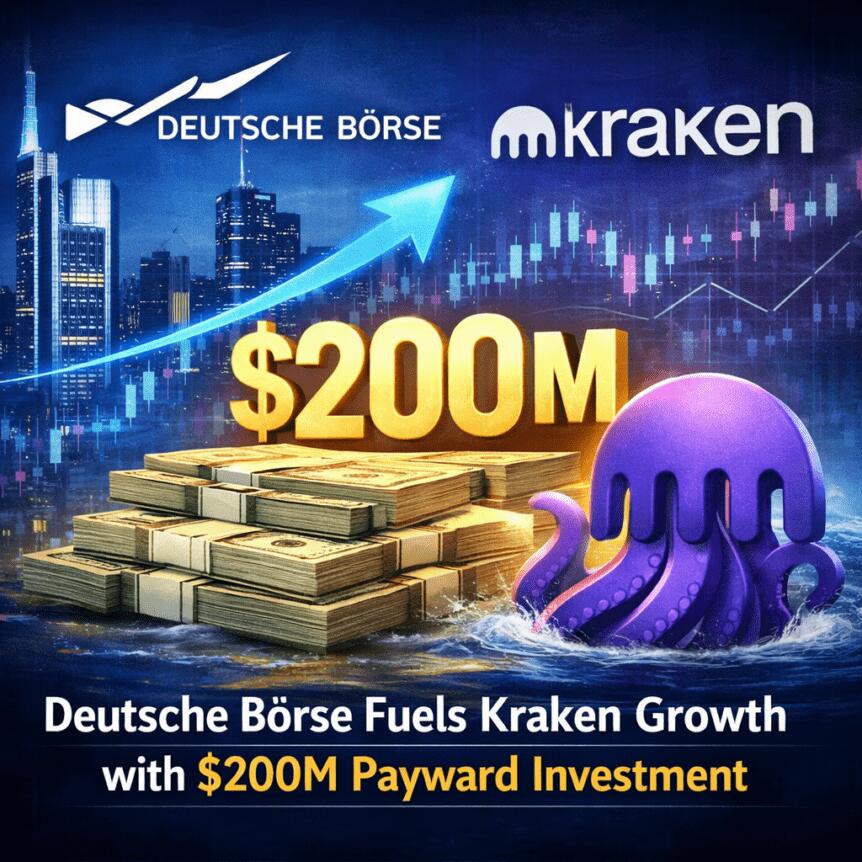
Deutsche Börse is stepping deeper into the crypto economy, agreeing to invest $200 million in Payward, the parent company of Kraken. The deal, which would grant Deutsche Börse a 1.5% fully diluted stake in Kraken via a secondary share purchase, is subject to regulatory approval and is expected to close in the second quarter. The investment signals a widening appetite among traditional finance firms to participate in regulated crypto markets and tokenized assets as exchanges accelerate partnerships and product development.
The move builds on Deutsche Börse’s ongoing collaboration with Kraken to broaden access for institutions to regulated crypto investment products, including spot trading, tokenized markets and derivatives, and the integration of Kraken-backed xStocks into its 360X digital asset infrastructure. Deutsche Börse disclosed the stake plan as part of its broader strategy to offer a wider array of blockchain-based securities and tokenized investment opportunities.
Key takeaways
- The deal values Kraken at a level consistent with a $200 million secondary investment, yielding Deutsche Börse a 1.5% stake on a fully diluted basis, pending regulatory clearance and completion in Q2.
- The investment reinforces Deutsche Börse’s broader plan to expand access to tokenized assets, custody, settlement and collateral management through its 360X platform, following a December 2025 strategic collaboration with Kraken.
- Kraken has been actively expanding its market footprint, including a confidential IPO filing with the U.S. Securities and Exchange Commission announced on Nov. 19, 2025, shortly after Kraken disclosed an $800 million funding round that valued the company at $20 billion.
- Traditional financial firms are increasingly partnering with crypto venues: Nasdaq linked with Kraken to build an equities tokenization gateway; Intercontinental Exchange (ICE) invested in OKX to bring NYSE-listed tokenized stocks toward market in 2026; CME Group outlined plans for crypto futures on multiple assets.
- The crypto exchange sector remains dynamic, with Kraken consistently ranked among the top exchanges by daily trading volume, according to CoinMarketCap data supporting its market presence.
Deutsche Börse deepens crypto collaboration amid a wave of TradFi activity
The announcement illustrates a broader push by traditional market operators to embed digital assets into mainstream finance. Deutsche Börse’s investment comes alongside a multi-faceted effort to deliver regulated crypto investment products that sit at the intersection of traditional custody, settlement, and tokenized on-chain markets. The company previously described its collaboration with Kraken as a catalyst for expanding institutional access to regulated crypto instruments, leveraging Kraken’s trading and custody capabilities with Deutsche Börse’s infrastructure reach.
The stake purchase will be funded through a secondary share acquisition, positioning Deutsche Börse to participate in Kraken’s growth without altering Kraken’s primary capital structure. The transaction is expected to close in the second quarter, subject to regulatory approvals and customary closing conditions. The collaboration also aligns with Deutsche Börse’s ambition to tokenize a broader array of asset classes, enabling new trading, clearing and settlement workflows on its platform.
TradFi accelerates into tokenized markets and crypto derivatives
The Deutsche Börse-Kraken move sits within a spate of high-profile industry collaborations aimed at accelerating crypto adoption among institutional users. Earlier this year, Nasdaq expanded its exposure to Kraken by partnering with Kraken’s infrastructure subsidiary, Backed, to develop an equities transformation gateway that complements Nasdaq’s tokenization efforts and the regulatory frameworks around tokenized stocks.
Meanwhile, Intercontinental Exchange (ICE) invested in crypto exchange OKX to bring NYSE-listed tokenized stocks to a broader audience, signaling continued appetite from large exchange operators to bridge traditional markets with crypto trading and tokenization. In the futures space, CME Group unveiled plans to launch crypto futures tied to Cardano, Chainlink and Stellar, with later expansions to Avalanche and Sui expected to begin in May, subject to regulatory approvals.
These moves underscore a broader narrative: traditional market operators are no longer hedging their exposure to crypto; they are actively building the rails for regulated, institution-friendly access to crypto and tokenized assets. The ongoing cadence of partnerships and product announcements suggests a shift toward a market infrastructure-compatible future where crypto strategies align with conventional trading, settlement and risk management practices.
In context, Kraken’s trajectory remains notable. The firm disclosed a confidential IPO filing in the U.S. around Nov. 19, 2025, shortly after revealing an $800 million fundraising round that implied a $20 billion valuation. The company remains one of the largest crypto exchanges by daily volume, a status reflected in industry data.
As Deutsche Börse steps further into crypto-enabled markets, investors will be watching closely how regulatory approvals unfold and how this stake relates to future product development, custody capabilities, and the broader ecosystem of tokenized assets. The evolving landscape suggests that more traditional finance players could follow a similar path, potentially broadening access to regulated crypto investment products for institutions and wealthy individuals alike.
Readers should watch upcoming updates on the closing timeline, potential product announcements tied to 360X and the concrete rollout of Kraken-backed tokenized equities in European markets, as well as how other TradFi players balance risk, compliance and innovation in this rapidly evolving space.