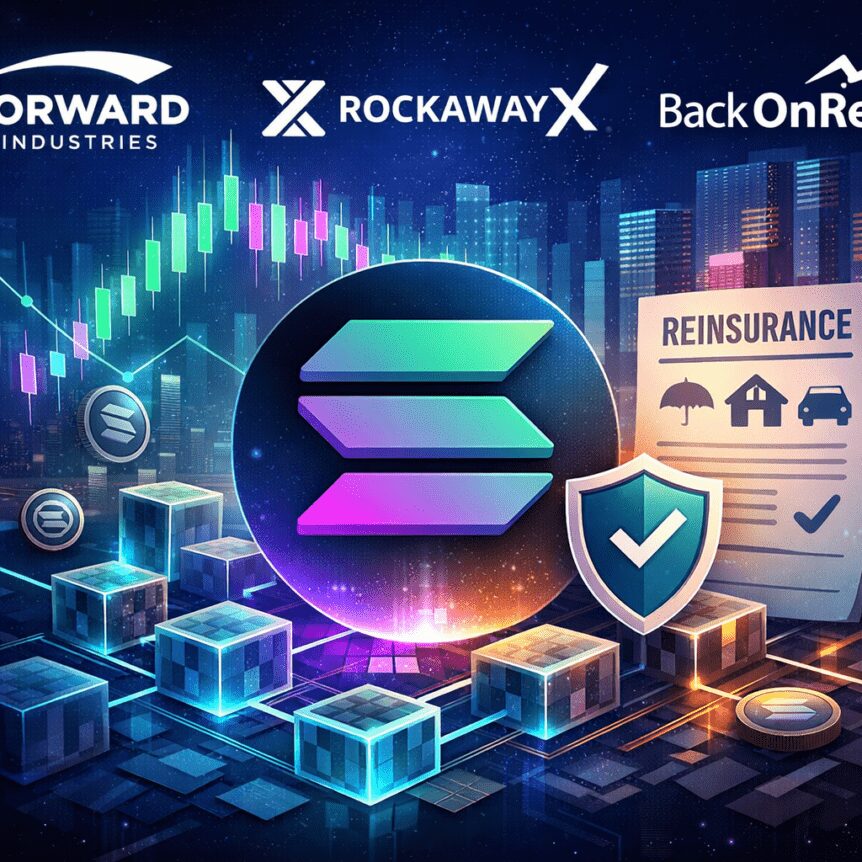
A Solana-based reinsurance venture, OnRe, has closed a $5 million Series A led by Forward Industries and RockawayX to accelerate the deployment of on-chain risk transfer infrastructure. The round is designed to scale OnRe’s platform and bring more institutional participants into blockchain-driven reinsurance, a niche but increasingly visible segment of decentralized finance. In addition to the fresh capital, Forward intends to deploy up to $25 million into OnRe’s yield-bearing token on Solana, signaling a deeper strategic commitment to tokenized risk transfer on the chain.
Forward Industries, which maintains what is described as the largest corporate Solana (SOL) treasury—holding more than 7.01 million SOL—has seen notable moves in traditional markets as well. In Tuesday’s regular trading session, Forward’s Nasdaq-listed shares rose about 5.8% according to Yahoo Finance, though much of that gain faded in after-hours trading. Solana itself traded near $86.61, up roughly 2.7% on the day. CoinGecko tracks Forward’s SOL holdings as a major component of its treasury strategy, underscoring how traditional balance-sheet assets intersect with blockchain ambitions.
Key takeaways
- OnRe raises a $5 million Series A led by Forward Industries and RockawayX, with an option for Forward to invest up to $25 million more into OnRe’s Solana-based yield-bearing token.
- The investment signals growing institutional interest in on-chain reinsurance and tokenized risk transfer, blending traditional risk markets with DeFi rails.
- Global reinsurance is large—well over $600 billion in market value—with total reinsurance premiums around $2 trillion; pilots aim to streamline underwriting, collateral management and claims through blockchain.
- OnRe faces competition and collaboration in a nascent space that includes projects like Re and broader efforts to apply blockchain to insurance value chains, including experiments with tokenized assets and stablecoin payments for premiums.
- Forward’s prominence in SOL and its funding of OnRe highlight a broader theme: established corporate treasuries may increasingly align with blockchain infrastructure and real-world asset tokenization.
OnRe’s funding, strategy and what it aims to change
The Series A funding puts OnRe at the forefront of a small but growing cluster of ventures trying to move reinsurance processes onto blockchain networks. By leveraging tokenization and smart contracts, OnRe aims to automate elements of underwriting and capital flows that have traditionally been managed through manual, paper-driven processes. In practice, the concept envisions insurers transferring portions of risk to tokenized contracts and capital pools that can be tracked in real time across a distributed ledger, potentially reducing conflict between counterparties and accelerating settlement timelines.
Industry observers say the move is less about replacing conventional reinsurers and more about shaving frictions from a market where efficiency gains can unlock new capacity. Reinsurance, often described as the market for insurance of insurance, maintains a sprawling global footprint. But as the sector explores new data, risk modeling, and collateral mechanisms, blockchain pilots are being pitched as a way to improve transparency, reduce operational latency, and align incentives across multiple players—ranging from primary insurers to capital providers and workshops managing collateral requirements.
Solana rails, yield-bearing tokens and the institutional lens
Central to OnRe’s narrative is its plan to back its platform with a yield-bearing token on Solana. While the project has not publicly disclosed the token’s exact mechanics in detail, the arrangement signals a broader trend: the use of blockchain-native tokens to represent risk exposure and to channel yield from insured premia and risk-transfer transactions back to capital providers. For Forward Industries, committing to fund up to $25 million into this token reflects a concrete bet that institutional users can access regulated, on-chain risk alongside real-world risk transfer structures.
The arrangement also positions a dialogue between traditional treasuries and blockchain-native ecosystems at a time when large holders of blockchain assets—especially those tied to major networks like Solana—are increasingly exploring how to deploy their holdings in ways that complement their core business and investment theses. Forward’s substantial SOL position, combined with active participation in a reinsurance project, illustrates how corporate balance sheets could align with tokenized risk markets if the regulatory and operational frameworks prove workable at scale.
Context: where on-chain reinsurance stands in the broader market
Even as pilots proliferate, the on-chain reinsurance space remains in early stages. Industry data points to a market that is undeniably large but complex, with substantial activity still anchored in traditional processes. Fortune Business Insights has estimated the global reinsurance market at more than $600 billion in value, with total reinsurance premiums approaching the $2 trillion level. In this environment, blockchain-based platforms aim to streamline real-time tracking, underwriting and settlement through shared ledgers and automated governance mechanisms. OnRe is among several projects testing these ideas, including Re, a decentralized reinsurance protocol that seeks to connect institutional capital with collateralized risk and offer tokenized yield products to participants.
Beyond pure reinsurance, other efforts illustrate how tokenized assets and blockchain primitives intersect with insurance at large. For instance, industry coverage has noted Aon’s exploration of stablecoins for premium payments, signaling a broader willingness among traditional insurers to experiment with digital assets within the insurance value chain. Tim Fletcher, who runs Aon’s financial services division, has suggested that tokenized assets are likely to become more integrated with conventional financial systems over time. While these experiments hint at a broad shift, participants acknowledge that regulatory clarity and demonstrated scalability remain critical hurdles before widespread adoption can unfold.
As with any frontier technology, the path ahead is not linear. The current momentum around OnRe’s Series A reflects investor appetite for tangible progress—namely, real-world teams drawing on blockchain to address long-standing inefficiencies in risk transfer. Yet observers emphasize that the sector’s evolution will hinge on disciplined product development, clear governance frameworks and the ability to attract durable capital from diverse institutional backers. The interplay between traditional insurers, crypto-native players and regulators will shape how quickly and how broadly real-world risk can migrate onto blockchain rails.
Related developments in the insurance-crypto space, including Dubai’s experiments with crypto wallet integration for premium payments and claims, illustrate a wider industry interest in crypto-enabled insurance mechanics. These efforts, while still emerging, underscore a shared goal: to deliver faster, more transparent and more cost-efficient risk transfer using digital assets and programmable contracts. As the ecosystem matures, investors will be watching whether such pilots translate into scalable products that can withstand the cycle dynamics of both insurance markets and crypto markets.
Cointelegraph is committed to independent reporting, and this article reflects information disclosed by the involved parties and public market data. Readers are encouraged to verify details through official statements and primary sources as the OnRe investment round unfolds.
Forward Industries’ ongoing SOL treasury accumulation and its exposure to blockchain ventures remain a notable signal in a space where traditional corporate treasuries are increasingly exploring strategic bets on decentralized finance and tokenized risk frameworks. As OnRe advances, market participants will be watching not only the platform’s technical development but also how institutional capital, governance policies and regulatory developments intersect to determine whether on-chain reinsurance can move from pilot to scalable market practice.