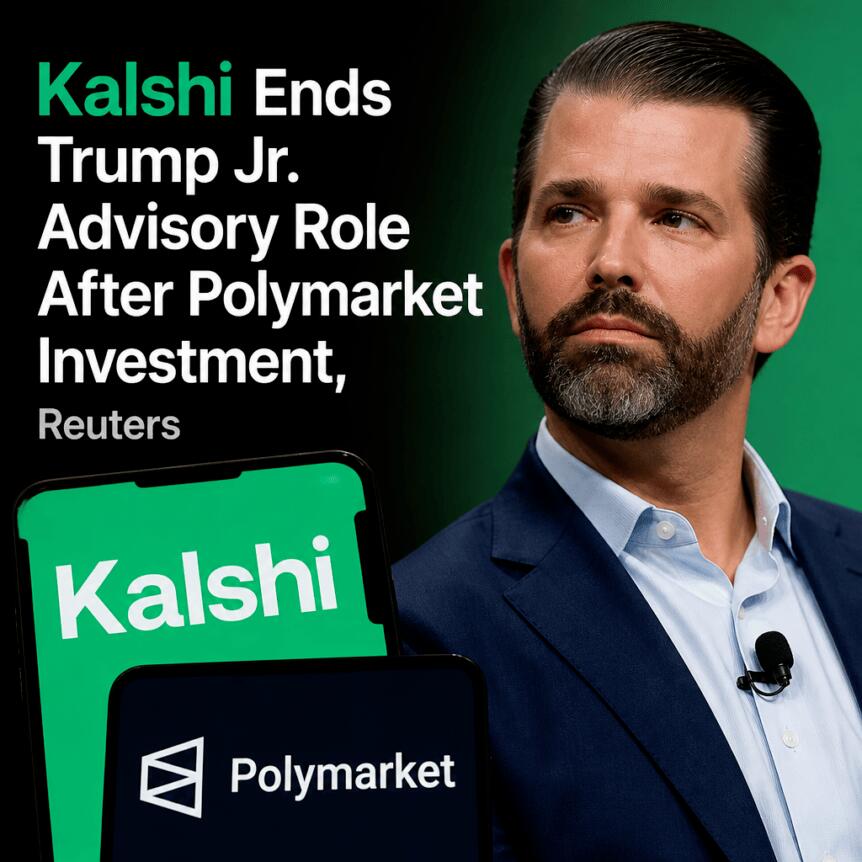
Prediction market operator Kalshi has cut ties with Donald Trump Jr. as a strategic adviser, according to Reuters. The change followed Trump Jr.’s venture capital firm, 1789 Capital, increasing its investment in Polymarket—an industry rival.
Kalshi told Reuters that discussions to end the advisory relationship began in August, after 1789 Capital took the lead in Polymarket’s funding round. The spokesperson said the firm’s “significant investment” in a competitor was the key factor behind the decision.
Key takeaways
- Kalshi ended Donald Trump Jr.’s advisory role, citing his firm’s increased stake in prediction market competitor Polymarket.
- The advisory discussions began in August, after 1789 Capital led Polymarket’s $1 billion funding round.
- Kalshi said political considerations were not involved, while Reuters reports internal concerns about the political environment.
- Trump Jr. joined Kalshi in January 2025, receiving an equity stake reported as worth about $300,000 at the time.
Why Kalshi moved to end the advisory role
Kalshi’s spokesperson told Reuters that the two sides “mutually agreed to end Don’s advisory role” after 1789 Capital made a substantial investment in a competitor in the summer.
In Reuters’ account, the advisory relationship had been in place since January 2025, when Trump Jr. joined Kalshi as a strategic adviser. Reuters notes that the Financial Times reported he received an equity stake worth about $300,000 at the time.
The decision highlights how quickly conflicts of interest can become operational issues in emerging crypto-adjacent sectors. Advisory roles can shape strategy, partnerships, and regulatory narratives; even without any stated allegation of wrongdoing, a major investment in a direct rival can force companies to redraw relationships to protect business focus.
Polymarket funding and the competitor link
Reuters reports that the trigger event was 1789 Capital’s increased investment in Polymarket. Kalshi’s spokesperson said talks started after 1789 Capital “took the lead” on Polymarket’s $1 billion funding round.
According to Reuters, the round would value Polymarket at $21 billion, with 1789 Capital set to contribute about $300 million. By drawing a clear line between the investment and the advisory relationship, Kalshi framed the matter as primarily commercial and governance-related.
For market participants, the practical implication is straightforward: prediction market operators are competing for users, liquidity, and credibility, and large capital commitments can intensify rivalry. Advisory connections—especially involving high-profile figures—can become sensitive when investors hold meaningful positions across competing platforms.
Kalshi’s statement vs. Reuters’ reporting on internal concerns
Kalshi’s spokesperson told Reuters that political considerations played no role in the decision to end Trump Jr.’s advisory role.
However, Reuters also reports that two people familiar with the matter said some individuals within Kalshi had raised concerns about what Democrats’ midterm sweep of both chambers of Congress could mean for the company. The report does not claim that this concern directly drove the final outcome, and Kalshi’s public position remains that politics was not a factor.
This creates a nuanced picture of how companies navigate both compliance and reputation risks. Even if a firm insists the decision is purely about advisory conflicts, internal members may still weigh the regulatory and policy environment—particularly for businesses whose operations can be closely linked to political attention and legislative oversight.
What this change signals for the prediction market sector
Kalshi’s move reflects a broader reality for prediction market platforms: relationships between prominent investors, advisers, and competing marketplaces are increasingly scrutinized. As capital flows into the space and valuations rise, firms may become more deliberate about separating advisory influence from cross-platform financial ties.
For readers watching the sector, two questions now stand out. First, whether other high-profile advisers or investors with interests across multiple platforms will face similar scrutiny. Second, how much policy risk—both legislative and regulatory—will shape internal governance decisions, especially as political control in the U.S. changes.
Kalshi’s next steps may also matter to users and partners: whether the company replaces the advisory function or leaves the role unfilled, and how it communicates governance standards going forward. Until more detail emerges, the most immediate takeaway is that large, visible investments in competitors can rapidly alter strategic relationships.