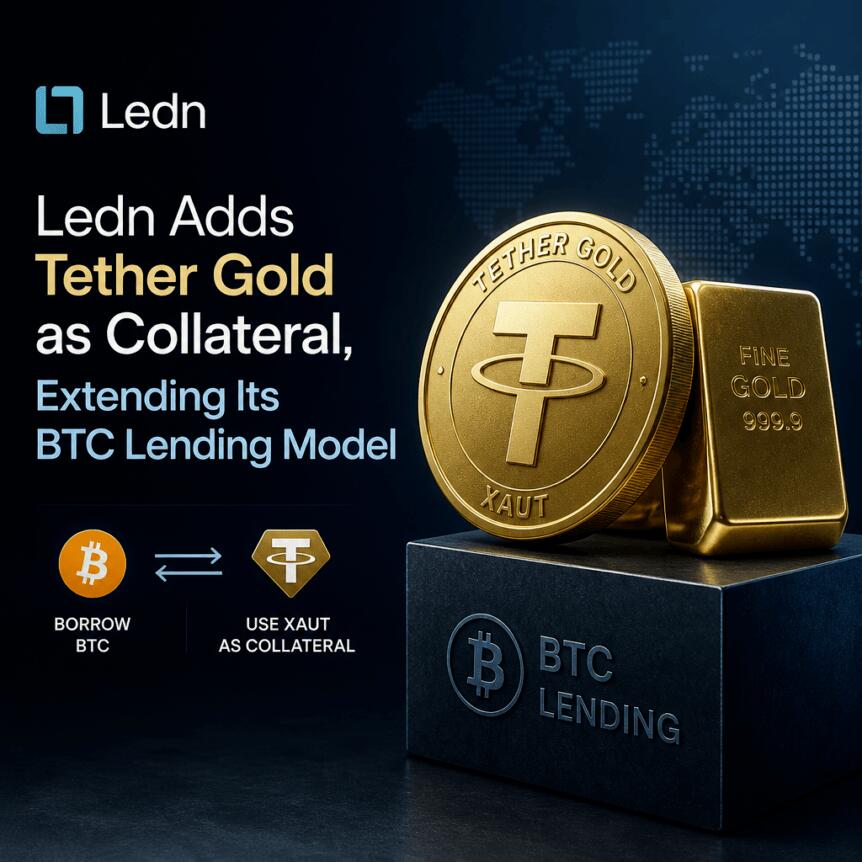
Bitcoin-focused lending platform Ledn is adding support for Tether Gold (XAUt), giving clients a way to pledge tokenized gold as collateral instead of selling their holdings for cash. The move extends Ledn’s collateral-based borrowing model to an asset that more closely tracks the real-world bullion market.
According to Ledn’s announcement on Thursday, clients can use XAUt to secure loans under the firm’s existing structure, where posted collateral is held one-to-one and is not rehypothecated, lent out, or used to generate yield. That design contrasts with lending arrangements where collateral may be reused elsewhere.
Key takeaways
- Ledn is enabling XAUt (tokenized gold) as collateral for loans, expanding beyond its current approach that centers on Bitcoin collateral.
- Collateral is held one-to-one and is not rehypothecated or deployed for yield within Ledn’s model.
- Loans are issued and repaid using Tether stablecoins—USDT or USAt—and borrowers can repay at any time.
- The service rollout is available in most Ledn jurisdictions, but is not offered in Canada or the European Union.
- The addition of tokenized gold reflects a broader shift toward real-world assets (RWAs) inside crypto financial services.
How Ledn’s XAUt collateral model works
Ledn says the new functionality allows clients to borrow against XAUt rather than converting the token into fiat or stablecoin liquidity upfront. That matters for users who want to access cash-like funding while retaining exposure to gold price movements—at least indirectly through the tokenized asset.
As with its existing lending framework, the company notes that collateral is maintained one-to-one. It does not reuse customers’ collateral for additional lending activity or yield strategies, a point that investors often watch for because collateral deployment can affect risk profiles in stressed markets.
The loans themselves are issued and repaid in Tether stablecoins: either USDT or USAt. Ledn also highlighted that borrowers can repay at any time, without scheduled monthly payments tied to a fixed calendar schedule.
USAt is a Tether stablecoin launched in the United States, with the goal of aligning with the GENIUS Act, according to earlier reporting from Cointelegraph. That regulatory-oriented detail is relevant because it connects the product expansion to the broader push for compliant stablecoin rails in major jurisdictions.
Why tokenized gold changes the “borrow without selling” equation
Bitcoin-backed lending has become a mainstream feature of crypto finance, but adding a tokenized commodity introduces a different kind of underlying exposure. Tokenized gold is intended to represent ownership tied to the precious metal, enabling transfers and settlement on-chain while maintaining the commodity link for investors.
Ledn’s decision broadens the range of assets that can be used to access liquidity in a borrowing workflow—something that can reduce the need for a taxable sale in some jurisdictions compared with direct conversion from an appreciating asset into cash. The availability of an alternative collateral type may also appeal to investors who prefer diversification away from purely crypto-native volatility while still using crypto-native credit.
The expansion also aligns with a market environment where gold has been drawing attention. In this year’s rally, gold has pushed to record highs above $5,600 per troy ounce, before later cooling to around $4,300 per ounce, according to figures referenced in the original reporting. Ledn’s product launch positions tokenized gold as a collateral option while bullion remains a focus of investor interest.
Ledn isn’t the first to push RWAs—commodities are a growing slice
The XAUt collateral rollout arrives as commodities and other real-world assets continue to gain visibility within the tokenization sector. A Token Terminal report cited in the earlier coverage suggests tokenized financial assets have surpassed $43 billion, with commodities representing nearly 17% of that total.
Token Terminal’s framing highlights a key difference between tokenized commodity ownership and traditional derivatives. Where commodity futures and derivatives can be structured for exposure without direct ownership, tokenized assets like gold are described as being backed by the underlying asset. In practice, that means token holders are designed to hold representation of the commodity, while benefiting from blockchain-based transfer and trading mechanics.
There’s also a structural reason this matters for crypto credit markets: as more tokenized assets become available in liquid formats, lenders can expand collateral choices beyond a narrow set of native cryptocurrencies. That can potentially attract a wider set of customers—especially those seeking to finance positions without fully exiting exposure to underlying real-world assets.
Where the product is available—and where it isn’t
Ledn says the new XAUt and Tether-stablecoin lending products are rolling out across most jurisdictions where the platform operates. However, it is not currently available in Canada or the European Union.
For market participants, this uneven availability is a reminder that even when tokenized assets are globally issued, lending and custody services still face jurisdiction-by-jurisdiction constraints—often tied to stablecoin compliance, regulatory treatment of collateral, and broader financial services rules.
What to watch next
With XAUt now entering Ledn’s collateral lineup, investors should watch how quickly adoption grows and whether additional jurisdictions follow as Tether stablecoin infrastructure expands. Equally important will be monitoring how tokenized commodity collateral performs during volatility—when investors are most likely to need liquidity while trying to preserve exposure to the underlying asset.