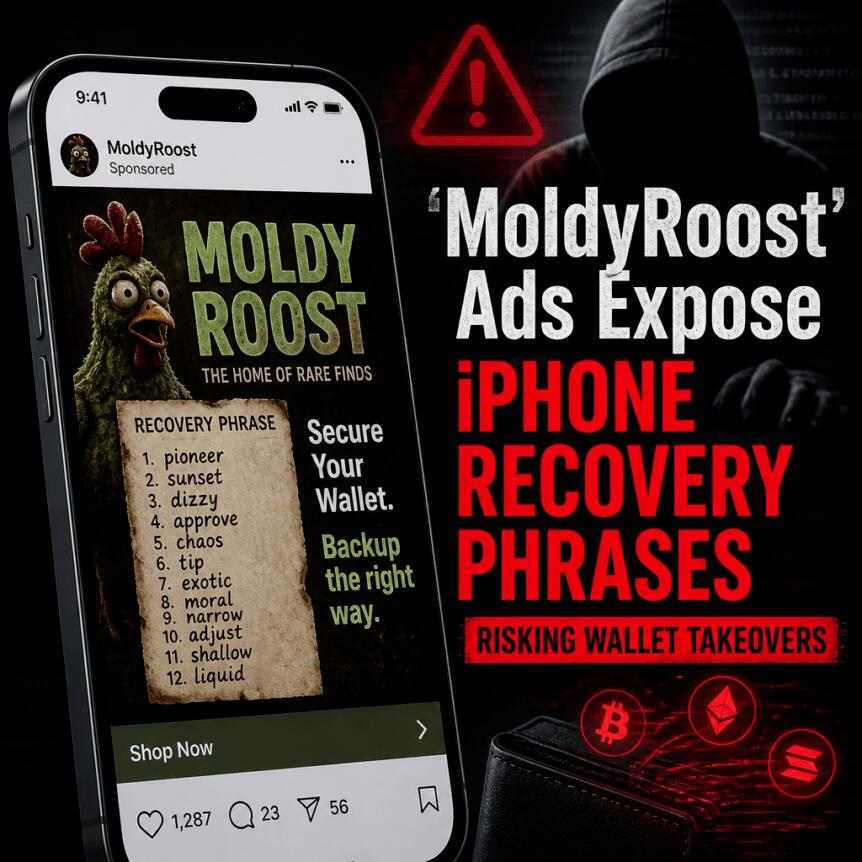
Cybersecurity firm Confiant says hackers are increasingly relying on fake advertisements to deliver malware designed to steal cryptocurrency wallet recovery phrases from vulnerable iPhones. The scheme, which Confiant links to a campaign it calls “MoldyRoost,” appears to have reached users across a wide range of countries and platforms through malvertising rather than direct downloads.
Confiant reports that the campaign connected at least 480 ad domains to its infrastructure between May 12 and Nov. 17. The company warns that even simply loading a MoldyRoost ad’s landing page on a compromised iPhone can be enough to trigger infection—raising the stakes for anyone who clicks or views suspicious ads without verifying their legitimacy.
Key takeaways
- Confiant attributes a large malvertising campaign (“MoldyRoost”) to malware capable of targeting iPhone users via fake ads.
- The campaign is linked to at least 480 ad domains over roughly six months and reached users in more than 47 countries.
- Confiant says infection can occur after merely loading the landing page on a vulnerable iPhone—not only after clicking.
- Google previously reported related activity using the “Coruna” tool to steal seed phrases and read wallet QR codes from stored iPhone data.
- Researchers also flagged a second tool, “DarkSword,” with guidance focused on updating iOS and avoiding seed phrases in Notes, photos, or screenshots.
MoldyRoost: malvertising aimed at crypto recovery phrases
Confiant’s Friday report describes how MoldyRoost spreads through advertisements rather than overtly crypto-themed websites. According to the firm, the attackers linked their operation to large volumes of ad infrastructure—480 ad domains—over the period from May 12 to Nov. 17. Confiant also says the ads targeted users in more than 47 countries.
What makes the campaign particularly concerning is Confiant’s assertion that loading the landing page associated with a MoldyRoost ad on a vulnerable iPhone can be sufficient for infection. In practice, this means users may be exposed even if they do not complete a full sequence of clicks or downloads.
Why iPhone Notes and QR codes are a weak point
Confiant ties MoldyRoost to theft methods that go beyond tricking victims into handing over keys directly. The firm explains that the campaign’s related tooling can search Apple Notes for crypto wallet recovery phrases and extract information from QR codes saved in images.
That matters because recovery phrases (also known as seed phrases) are effectively the “master password” for many self-custody wallets. If an attacker obtains those words, they can often import or reconstruct the wallet on another device and move funds.
Confiant’s findings build on earlier warnings from Google Threat Intelligence. In March, Google reported that attackers used a tool called “Coruna” to target visitors to fake crypto sites and to expose recovery phrases stored on vulnerable iPhones. The newer detail from Confiant is that the attackers expanded distribution by buying ads that led users to their landing pages on non-crypto-related sites—shifting the attack surface from purely fake websites to the ad ecosystem itself.
DarkSword adds another layer of wallet theft risk
Beyond Coruna, Confiant says the MoldyRoost campaign also used “DarkSword,” another tool associated with stealing wallet data. This is consistent with prior reporting and warnings from researchers at Google, who highlighted DarkSword in March.
In a Nov. 6 warning about DarkSword, blockchain security firm CertiK urged iPhone users to update their software and to avoid storing seed phrases in Apple Notes, photos, and screenshots. CertiK also recommended avoiding unfamiliar links and using a hardware wallet for larger holdings.
Taken together, these advisories point to a broader pattern: modern wallet-stealing malware is increasingly designed to harvest sensitive information from routine places where users already store it—such as notes and images—rather than relying solely on social engineering at the moment a person is trying to receive funds or claim rewards.
What this means for users and crypto security habits
For iPhone owners, Confiant’s reporting reinforces several practical risk-reduction steps. First, keeping iOS updated can be critical, since the attacks described are tied to “vulnerable” devices and involve malware execution after ad page loads. Second, storing recovery phrases in places that can be accessed or indexed by malware—like Notes, photos, or screenshots—raises the chance of extraction if a device is compromised.
Third, the malvertising route suggests that “not clicking” may not always be enough if malicious ads can trigger infection through landing-page visits. Users should therefore treat unexpected ads—especially those that look unrelated to the content of the page—as a security prompt, not a form of entertainment.
For people managing crypto accounts, the operational takeaway is to reduce the payoff for attackers. A hardware wallet can help limit damage if a phrase is exposed, and safer backup practices can reduce the likelihood that seed material is harvested from everyday apps and galleries. Even then, the central risk remains: once a seed phrase is in the wrong hands, the attacker can usually act quickly.
As Confiant’s MoldyRoost report circulates, the immediate questions for investors and everyday users are whether ad-targeting campaigns like this continue to expand and how quickly platform and device defenses respond to the underlying iPhone vulnerabilities. The safest near-term move is to keep iOS current and avoid storing recovery phrases in Notes, photos, or screenshots, particularly when interacting with unfamiliar ads.