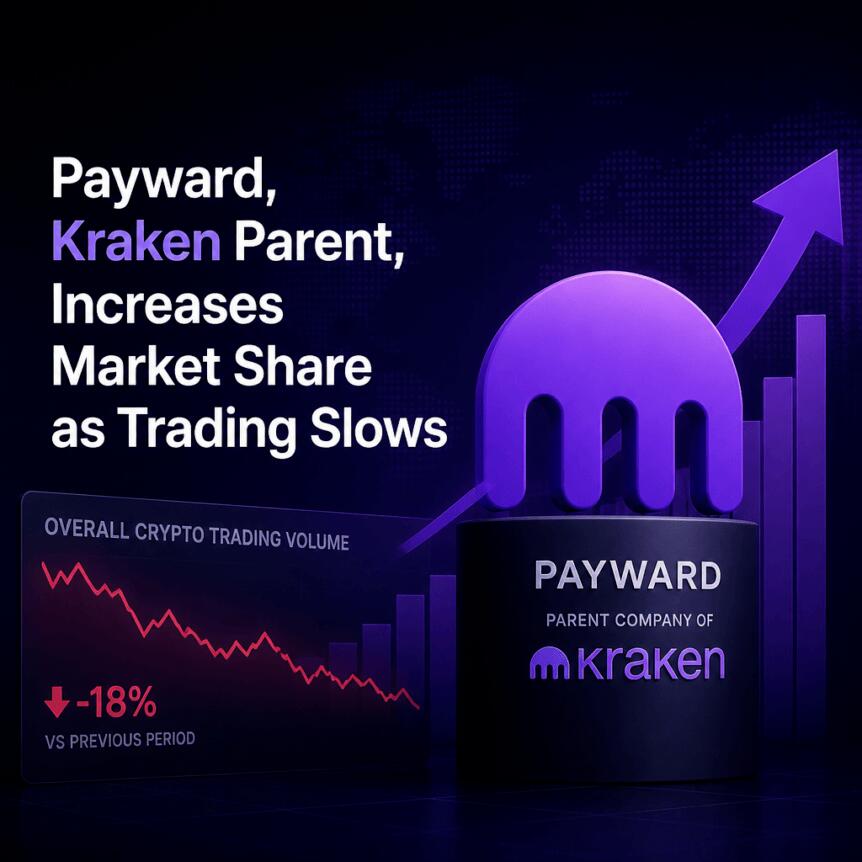
Payward, the parent company of crypto exchange Kraken, reported a sharp drop in earnings for the third quarter, even as its platforms captured a larger share of global spot trading. In September, Payward’s share of worldwide spot trading nearly doubled to 6.5%, up from 3.3% a year earlier, according to financial highlights released Friday.
While the market-share figure points to stronger competitive positioning in spot, the company’s underlying activity remained pressured. Payward said it handled $353 billion in transactions in Q3, down 30% from the same period a year earlier—an important reminder that higher share does not necessarily mean more overall trading across its systems.
Key takeaways
- Payward nearly doubled its global spot trading share in September to 6.5% from 3.3% a year earlier, but Q3 transaction volume fell 30% year-on-year.
- Adjusted EBITDA dropped to $60 million in Q3 from $178.6 million a year earlier, reflecting continued profitability pressure.
- Total platform margin rose to $487 million in Q3 (up 12% from the second quarter) but was lower compared with the prior-year profitability picture.
- A growing portion of margin comes from asset- and access-based services rather than trading alone, including staking-related revenue streams.
- Payward’s recent acquisition strategy has widened the business beyond spot trading, including derivatives and stablecoin payments.
Market share up, volumes down
The company’s September market-share gain is notable, but it measures a different thing than its quarterly transaction volume. Payward said the 6.5% figure reflects its portion of global spot trading across its platforms in September versus the prior year. In contrast, its Q3 transaction volume aggregates activity across multiple product lines—including spot, margin, equities, payments, and certain derivatives—so it can decline even when market share improves.
That distinction matters for investors assessing momentum. A higher share typically indicates relative competitiveness, better product fit, or improved liquidity relative to peers. But when overall market participation is weak, total volumes—and therefore fee-driven results—can still slide.
Earnings slide as profitability remains under strain
Payward’s earnings performance in the third quarter showed clear deterioration compared with a year earlier. Adjusted EBITDA fell to $60 million from $178.6 million, based on Payward’s Q3 results. The company also reported that total platform margin declined 12% to $487 million.
To better reflect how the business is earning income, Payward introduced a platform margin measure this quarter to replace adjusted revenue. The company added a deduction for staking rewards paid to customers as part of that methodology shift. That change underscores how results interpretation may require looking beyond a single headline metric, particularly when staking-related economics affect the way income is reported.
Acquisitions broaden Payward beyond spot
Payward has spent much of the past two years pushing past its core exchange model through acquisitions tied to derivatives, proprietary trading, tokenized assets, and payments. The goal, as the company expands its platform, is to diversify revenue away from transaction fees that tend to move with market activity.
Among the transactions highlighted in the company’s report: Payward acquired futures broker NinjaTrader and proprietary trading firm Breakout in 2025. It later moved into US-regulated derivatives through the acquisition of Bitnomial in May 2026, and expanded stablecoin payments and related card-issuing functionality with its purchase of Reap in July.
Those additions appear to be contributing to a wider mix of business during Q3. Payward said the number of derivatives contracts on which it charges a per-contract fee rose 84% to 66 million. It also reported that margin from subscriptions, trader evaluations, and other paid services increased 59% to $125 million.
Payward noted that Breakout was included for the full quarter after joining in September 2025, while Reap’s stablecoin payments and card-issuing business came from the July acquisition. Even so, the company did not quantify exactly how much either acquisition contributed to Q3 figures.
Third-quarter improvement vs. early-year lows
Despite the year-on-year declines in earnings, Payward’s third-quarter performance improved from the second quarter. Total transaction volume rose 22% quarter-on-quarter, while total platform margin increased 12% to $487 million from $436 million.
Crucially, management said the improvement was not driven purely by spot or general trading volumes. Margin generated from assets customers hold on Payward’s platforms—explicitly including staking-related services—rose 26% to $128 million. Payward said this accounted for roughly half of the $51 million increase in total platform margin during the quarter.
The company’s adjusted EBITDA also improved sequentially, rising to $60 million from $23 million. Payward added that margin relative to total platform margin increased to 12% from 5%. Yet on a year-over-year basis, adjusted EBITDA was still down 66%, pointing to ongoing challenges in profitability even as services play a bigger role.
Payward also highlighted a shift in the composition of its margin. Asset- and access-based services made up 52% of total platform margin in Q3, up from 46% a year earlier. That shift could be strategically important for a potential listing, because services tied to client holdings and platform access can be less directly tied to daily trading intensity than pure exchange fees.
On the public listing front, Payward confidentially filed for a US IPO in November 2025 but paused plans in March as market conditions weakened. By September, the earliest potential listing window under consideration was the second quarter of 2027, according to the company’s disclosures referenced in the results discussion.
Looking ahead, traders and investors should watch whether Payward’s spot market-share gains continue while total transaction volume stabilizes. Just as important will be whether the growing share of margin coming from staking- and access-related services can offset the volatility typically associated with trading-driven revenue.