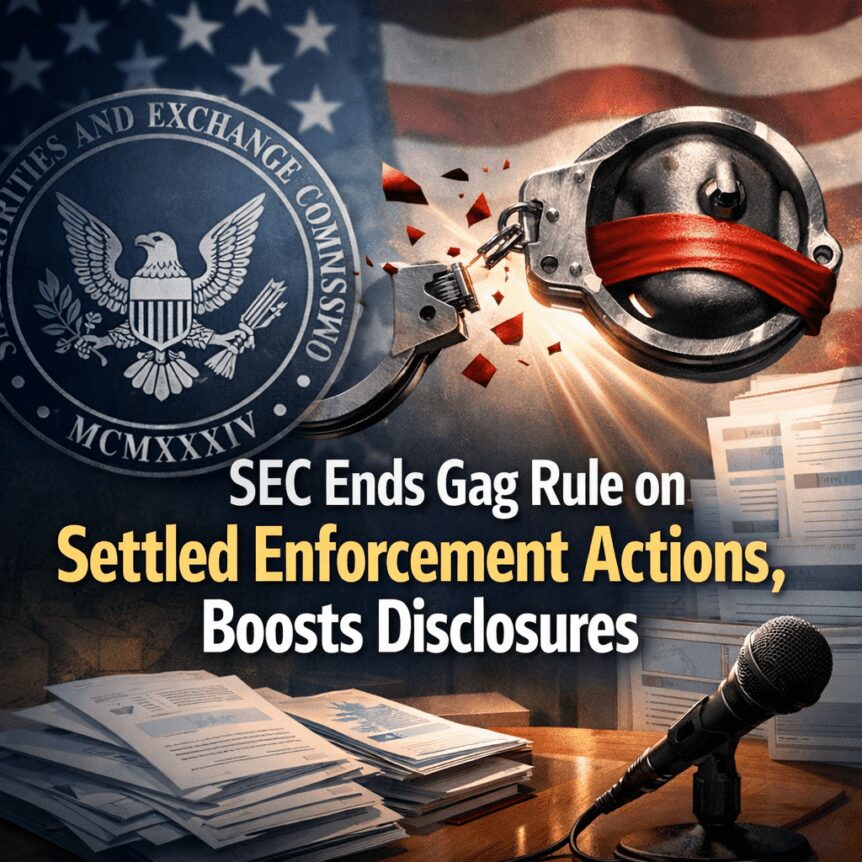
The U.S. Securities and Exchange Commission has rescinded a decades-old rule that barred parties from denying the agency’s allegations in enforcement settlements. The change ends a policy that had persisted since 1972 and signals a shift toward greater flexibility in how the SEC resolves—and potentially discloses—enforcement actions, including those affecting the crypto sector.
The SEC explained in its announcement that the no-deny policy created the impression that the agency was seeking to shield itself from criticism and did not reflect current enforcement practice. By removing the rule, the SEC said it would bring its settlement process in line with the approach used by the bulk of federal agencies, which do not maintain a comparable restriction on settlements.
“For more than 50 years, the Commission has conditioned settlement on a defendant’s promise not to publicly deny the Commission’s allegations. I am pleased that we are rescinding the no-deny policy today. This rescission ends the policy prohibiting such criticism by settling defendants,” SEC Chair Paul Atkins stated. The move follows a period of scrutiny over how crypto cases have been handled and how settlements are framed in public disclosures.
With the policy removed, the SEC indicated it will enjoy “more flexibility in settling enforcement actions.” The agency emphasized that it would not enforce existing no-deny provisions, though it may still require some defendants to admit to facts or liabilities as part of settlements on a case-by-case basis. The White House had been notified earlier in the month of the plan to rescind the rule, with the SEC submitting the rescission plan to the Office of Management and Budget for review.
Commissioner Hester Peirce supported the change in a separate statement, arguing that settlements that impose silence on non-governmental parties do not serve market integrity or investor protection. “Settlements shrouded in forced silence by the non-governmental party do not serve either the markets or the Commission’s investor-protection mission,” Peirce said.
As the policy shift takes effect, several contextual elements stand out for crypto markets and enforcement practices. Notably, the SEC has faced a steady stream of crypto-related actions in the past few years, with industry participants often criticizing the no-deny constraint as constraining legal rights and transparency in settlement disclosures. The agency’s crypto-related enforcement actions reached a high point in 2023, when dozens of actions were brought against crypto firms and settlements yielded hundreds of millions of dollars in penalties.
According to the broader regulatory narrative surrounding the sector, the move aligns with a trend toward more permissive public disclosures in settlements and a rebalancing of enforcement posture. The agency’s decision also unfolds within a wider ecosystem of U.S. policy and international standards, where firms monitor developments such as MiCA in the European Union and ongoing coordination among U.S. agencies on crypto regulation, licensing, and oversight. While the SEC is not adopting a blanket stance on admission or denial in all cases, the rescission invites attention to how settlements will be structured going forward and what information will be publicly reconciled as part of each resolution.
Key takeaways
- The SEC has rescinded its no-deny policy, ending a rule dating back to 1972 that barred defendants from denying allegations in settlements.
- The agency asserts greater flexibility in resolving enforcement actions, with no blanket requirement to deny or admit allegations in settlements.
- The SEC may still require some admissions of facts or liability on a case-by-case basis, signaling continued use of admissions in certain settlements.
- Historical context includes a notable Ripple Labs settlement and a record of crypto-related actions in the early 2020s, highlighting evolving enforcement strategies and industry responses.
<liThe policy change follows external scrutiny of crypto enforcement and comes amid a broader discussion of how settlements are disclosed and perceived by markets.
Policy reversal and its practical implications for the crypto ecosystem
The rescission removes a long-standing constraint on how the SEC communicates settlements and how defendants articulate their positions in public disclosures. In practice, this change could affect the risk calculus for crypto firms negotiating settlements, particularly those that seek to limit public admissions or denials in order to maintain regulatory certainty for investors, partners, and banking relationships.
From a regulatory compliance perspective, the shift has several implications. First, it may alter how settlements are documented and disclosed, influencing due-diligence processes for banks, exchanges, and asset managers that rely on transparent and consistent enforcement histories. Second, the move interacts with ongoing licensing and oversight efforts by U.S. regulators, which increasingly emphasize clarity around liability, permissible conduct, and investor protection standards. Finally, the change dovetails with a global emphasis on clear governance and accountability in crypto markets, including how cross-border enforcement actions are coordinated and disclosed.
Historical context, enforcement strategy, and market impact
Several crypto actions have framed the enforcement landscape in recent years. The SEC’s crypto program has been characterized by a high volume of actions and settlements, with commentators noting the tension between aggressive regulatory posture and the need for transparent, predictable processes. A widely cited case from 2025—though not the only example—was a $50 million settlement with Ripple Labs that drew attention to the scope and terms of settlements in high-profile crypto matters. While the revised policy does not guarantee uniform outcomes across cases, it signals a shift toward more explicit public disclosures and potentially more nuanced settlements in which the government may permit or require admission of facts or liability where appropriate.
Industry observers have also pointed to ongoing debates about how settlements should balance investor protection with market openness. Commissioner Peirce’s remarks underscore concerns that silence in settlements can undermine regulatory integrity and market confidence. The SEC’s broader enforcement posture—particularly in the crypto arena—will likely continue to influence licensing decisions, collaboration with financial institutions, and the integration of crypto services within traditional banking rails.
Existing industry commentary suggests the rule’s removal may help reduce some of the friction encountered by firms negotiating settlements, while also preserving safeguards where admissions of facts or liability are warranted. In the regulatory context, the change may prompt lawmakers, watchdogs, and market participants to reassess how enforcement history is used in ongoing risk assessments, due diligence, and compliance programs.
According to Cointelegraph, the policy reversal reflects a broader shakeout in the approach to crypto enforcement and a recalibration of how settlements are framed for public accountability and investor protection. The move invites closer scrutiny of how the SEC will calibrate consent orders, admissions provisions, and the balance between rapid resolution and transparent disclosure, particularly for firms operating across multiple jurisdictions.
What comes next and how to monitor the trajectory
Key questions remain about how individual settlements will be structured going forward. Regulators will need to articulate when admissions will be required and how much emphasis will be placed on a defendant’s public statements as part of a resolution. Analysts and compliance teams should watch forthcoming enforcement actions and settlement agreements for changes in language, disclosures, and the presence or absence of admissions of facts or liability. Cross-agency coordination and potential impacts on licensing, enforcement priorities, and international cooperation will also merit close attention as market participants adapt to a recalibrated framework for enforcement settlements.
Institutions should reassess their internal policies on settlement disclosures, risk assessment, and communications with investors. The removal of the “gag” element could affect how inquiries from auditors, regulators, and counterparties are addressed, and may influence due-diligence practices in crypto product offerings, custody, and settlement services. As the regulatory landscape evolves, firms would do well to align their internal controls with the updated posture, ensuring that any admissions in settlements are consistent with risk appetite, disclosures, and investor protection standards.
Closing perspective: while the rescission broadens the toolset available in settlements, it also places renewed emphasis on regulatory clarity, lawful conduct, and transparent accountability. Stakeholders should monitor how this shift translates into practical terms for disclosure practices, enforcement outcomes, and the governance standards that underpin crypto market integrity in the United States.