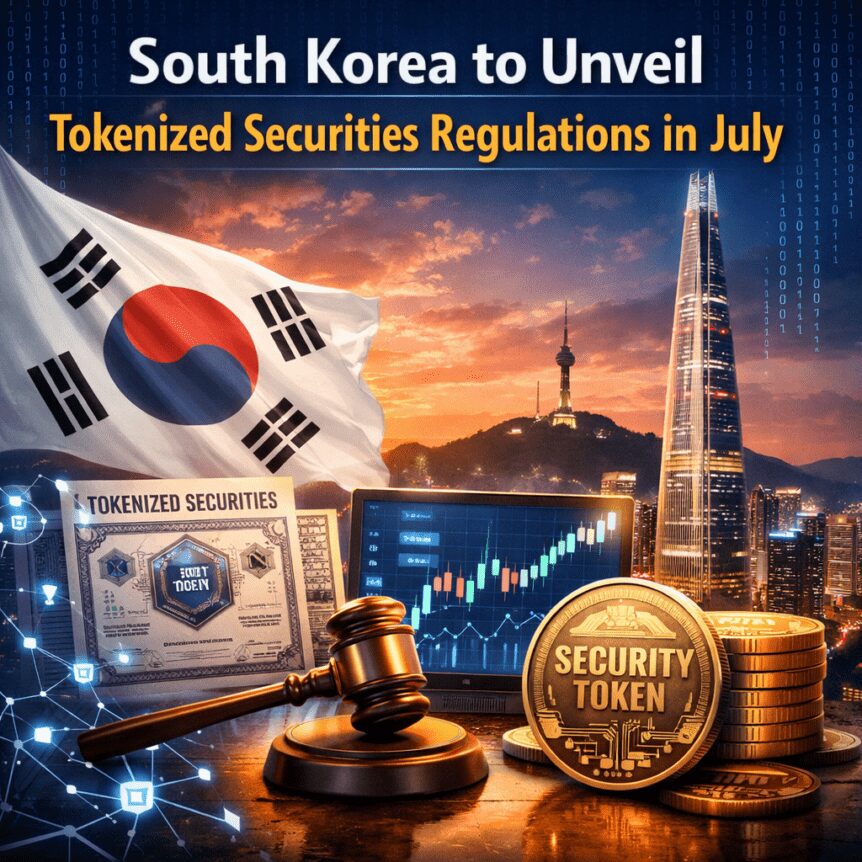
South Korea’s Financial Services Commission (FSC) is accelerating the drafting of a formal framework for tokenized securities, with a detailed rule package slated for release in July as the country choreographs a 2027 transition of blockchain-based securities into its capital markets regime. The measures are expected to outline a roadmap for tokenizing assets such as stocks, bonds and money market funds, and may contemplate adjustments to over-the-counter trading limits as well as the pooling of similar underlying assets through fractional investment products. The FSC disclosed the plan at the second meeting of its public-private tokenized securities council, created in March to design issuance, trading, infrastructure and settlement rules ahead of the framework’s 2027 rollout.
“The goal is to make an announcement in July,” stated FSC Vice Chairman Kwon Dae-young, underscoring that the forthcoming rules will serve the “institutionalization” of tokenized securities. The July package will serve as a critical test of how far South Korea is willing to open regulated capital markets to distributed ledger technology while maintaining existing investor-protection standards.
The announcement comes on the heels of broader developments signaling regulatory readiness and institutional interest in tokenized finance. In a separate public address, Bank of Korea Governor Hyun-Song Shin voiced support for tokenized deposits. The remarks were reported as part of ongoing coverage on the sector’s policy trajectory. In a related move, the Ministry of Economy and Finance announced a pilot project to use tokenized deposits for government operational spending, with a full rollout earmarked for the fourth quarter of 2026.
FSC accelerates tokenized regulation efforts ahead of 2027 rollout
The accelerated rulemaking aligns with the amended Capital Markets Act and Electronic Securities Act, which are scheduled to take full effect on February 4, 2027. When enacted, the reforms will inaugurate South Korea’s first regulated environment for issuing, distributing and trading tokenized securities on distributed-ledger technology. The framework is designed to bring tokenized assets under the FSC’s jurisdiction, transitioning them from an experimental phase into formalized market infrastructure.
In January 2026, the FSC announced amendments to the legislation, establishing a one-year preparatory period for lawmakers and market participants. This timeline places significant emphasis on governance, disclosure, and investor protection as tokenized instruments move from pilots to regulated products. As the regulatory architecture evolves, the government intends to provide clear registries, compliance standards and oversight mechanisms that can accommodate diverse tokenized asset classes while preserving the integrity of traditional capital markets.
For market participants, the transition implicates a broad set of compliance requirements. Banks, securities firms, exchanges and asset managers will need to adapt their risk controls, KYC/AML procedures, and reporting capabilities to a hybrid environment where blockchain-ledgers function as recognized securities registries. The process also raises questions about cross-border recognition, interoperability with EU-style regimes such as MiCA, and the alignment of Korean rules with international standards for custody, settlement finality and asset custodianship.
Policy and market structure implications for participants
Key regulatory levers under consideration include the scope of tokenized trading on regulated venues, the treatment of OTC transactions involving tokenized assets, and the framework governing fractional investment products that pool multiple underlying assets. Officials have signaled a careful balance: regulatory certainty and investor protection must be preserved, even as the market tests the efficiency gains of blockchain-based settlement and programmable asset terms. The contemplated changes could affect a wide range of actors, including conventional securities exchanges, licensed broker-dealers, banks engaging in custody or settlement services, and institutional investors exploring tokenized exposure to baskets of assets.
From a compliance perspective, the regime is expected to emphasize robust AML/KYC controls, clear disclosure obligations, and centralized or delegated supervisory oversight to monitor tokenized issuance, distribution and trading. The design aims to reduce counterparty risk and settlement risk while ensuring that tokenized instruments remain within the protective perimeter of existing securities laws. The broader regulatory posture also matters for cross-border activity, as Korea’s approach will influence financial institutions that operate in Asian and global markets, and could shape discussions with international standard-setters about the treatment of tokenized assets within a harmonized framework.
Government use-cases and public-finance integration
In parallel with private-sector regulation, Seoul is exploring how tokenized assets can support public-finance and government operations. The pilot program announced by the Ministry of Economy and Finance will deploy tokenized deposits to execute government spending, with a full rollout anticipated in late 2026. Bank of Korea Governor Shin’s expressed support for tokenized deposits signals a policy openness to integrating digital-asset rails into public finance and central-bank–fiscal coordination, potentially influencing how future government payments, procurement and cash management are conducted within a regulated, ledger-based infrastructure. While the work remains in pilot form, observers note that tokenized public-finance mechanisms could offer benefits in transparency, traceability and efficiency, provided appropriate risk controls and regulatory guardrails are in place.
This convergence of regulatory reform and public-finance experimentation occurs within a global context of evolving central-bank digital-currency (CBDC) discourse and tokenized-asset regulation. Authorities have emphasized that tokenized securities will be treated as true securities under existing investor-protection regimes, avoiding a treatment that would place them outside the framework governing traditional assets. The Korean path may offer a blueprint for jurisdictions weighing similar transitions, balancing innovation with compliance obligations that are central to institutional trust and market stability.
Related reporting underscores Korea’s broader ambition to test real-world utility for distributed-ledger infrastructure in both financial and fiscal domains. As Korea positions its regime ahead of 2027, the interplay between securities tokenization, custody solutions, and government-led use cases will be a focal point for policymakers, market participants and international observers assessing the maturation of crypto-enabled capital markets.
Regulatory path and international context
The forthcoming regime situates Korea within a growing global wave toward formalizing tokenized assets. While MiCA in the European Union provides a comprehensive framework for crypto-assets and related services within the EU’s single market, Korea’s approach focuses on incorporating tokenized securities into the established capital markets architecture, with explicit recognition of blockchain-ledgers as valid securities registries. This alignment with traditional securities oversight—coupled with a parallel push to harness blockchain-based settlement and issuance—signals a policy stance that prioritizes investor protection and market integrity while gradually expanding the regulatory perimeter to include tokenized instruments.
Industry observers will be watching several regulatory and operational touchpoints: the precise definitions of tokenized securities under the amended acts; the treatment of cross-border trading and custody; the adequacy of AML/KYC controls for tokenized offerings; and the readiness of financial institutions to integrate ledger-based settlement with existing clearing infrastructures. The government’s public-private council remains a key mechanism for ironing out technical standards, interoperability requirements and enforcement expectations as the 2027 milestone approaches.
Closing perspective
South Korea’s tokenized-securities initiative reflects a deliberate policy evolution that prioritizes clear regulatory guardrails while pursuing the efficiencies of distributed-ledger technology. The July rule package and the 2027 implementation timeline establish a concrete roadmap for institutional participants, with implications for licensing, compliance programs, and cross-border cooperation. As government pilots advance and the private sector adapts, the central question will be how seamlessly tokenized assets can be integrated without diluting investor protections or market integrity. Watch for ongoing policy clarifications, interoperability standards, and enforcement guidance as Korea moves from pilots toward a regulated, ledger-based capital markets environment.