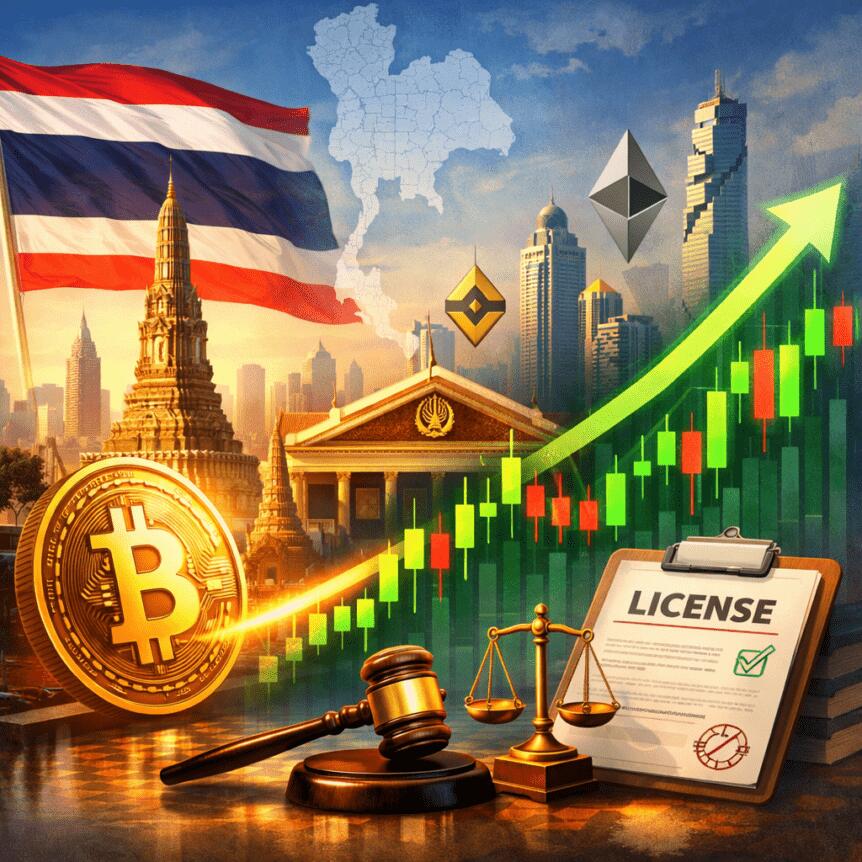
Thailand’s primary securities regulator has opened a public consultation on proposed rule changes that would let licensed digital asset businesses apply directly for derivatives licenses, eliminating the need to set up stand-alone entities. The move would extend the reach of Thailand’s derivatives market by enabling crypto firms to operate within existing corporate structures, while introducing tighter governance measures to manage conflicts of interest and strengthen supervisory oversight. According to Cointelegraph, the proposal signals a deliberate shift toward integrating digital asset activities more fully into the established financial-regulatory framework.
The proposed revisions would build on prior steps that recognize digital assets as eligible underlying assets for futures contracts. If enacted, the changes aim to streamline licensing processes for crypto businesses, reduce entry barriers for participants, and align Thailand’s derivatives market with international standards for transparency, risk management, and market integrity. The regulator emphasizes that this is not a deregulatory move; rather, it couples easier access with enhanced controls to ensure that derivative activities are conducted within a robust regulatory perimeter. The Thai SEC notes that the modifications would apply to exchanges and clearing houses operating within the licensed digital asset ecosystem and would be accompanied by explicit requirements to manage conflicts of interest and ensure appropriate supervision.
The consultation period runs through May 20, and industry participants are expected to provide feedback that will shape the final framework. The Thai SEC’s intention is to broaden hedging and portfolio-management tools available to investors while harmonizing local standards with international best practices. For context, the regulator has previously signaled a reform path aimed at increasing institutional participation in Thailand’s crypto markets while maintaining stringent oversight over product design, trading venues, and clearing operations. According to Cointelegraph, the public-comment phase will be a key input for calibrating licensing thresholds, governance requirements, and the scope of eligible derivatives products.
Key takeaways
- Direct derivatives-licensing pathway: Licensed digital asset firms could apply for derivatives licenses within existing corporate structures, reducing the need for standalone entities.
- Strengthened governance: Provisions would address conflicts of interest and reinforce oversight of exchanges and clearing houses handling crypto derivatives.
- Market expansion with guardrails: The framework aims to broaden hedging and risk-management tools while maintaining international-standard supervision.
- Public input window: Industry feedback is invited through May 20 to shape the final rule set and implementation timeline.
Thailand’s regulatory reform and its practical implications
At the heart of the Thai proposal is a measured effort to balance market access with robust regulatory governance. By allowing crypto firms to operate derivatives activities under existing entities, the framework could lower setup costs, shorten time to market, and reduce operational friction for participants seeking to offer futures and other standardized derivatives backed by digital assets. However, these gains come with reinforced requirements designed to address potential conflicts of interest, ensure fair dealing, and support supervisory capabilities across the trading lifecycle—trading, clearing, and settlement.
From a compliance perspective, the overhaul would necessitate stronger alignment with anti-money laundering (AML) and know-your-customer (KYC) standards, as well as more rigorous arrangements for risk controls, governance disclosures, and supervisory reporting. The Thai SEC’s stance indicates an intent to bring crypto-derivatives activities into a regulated framework that mirrors conventional futures marketplaces, including governance norms for exchanges and clearing houses. For market participants, the changes could translate into clearer licensing paths, standardized product approvals, and more predictable supervisory outcomes—key factors for institutions evaluating risk, capital requirements, and operational due diligence.
As Thailand progresses toward finalizing the rules, observers will watch how the inclusion of digital asset derivatives into the formal regulatory perimeter interacts with cross-border activity. The proposed model underscores the country’s broader objective of integrating crypto-based finance with established financial infrastructure, a trend echoed in regional regulatory dialogues that seek to harmonize standards with international practice while accommodating local market needs. The public comment period will be pivotal in testing these ideas against practical implementation challenges, such as governance disclosures, conflict-management mechanisms, and the calibration of licensing thresholds for diverse market participants. The Thai SEC has linked the reform to a wider goal of delivering reliable hedging tools to investors while preserving market integrity and supervisory control.
Global derivatives expansion and cross-border regulatory dynamics
Thailand’s initiative arrives amid a global wave of crypto-derivatives expansion, alongside heightened regulatory scrutiny in other jurisdictions. In the United States, momentum is building toward regulatory approval of crypto perpetual futures, with officials signaling potential action in the near term. As reported, the Commodity Futures Trading Commission (CFTC) has indicated progress toward enabling crypto perpetual futures, a development that could reshape access to sophisticated derivatives for domestic investors and institutions. The trajectory in the U.S. stands in contrast to, yet complements, Thailand’s efforts to broaden non-US markets’ access to regulated crypto-derivatives products.
Industry participants are positioning for potential regulatory clarity. For example, the recent move by Kraken’s parent company to acquire Bitnomial—an established US-regulated derivatives venue—illustrates strategic intent to broaden access to perpetual futures and other crypto-derivative offerings for U.S. clients, should approvals materialize. Similarly, perpetual futures traded in self-custody or semi-regulated environments elsewhere signal a trend toward more flexible, around-the-clock, multi-asset trading. While many of these products remain inaccessible to U.S. retail investors today, the regulatory landscape abroad continues to mature, potentially informing harmonization efforts and cross-border product design. The industry’s broader narrative emphasizes the need for clear licensing regimes, robust risk-management standards, and enforceable disclosure requirements to support institutional participation and investor protection.
From a policy standpoint, the Thai proposal aligns with ongoing discussions about licensing, supervisory oversight, and the integration of digital-asset activities within traditional financial-market structures. It highlights questions central to MiCA (Markets in Crypto-Assets Regulation) and other cross-border regulatory frameworks: how to classify and regulate crypto-derivatives, how to ensure consistent AML/KYC controls, and how to manage systemic risk as more participants access sophisticated hedging instruments. In this context, the Thai framework could serve as a practical case study for regulators weighing similar moves—balancing market access with the imperative to mitigate conflicts of interest and maintain robust market-surveillance capabilities. As regulators increasingly emphasize licensing clarity and supervisory rigor, Thailand’s approach may influence other jurisdictions considering analogous consolidation of digital-asset activities within existing financial-market license regimes.
According to Cointelegraph, the convergence of licensing reforms, governance safeguards, and international-practice alignment marks a notable point in the global policy landscape for crypto derivatives. The evolving regulatory regime invites jurisdictions to articulate clear product definitions, standardized risk controls, and interoperable reporting frameworks that support both hedging efficiency and investor protection—core considerations for institutions, exchanges, banks, and asset managers navigating cross-border operations and compliance obligations.
Closing perspective
Thailand’s proposed licensing reforms for derivatives involving digital assets signal a deliberate move toward integrating crypto markets with conventional financial infrastructure while emphasizing governance and oversight. As the public consultation unfolds, observers will assess how the final policy balances market access with protection against conflicts of interest and systemic risk, and how it interacts with emerging global norms on crypto-derivatives, licensing, and cross-border supervision.