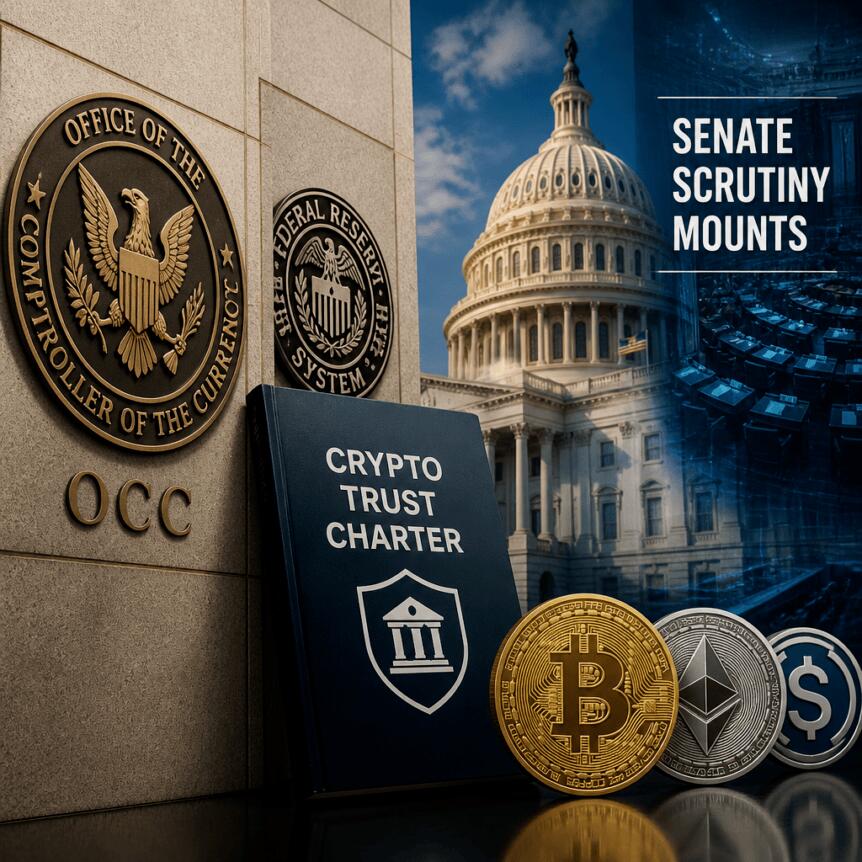
U.S. financial regulators are moving toward a more structured path for certain crypto firms to operate under federal oversight, even as congressional investigators press for deeper documentation on how those approvals were reached. The latest flashpoint combines an Office of the Comptroller of the Currency (OCC) action affecting Coinbase with parallel record requests from Senate committees targeting Binance, Tether, and entities tied to former President Donald Trump’s orbit.
Coinbase said on Nov. 9 that its national trust company received final approval to open. The OCC had previously granted preliminary conditional approval in April, paving the way for Coinbase to operate its custody business within a consistent federal framework.
Key takeaways
- Coinbase’s national trust company cleared an additional regulatory step: it moved from preliminary conditional approval (April) to final approval (Nov. 9), enabling it to open.
- Senate oversight is intensifying alongside regulatory expansion: lawmakers are asking how OCC justified trust-charter approvals under existing authority.
- Requests for internal and external communications are central: investigators want applications, legal analyses, and records of interactions involving OCC officials and the White House or Trump-related parties.
- Parallel subpoenas-or-records pressure is underway: Senate inquiries tied to Binance, Tether, and Trump-linked ventures have deadlines extending into early January 2027.
Coinbase’s trust charter moves from conditional to final
Coinbase’s announcement centers on its national trust company, which the company said has now received final approval to open. According to the company, the OCC’s action provides a consistent federal structure for its custody activities.
The timeline matters for investors and compliance teams watching regulatory clarity. The OCC’s preliminary conditional approval in April signaled that regulators were willing to allow Coinbase to progress under a federal framework, but final approval is what typically allows the firm to operationalize the charter fully. Coinbase’s move therefore represents more than a press release—it indicates that at least one major U.S. crypto operator is advancing from the “approvals-in-progress” stage toward a more stable institutional footing.
For market participants, this kind of progression can influence how other firms plan compliance roadmaps. Trust-charter routes, when available, may offer a more uniform federal supervisory environment than patchwork interpretations across states and regulators—though that does not remove the need to meet other legal and regulatory obligations.
Senators challenge the basis for trust-charter expansion
While Coinbase’s charter path is moving forward, it is drawing scrutiny from lawmakers who question how regulators are using existing authority to broaden crypto companies’ reach through trust charters.
In a May 18 letter to the OCC, Sen. Elizabeth Warren challenged at least nine crypto trust-charter approvals, including Coinbase’s earlier conditional approval. She asked for detailed materials tied to those approvals, including the applications, the legal analyses supporting each decision, and any related communications between OCC officials and the White House or people associated with the Trump family.
Warren’s focus suggests a broader concern that oversight is not merely about whether companies receive permission, but about how the legal reasoning is documented and whether decision-making processes are appropriately insulated from political influence. For readers tracking regulatory risk, the practical implication is that even when firms receive approvals, additional scrutiny could continue—potentially affecting timelines, compliance expectations, or the willingness of regulators to extend similar frameworks to other applicants.
Record demands expand beyond Coinbase
Coinbase’s situation is not the only one drawing attention. Four days before Coinbase announced final approval, Sen. Richard Blumenthal renewed demands for records from Binance, Tether, and two ventures described as Trump-linked.
Blumenthal set a voluntary turn-over deadline of Jan. 4, 2027, warning that his subcommittee could take additional steps if the requests are not satisfied. The structure of the request is significant: the senator is seeking records in advance, with the explicit possibility of escalation if entities do not cooperate.
This matters because it places two timelines in motion at once. Regulators are moving through charter approvals, while congressional investigators are collecting information that could later shape how regulators justify or refine policy. Even absent immediate changes, longer-term oversight can alter expectations around governance, compliance documentation, and the visibility of business relationships.
Why the parallel tracks may matter to compliance and strategy
Taken together, the actions point to an evolving U.S. regulatory landscape where federal permission for crypto firms to expand into regulated roles is increasing—yet the political and oversight environment remains highly active.
For custody-focused businesses, a trust charter can serve as a structural anchor for compliance planning. Coinbase’s message is that the charter provides a consistent framework for custody operations. But congressional inquiries—especially those requesting legal analyses and communications—signal that recordkeeping and transparency will likely remain a high bar, even for firms that successfully navigate regulatory steps.
At the same time, companies that are not yet pursuing (or have not obtained) similar trust-charter pathways may face continued uncertainty about how regulators will interpret authority and how lawmakers will evaluate those decisions. Blumenthal’s and Warren’s letters underscore that investigatory pressure can persist alongside regulatory approvals, raising the likelihood that firms should be prepared to explain not just outcomes, but the processes behind them.
Readers should watch whether the OCC responds with the requested documentation and whether the Senate record demands lead to further enforcement or additional legislative moves. Until that happens, the key uncertainty is how regulators will balance operational expansion with the scrutiny of their reasoning and communications—and how quickly that scrutiny translates into practical changes for other crypto custodians and platforms.