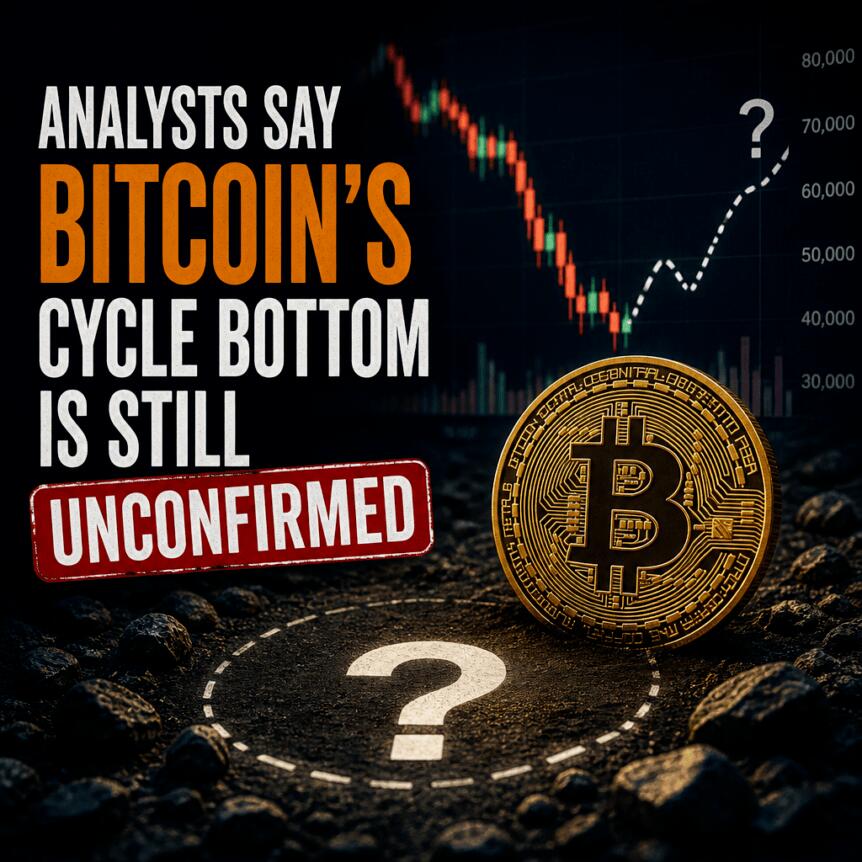
Bitcoin is trading near $64,000 and is still down sharply from its most recent cycle high above $126,000 reached in October 2025. The drawdown is less dramatic than in earlier cycles, but the rally that followed the 2025 post-halving momentum and exchange-traded fund (ETF) inflows has clearly cooled—leaving analysts to debate not only where the market will go next, but what “a cycle bottom” even means in a market increasingly shaped by traditional finance.
As bearish and bullish camps clash, the common thread is that Bitcoin’s current moves are harder to interpret using old playbooks. Several analysts argue that liquidity and macro conditions are still driving outcomes, while others say ETF-linked institutional demand has shifted the dynamics enough that standard cycle signals may not fully reset. Meanwhile, one view increasingly framed the question as an issue of global capital allocation—whether crypto can again attract marginal risk capital versus AI and equities.
Key takeaways
- Bitcoin’s decline from the October 2025 peak has not triggered a clear consensus on whether a durable bottom is already in.
- One camp links downside risk to macro liquidity and expected retests of lower ranges, rather than crypto-native cycle indicators.
- Another camp points to sell-side exhaustion signals and suggests downside may be limited, even if the final bottom remains unconfirmed.
- A structural perspective argues that ETFs and the growing role of derivatives mean Bitcoin may build a broader base rather than print a sharp V-shaped low.
Why bulls and bears disagree on the meaning of “bottom”
In the run-up to the October 2025 high, Bitcoin’s strength was tied to a mix of post-halving momentum and renewed institutional demand, with spot Bitcoin ETF flows playing a prominent role. Since then, price action has turned downward, but the magnitude of the pullback—roughly half from the cycle peak—has been enough to keep both sides engaged.
Standard Chartered and other bullish institutional desks have suggested Bitcoin may have already found a cycle bottom, citing improving long-term capital flows and structural ETF-related demand. In contrast, Galaxy Research argued in June that traditional cycle signals may not have fully reset, meaning investors should not assume the worst is over simply because the market has declined materially.
That tension has become more pronounced because Bitcoin’s trading environment is now different. ETFs increase off-chain participation, macro liquidity affects risk appetite more directly, and the way derivatives markets feed into day-to-day pricing can blur the signals that historically defined cycle turning points.
Downside scenarios: Bitcoin still tied to macro liquidity
On the more cautious end, Russell Thomson, chief investment officer at Hilbert Capital, told Cointelegraph that Bitcoin remains in a downcycle and could break below recent lows before forming what he considers a durable base.
Thomson’s path is explicit: he expects Bitcoin to first revisit the $56,000 to $52,000 area, which corresponds to summer 2024 lows. If that range does not stabilize the market, he pointed to a further extension toward approximately $40,000 to $45,000, which he associates with prior consolidation phases early in 2024.
He also framed timing in terms of the broader cycle rhythm, suggesting a potential low around October 2026, while emphasizing that macro policy changes could move that timeframe earlier. Thomson singled out Fed rate cuts and the potential passage of the CLARITY Act as examples of developments that could bring the bottom forward.
Importantly, his argument is not that Bitcoin is insulated by institutional participation—it is that institutional capital may have increased Bitcoin’s sensitivity to global liquidity. In his characterization, Bitcoin behaves less like a detached, crypto-native asset and more like a “high-beta macro instrument.”
That framing aligns with research coverage from Citibank. Reuters reported on July 1 that Citi cut its 12-month Bitcoin price target to $82,000 from $112,000, citing ETF flows turning negative and broader market dynamics. Reuters also emphasized that the growing integration of Bitcoin into traditional markets may have strengthened correlations with risk assets and macro liquidity rather than reducing volatility.
Late-stage bear market view: exhaustion signals, but confirmation lacking
André Dragosch, head of research (Europe) at Bitwise, offers a middle position: he sees the environment as consistent with a late-stage bear market, where multiple indicators already point to downside exhaustion.
Dragosch told Cointelegraph that sentiment deterioration has reached levels last seen after the collapse of FTX in 2022, a period often associated with seller fatigue. However, he stopped short of declaring that the cycle bottom is definitively in place, saying he does not believe the final bottom has been confirmed—though the market is probably “very close.”
He also cautioned against treating any single indicator as definitive for identifying a cycle bottom, especially as the market structure evolves. With ETFs and institutional participation increasing off-chain trading, Dragosch argued that some historical cycle indicators may be less reliable than they were in prior cycles.
Even with that uncertainty, he suggested that risks may be increasingly limited at current levels. He added that Bitcoin could potentially outperform artificial intelligence equities over the coming months if macro conditions stabilize—an observation that reinforces the broader theme: the next stage may depend less on internal crypto metrics and more on whether the macro backdrop shifts in favor of risk assets.
Galaxy Research’s base-case scenario, referenced in the same discussion, similarly points to the possibility of further downside—projecting a range of roughly $40,000 to $46,000—depending on how liquidity and macro conditions evolve.
Structural shift: derivatives and ETF-era competition complicate cycle calls
Dean Chen, an analyst at Bitunix Exchange, approached the debate from a structural angle. He told Cointelegraph that Bitcoin remains in a downcycle, but that the decline is increasingly defined by global liquidity competition rather than internal crypto market structure.
Chen argued that the approval of US spot Bitcoin ETFs in 2024 created a structural capital base that supports Bitcoin’s valuation range, even if price is still trending downward. In his view, ETFs have made institutional demand more persistent, but they have also placed Bitcoin into direct competition with other major global narratives for incremental liquidity—particularly artificial intelligence and equities.
This is a key distinction. If Bitcoin is competing for marginal capital rather than acting as a self-contained asset within crypto-specific cycles, then “bottom calling” may need to shift. Chen said the more important question is not simply when Bitcoin bottoms, but when crypto once again becomes the most attractive destination for global risk capital.
He further noted that derivatives markets play a larger role in price discovery now than in previous cycles. With funding rates and open interest increasingly influencing short-term volatility, Chen argued that Bitcoin may not print a sharp, single-moment V-shaped bottom. Instead, he suggested it could spend a prolonged period building a structural base.
A cycle that may not fit the old template
Taken together, the competing views highlight a deeper disagreement than just where prices might land. Thomson emphasizes macro-driven downcycle risk and expects additional retests before a durable base. Dragosch points to late-stage bear market characteristics and seller fatigue signals, but stresses that the final bottom still isn’t confirmed. Chen argues that ETF-era structure, derivatives-driven volatility, and competition for liquidity make historical “cycle bottom” frameworks increasingly incomplete.
In this cycle, the dispute appears to be shifting from “what price is the bottom?” to “whether a bottom still behaves like a single, discrete event.”
For investors and traders, the next signals to watch may be less about finding a precise turning-point label and more about whether macro liquidity conditions improve, how ETF-linked flows behave, and whether derivatives positioning stabilizes. Until those forces align, the question of a confirmed bottom is likely to remain open—even if downside exhaustion is already visible in sentiment.