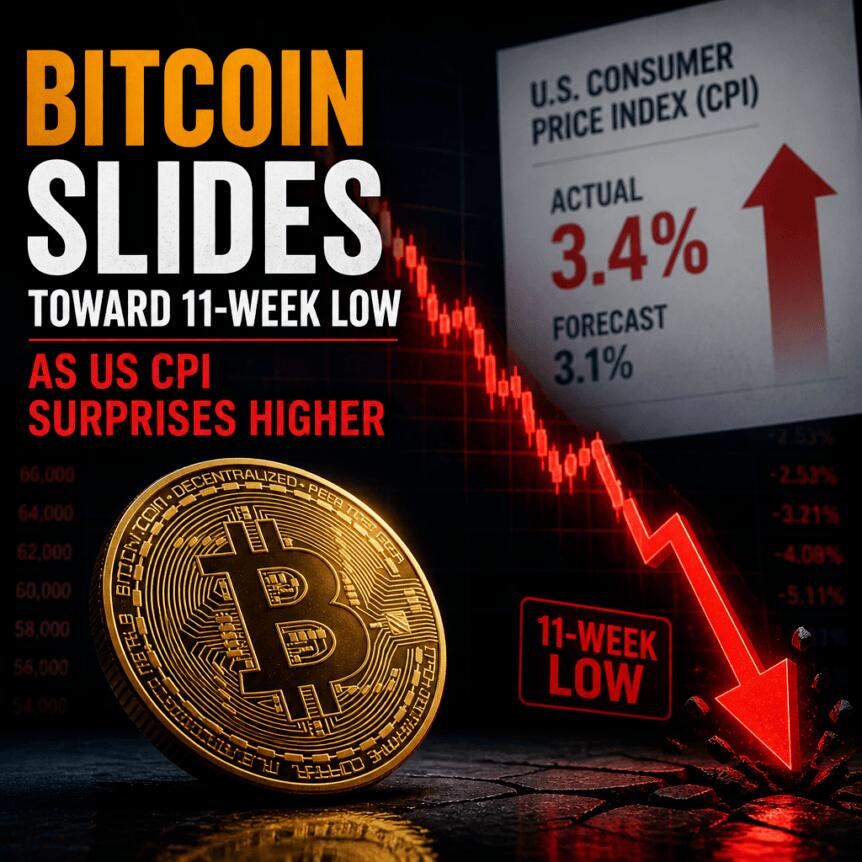
Bitcoin slid toward 11-week lows in early trading on Tuesday after the latest US inflation report landed above expectations, reviving concerns that the Federal Reserve may still need to keep policy restrictive into December.
After dipping to about $73,518—nearly matching Bitcoin’s Sunday low—BTC later recovered to trade back above $74,000, as markets digested both the CPI details and shifting odds for a December interest-rate decision.
Key takeaways
- Bitcoin tested near 11-week lows around $73,518 following a hotter-than-expected October CPI print before rebounding above $74,000.
- October CPI rose 0.4% month-on-month versus expectations of 0.3%, with energy price growth slowing sharply to 0.7% from 5.2% in September.
- Economists pointed to “discouraging” underlying inflation components despite cooling in energy, linking the report to broader core pressures.
- FedWatch odds moved, with a 25-basis-point hike becoming the most likely outcome after the report.
- Equity markets—especially the Nasdaq—showed signs of heavy sell-side pressure, reinforcing risk-off sentiment for crypto.
US CPI surprises higher, pressures Bitcoin near 11-week lows
According to TradingView data cited in the market wrap, BTC/USD fell to $73,518 at the Wall Street open, closely tracking the low it set on Sunday and marking its weakest level since Aug. 21.
The October Consumer Price Index (CPI) rose 0.4% month-on-month, beating the 0.3% expected by markets. While the CPI release notably did not include a year-on-year component—because of missing data collection during the 2025 US government shutdown—the month-on-month figures still pointed to a slower but insufficient cooling trend compared with September.
As detailed in the Bureau of Labor Statistics (BLS) release, the “shelter” component increased by 0.3% in October, accounting for more than 30% of the month’s all-items rise. The food index climbed 0.5%, with food at home up 0.4% and food away from home up 0.5%, according to the BLS.
Energy contributed less this time: the energy index increased 0.7% in October compared with 5.2% in September. Still, economists highlighted that the prior energy shock could continue to bleed into broader inflation trends.
Economist Robin Brooks characterized the CPI outcome as “discouraging,” adding that October coincided with the peak of a second oil-price shock this year—an effect he said is likely to show up in core CPI inflation. Brooks’ comments were published in an analysis on Substack.
Fed expectations turn more hawkish after CPI; December hike probability rises
Bitcoin’s move came alongside a rapid repricing in interest-rate expectations. In remarks earlier on Tuesday, Federal Reserve governor Christopher Waller indicated he favored a 25-basis-point hike in December, even if inflation has cooled relative to September, according to coverage referenced in the report.
CME Group’s FedWatch Tool data showed markets previously priced that outcome, and following the CPI release the odds skewed more hawkish. In the update cited, a 25-basis-point hike attracted 85.3% odds, while a 50-basis-point hike accounted for 14.7%. The remaining distribution implied a low probability for smaller or no hikes at the December meeting.
For crypto, this matters because higher rates generally raise the discount rate applied to future cash flows and can pressure risk assets broadly. Even when inflation cools in headline terms, a market reaction that leans toward further tightening can keep volatility elevated and limit upside follow-through.
Risk assets wobble as Nasdaq sell-off signals turn cautious
US stocks weakened at the Wall Street open, and the tech-heavy Nasdaq Composite reflected the broader shift toward caution. The Nasdaq opened down 0.6% before recovering part of the move, according to the trading snapshot in the report. Meanwhile, Nvidia shares fell nearly 4% amid a board investigation related to whether CEO Jensen Huang was targeted by a foreign intelligence effort—an issue that contributed additional uncertainty to the tech complex.
Trading resource Mosaic Asset Company, in analysis published on Tuesday, pointed to a market environment where inflation remained above target and a strong labor-market backdrop removed concerns about a slowdown. That mix, Mosaic noted, coincided with signs of “extreme” sell-side pressure on the Nasdaq, potentially suggesting the index may be forming a longer-term base.
One of the indicators Mosaic highlighted was the equity put/call ratio, which it said spiked above 1.0—higher even than during the trade-war selloff in April 2025. While such metrics do not guarantee a bottom, they can help explain why investors become more sensitive to macro surprises, including inflation prints.
For Bitcoin, which often trades as a high-beta asset during risk-off episodes, equity stress can quickly translate into weaker demand—especially when bond-market expectations and central-bank pricing shift at the same time.
What traders should watch next
With CPI having reset rate expectations toward a December hike and Nasdaq volatility showing signs of unusual intensity, the key question for Bitcoin is whether price action stabilizes above the recent range lows as markets digest the report—or whether further hawkish repricing extends the risk-off tone. The next developments to monitor are new rate-probability movements from CME FedWatch and follow-through in US equity sentiment in the sessions after the CPI shock.