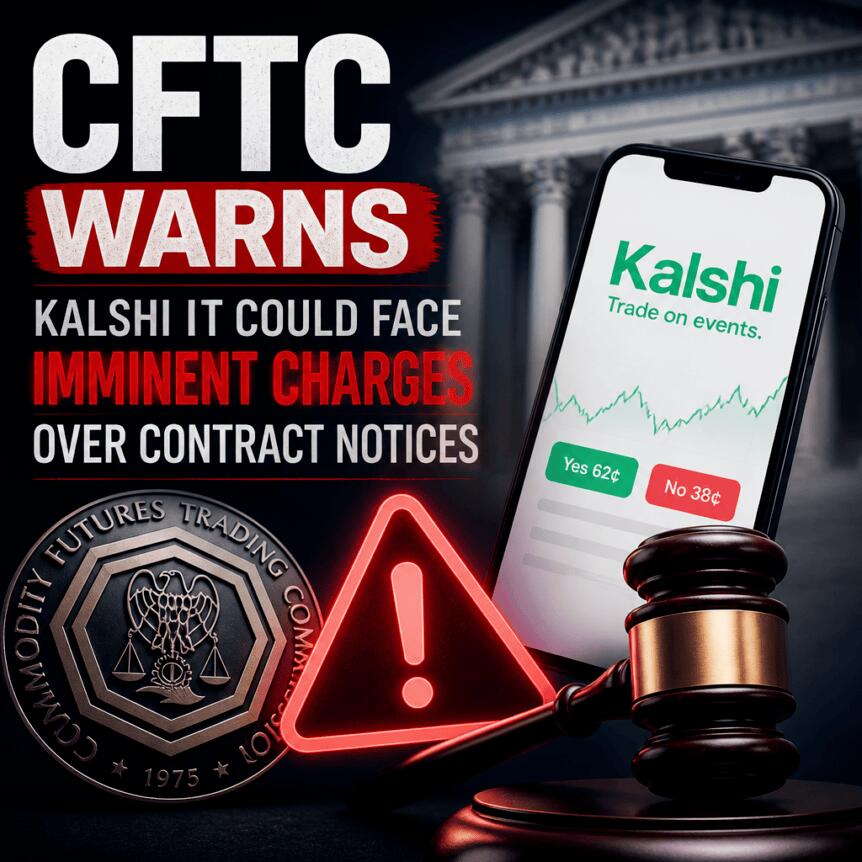
Prediction markets operator Kalshi is facing a potential enforcement move from the US Commodity Futures Trading Commission, according to Politico, which reports that the regulator is preparing charges related to whether the firm properly notified the CFTC when launching certain products.
Politico said the CFTC’s investigation is focused on notification procedures covering dozens of contracts. It also reported that the agency has already sent Kalshi a private notice, a step that can be a precursor to formal action. The probe, the outlet added, has been ongoing for months.
Key takeaways
- Politico reports the CFTC is investigating whether Kalshi followed proper notification requirements for new prediction-market products.
- The probe reportedly involves dozens of contracts, and the matter at issue in Kalshi’s case includes multiple notifications tied to contracts that may never have launched.
- A private notice to Kalshi, as described by Politico, suggests the CFTC may be moving toward charges.
- The potential enforcement risk comes while the CFTC continues pushing for exclusive control over prediction markets.
- Separately, Kalshi is supporting the CFTC in another court fight concerning how stock-linked perpetual futures are treated.
CFTC scrutiny over product notifications
At the center of the report is the question of whether Kalshi sufficiently notified the CFTC before rolling out certain prediction-market contracts. Politico cited a person with direct knowledge of the investigation, stating that the CFTC is scrutinizing notifications that span dozens of products.
According to the same account, the CFTC’s private communication to Kalshi indicates that charges could follow. Politico also reported that the investigation has been underway for months, implying that this is not a last-minute dispute but an extended compliance review.
Kalshi pushed back on the seriousness of the issue, framing it as a limited procedural problem. Speaking to Politico, Kalshi spokesperson Elisabeth Diana described the matter as an error related to submissions for “a handful of contracts,” noting that many of the affected products “never went live.” Kalshi said it is addressing the issue.
Why notification rules matter in prediction markets
In practice, notification and approval processes are often where regulatory oversight becomes tangible for exchanges and market venues. For prediction markets—contracts designed to resolve based on real-world outcomes—the timing of product listings, the way contracts are structured, and the manner in which filings or notices are submitted can determine whether a venue is treated as compliant with applicable futures or derivatives rules.
Even when specific contracts never reach the public, investigators can still examine whether the underlying steps taken before listing met regulatory expectations. That is consistent with Kalshi’s characterization of the issue as procedural rather than operational, but it also underscores a key risk: enforcement actions can hinge on process, not only on whether consumers ultimately traded the product.
For market participants, traders, and counterparties, the main uncertainty is what the CFTC ultimately alleges and what remedies it seeks. A private notice typically signals that the regulator believes there is enough to warrant further proceedings. The scope of the review—reports of dozens of products—also suggests the CFTC may be testing compliance patterns across the broader prediction-market ecosystem.
CFTC’s broader push for authority over Kalshi
The potential charges arrive during a period when the CFTC has been working to establish what it considers its exclusive authority over prediction markets. Politico notes that the agency is pursuing this goal not only through enforcement or compliance scrutiny, but also by challenging efforts by states to regulate Kalshi.
That matters because regulatory fights over jurisdiction can shape how much leeway exchanges believe they have when designing and introducing products. If the CFTC ultimately succeeds in reinforcing its position, prediction-market operators may face tighter constraints on product launches and the documentation tied to those launches. Conversely, if courts limit the agency’s interpretation of its authority, the compliance landscape could change again—potentially altering what “proper notification” requires in practice.
Kalshi’s situation illustrates how these battles can overlap: a venue can be defending itself in court while also preparing for possible enforcement over procedure in parallel. Even where the company says affected contracts never went live, the regulatory process can still lead to formal charges if a regulator concludes that submissions or notices fell short.
Kalshi also supports the CFTC in related futures litigation
Beyond the notification dispute reported by Politico, Kalshi is also involved in a separate legal matter related to the CFTC’s authority over certain derivatives products.
On Monday, Politico reported that Kalshi joined Coinbase and four other firms in seeking permission to submit a brief supporting the CFTC’s treatment of perpetual futures tied to individual US stocks. The development was described alongside coverage from Cointelegraph in a “Related” link included in the original report.
The practical significance for Kalshi is that these two tracks—notification enforcement risk and broader jurisdiction litigation—share a common theme: who has the authority to regulate how derivative-like financial products are structured and governed. In that sense, the current report is not just about a compliance misstep in product submissions, but about the regulatory framework under which Kalshi and similar platforms operate.
For observers, the open question is how the court posture in the stock perpetuals case and the CFTC’s push for exclusive control over prediction markets might influence enforcement decisions. While they are distinct disputes, outcomes could affect how comfortable the CFTC is in asserting broad oversight and how exchanges prepare their compliance systems going forward.
As more details emerge, readers should watch for whether the CFTC converts its private notice into formal charges, how it defines the alleged notification failures, and whether the investigation expands beyond the contracts Kalshi says never went live—especially given the report that similar notifications involving dozens of products are under review.