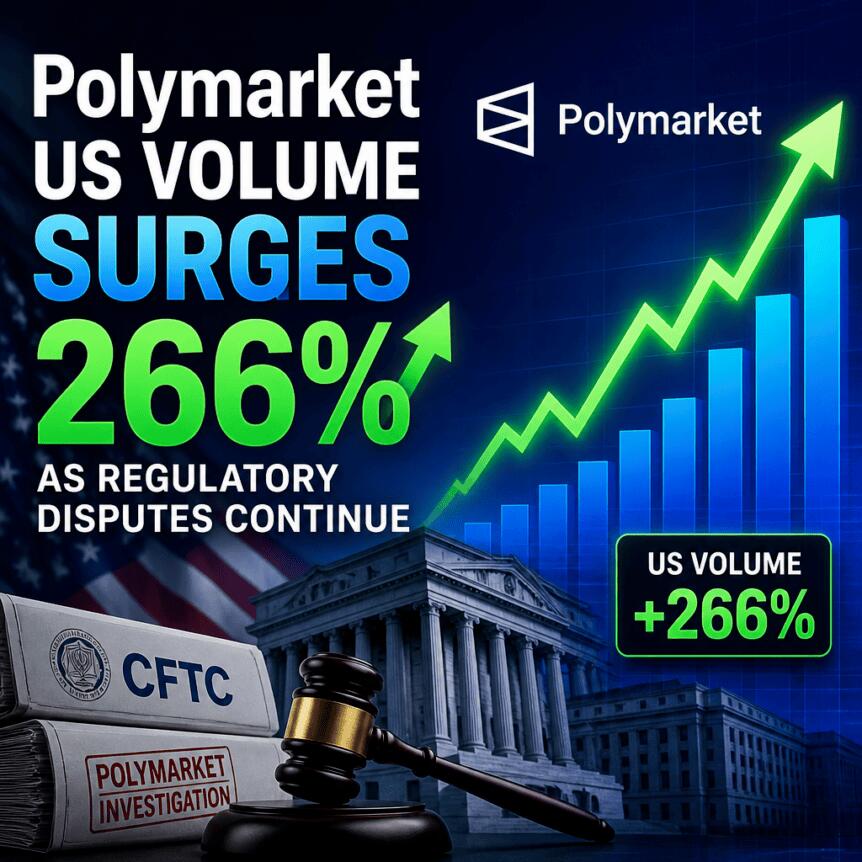
Polymarket’s US-focused trading business has accelerated sharply over the past several months, according to analytics compiled by TickerTracker. Trading volume on Polymarket’s US exchange rose about 266% between June and October, climbing to $14.77 billion from $4.04 billion, as the platform contends with continued state and federal regulatory scrutiny.
In parallel, Polymarket told CNBC that annualized revenue on its US operation has surpassed $1.8 billion, up from more than $1 billion in June. The platform’s category mix in October also highlighted where users were concentrating their bets—especially “combo” contracts, which bundle multiple predictions into a single wager.
Key takeaways
- Polymarket US monthly volume increased to $14.77B in October from $4.04B in June, a roughly 266% jump, per TickerTracker.
- Polymarket said its annualized US revenue exceeded $1.8B, rising from more than $1B reported in June to CNBC.
- Combo contracts dominated October trading with $8.6B in volume (58.2%), followed by sports contracts at $4.57B (31%).
- Sports activity surged during the FIFA World Cup period, with June soccer-volume reaching $1.81B versus $85.4M in May, according to TickerTracker.
- Despite higher November political activity tied to the US midterms, political markets remained a small slice of overall US volume at 2.2%.
US trading volume climbs—led by bundled and sports markets
TickerTracker’s methodology counts trades at the contracts’ full payout value, and its dashboard data shows that Polymarket US kept gaining momentum from early summer through October. Between June and October, the platform’s monthly total expanded from $4.04 billion to $14.77 billion.
October’s volume was concentrated in two main areas. Combo contracts accounted for $8.6 billion in trading volume, representing 58.2% of the month’s total. Sports contracts were the next-largest category at $4.57 billion, or 31%.
That concentration matters because it suggests user behavior is aligning with product design and time horizons that can bundle multiple outcomes—or simply capture high-attention sports moments—rather than broad-based diversification across themes.
Sports catalysts: World Cup trading helped lift June
Part of the growth trajectory can be traced to major sporting events. During the FIFA World Cup (June 11 to July 19), soccer-related contracts generated $1.81 billion in trading volume in June, up from $85.4 million in May, according to TickerTracker.
The World Cup’s impact is visible in the category shifts: sports contracts were later the largest contributor after combo positions in October. In effect, the World Cup provided an early, measurable volume impulse that preceded the broader acceleration seen over the June-to-October window.
For investors and traders watching Polymarket’s ability to sustain engagement, this pattern is a reminder that liquidity can be event-driven, but the key question is whether activity persists beyond headline events—especially amid ongoing regulatory challenges.
Political activity rises around US midterms, but stays marginal
Beyond sports, election-related trading also picked up. According to TickerTracker data cited in the report, election contracts generated $108.2 million in trading volume during the first 10 days of November on Polymarket’s US exchange. That compares with $16.6 million throughout September.
Even with that improvement, political markets remained a relatively small portion of overall demand. The report states that political markets accounted for 2.2% of Polymarket’s November trading volume.
For readers interpreting the figures, the takeaway is that catalysts can move a category quickly without changing the platform’s overall positioning. Sports and bundled contracts still appear to be the primary volume engines in the US market data being cited.
Regulatory pressure persists as Polymarket expands
Polymarket’s growth in the US comes alongside legal and regulatory friction. The platform’s US arm expanded access after the company widened access in May, while states continued to challenge whether federally regulated prediction markets can offer sports contracts without state gambling licenses.
The platform’s path to the US exchange also reflects earlier regulatory history. Polymarket began admitting US traders to the separate exchange in late 2025, after a settlement with the Commodity Futures Trading Commission (CFTC) led it to block US trading on its international platform.
Meanwhile, scrutiny has not eased. Earlier this year, the CFTC was reported to be investigating Polymarket, as covered by Cointelegraph in connection with allegations around promotional activity. Separately, US Senators John Curtis and Adam Schiff called in June for the regulator to examine claims that Polymarket paid social media influencers to promote fabricated trades. Polymarket responded to Cointelegraph by saying it was conducting “a comprehensive audit of active promotional content” to ensure compliance with regulatory and disclosure requirements.
On the state level, New York Attorney General Letitia James sued Polymarket in September, alleging its sports-related event contracts violated state gambling laws. The lawsuit forms part of a broader push by US states aimed at prediction market platforms, including actions connected to Kalshi, over whether such contracts should be handled as commodities or as gambling under state law.
The CFTC has defended its regulatory authority in this area. The agency has also been involved in legal action involving 10 states as it seeks to enforce its view of federal oversight, and the dispute could ultimately require higher-court clarification. In September, New Jersey officials petitioned the US Supreme Court to hear their case against Kalshi, seeking a ruling that could clarify jurisdictional authority for sports-related prediction markets.
Funding and growth signals—while legal questions linger
Alongside the trading numbers, Polymarket is also pursuing capital. A report referenced in the article says the platform is seeking a $1 billion funding round at a reported $21 billion post-money valuation. The piece also states that 1789 Capital, where Donald Trump Jr. is a partner, is reportedly leading the round with an expected contribution of about $300 million, and it links to prior coverage from Cointelegraph about the financing effort.
However, the same regulatory uncertainty that has shaped the platform’s US product rollout also remains central to its longer-term prospects. As states and federal regulators continue to contest which framework applies to sports-related prediction contracts, traders should watch how Polymarket’s access rules, contract availability, and compliance disclosures evolve—especially if court decisions or new enforcement actions narrow what can be offered in the US.
Going forward, the most important signals for Polymarket are likely to be whether its US volume growth remains after major sporting and election cycles, and whether regulatory outcomes clarify jurisdiction for sports contracts. Until those issues settle, performance may continue to be shaped as much by product availability and legal risk as by user demand.