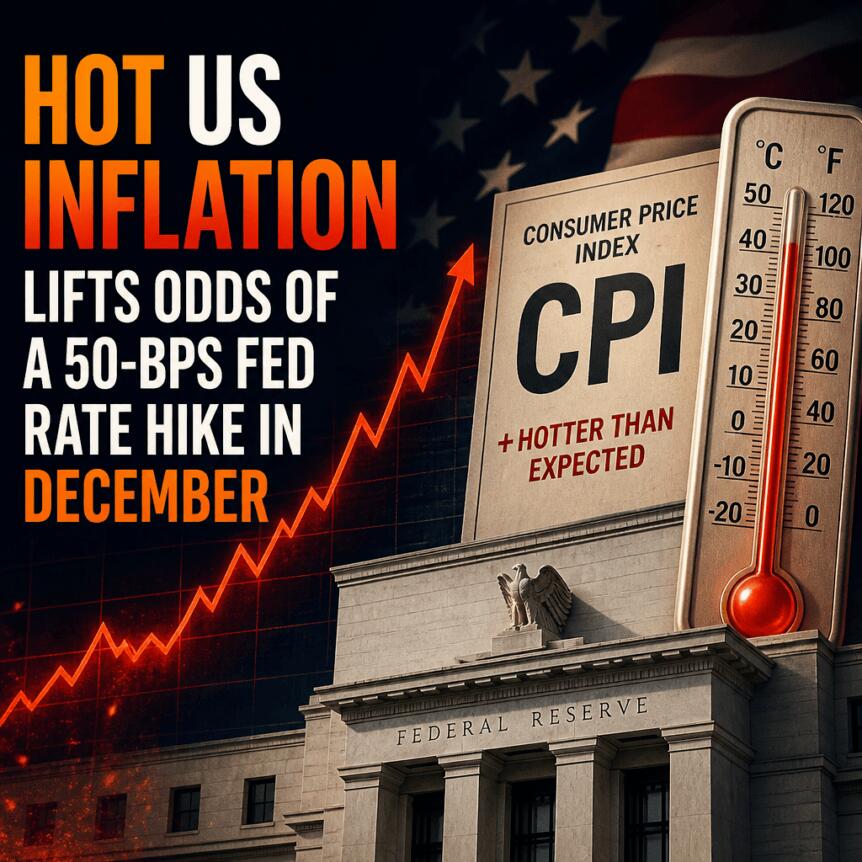
Crypto markets are bracing for the possibility of tighter US monetary policy after a hotter-than-expected inflation print revived expectations that the Federal Reserve could raise rates again in December. The warning comes as investors already weigh how higher borrowing costs tend to ripple through risk assets, including crypto.
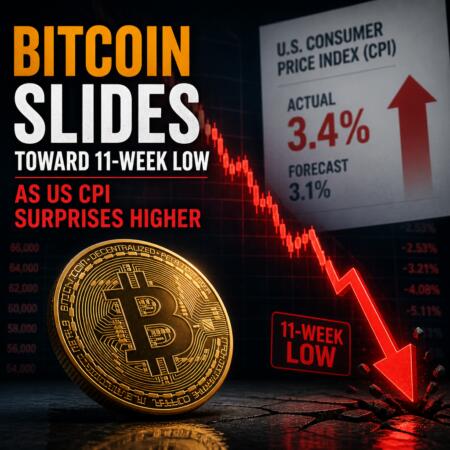
According to the US Bureau of Labor Statistics, the Consumer Price Index (CPI) rose 0.4% month over month in October, beating economists’ forecast of 0.3%—though it was still a slowdown from September’s 0.6% increase. Core CPI, which excludes food and energy, increased 0.3% versus expectations of 0.2%.
Key takeaways
- October CPI came in hotter than expected, with core inflation rising 0.3%—a level Federal Reserve officials have flagged as potentially policy-relevant.
- Federal Reserve Governor Christopher Waller suggested that if core inflation readings stay at or above 0.3%, a 50-basis-point hike could be on the table for December.
- Markets shifted further toward tightening: CME FedWatch showed an 88.3% probability of a quarter-point hike for December and 11.7% for a half-point move.
- Higher rates can pressure crypto through reduced liquidity and weaker “carry” returns for investors using leveraged or borrowed capital.
- The data arrived shortly after the 2026 midterms, adding political pressure to “bring inflation under control,” according to crypto market commentary.
Inflation beats forecasts, re-energizing Fed-hike odds
The inflation release landed with the Federal Reserve already holding its policy rate at 3.75% to 4.00%. After raising rates by a quarter-point in September and leaving them unchanged in October, the Fed now faces fresh signals about whether inflation is cooling fast enough.
The October CPI slowdown versus September offered some comfort, but the core component mattered most for rate expectations. Core inflation rose 0.3% month over month, exceeding forecasts, and that discrepancy appears to have fed directly into the market’s December rate pricing.
Minutes earlier, Fed Governor Christopher Waller had also weighed in from London, noting that another core inflation reading at 0.3% or higher could prompt the Fed to consider a larger move in December. Waller said that in such a scenario, a 50-basis-point hike should be considered and argued that sticking to only a quarter-point increase could damage the Fed’s credibility.
What tighter policy could mean for crypto positioning
Even before the CPI data was digested, traders were already looking toward a December tightening decision. After the report, crypto market participants said the odds were moving in the direction of a more aggressive Fed response.
Jeff Anderson, head of US at crypto trading firm STS Digital, told Cointelegraph that CPI had nudged pricing into the December curve: markets were reportedly valuing roughly 27 basis points of tightening into the next decision. Anderson argued that the possibility of another rate hike is becoming harder to ignore.
CoinShares/Cointelegraph coverage referenced CME FedWatch data as of 16:28 UTC on Tuesday, which showed an 88.3% chance of a quarter-point increase in December and an 11.7% chance of a half-point move. In practical terms for the broader crypto trade, that shift suggests investors are increasingly treating the next Fed meeting as a potential inflection point for liquidity conditions.
The reaction extended beyond expectations: CoinGecko data cited in the report put total crypto market capitalization down 1.6% over the prior 24 hours to $2.57 trillion. Bitcoin traded near $73,274, down 2% over 24 hours, while Ether fell nearly 5% to about $2,028. Solana was also lower, down 5.6% to $82.
Beyond spot price moves, experts highlighted a more structural concern—how higher rates can reduce returns for strategies that rely on borrowed funds. Adam Haeems, head of asset management at Tesseract Group, explained that “carry” strategies earn the spread between what an asset yields and what it costs to borrow, and those spreads can narrow when borrowing becomes more expensive.
Haeems pointed to recent conditions on Aave, noting that the rate paid to USDC lenders on Aave’s main market ranged from about 3.2% to 7% over the past two weeks, while three-month Treasury yields stayed close to 4.2%. If borrowing costs rise while yields do not increase at the same pace, the attractiveness of leveraged crypto exposure can weaken.
Political momentum after midterms may reinforce rate pressure
Inflation arrived not long after the US midterm elections, in which Democrats won control of both the House and Senate. While Congress does not directly set interest rates, market commentary suggested that a political shift could increase pressure for policies aimed at reducing inflation.
Anderson said the election outcome could create growing political pressure from a “blue Congress” to bring inflation under control, potentially reinforcing the case for higher rates. At the same time, he expressed skepticism about whether additional hikes alone would address the deeper causes of inflation.
The report also noted that lawmakers can shape economic policy and influence crypto regulation. One example referenced was the CLARITY Act, designed to create clearer rules for digital assets, which has reportedly been stalled since January due to disagreements between Democrats and Republicans.
For crypto investors, this matters because monetary policy tightening and regulatory uncertainty often interact. Higher borrowing costs can reduce risk appetite, while delayed legislation can leave participants uncertain about compliance direction and the timeline for clearer market rules.
What to watch next
With markets already reflecting a meaningful probability of a half-point hike in December, the next core inflation prints—and any additional Fed messaging—will likely determine whether the tightening outlook stabilizes or intensifies. Investors should also keep an eye on how borrowing rates in DeFi and macro yields evolve relative to one another, since spread compression could directly affect strategies that depend on carry.