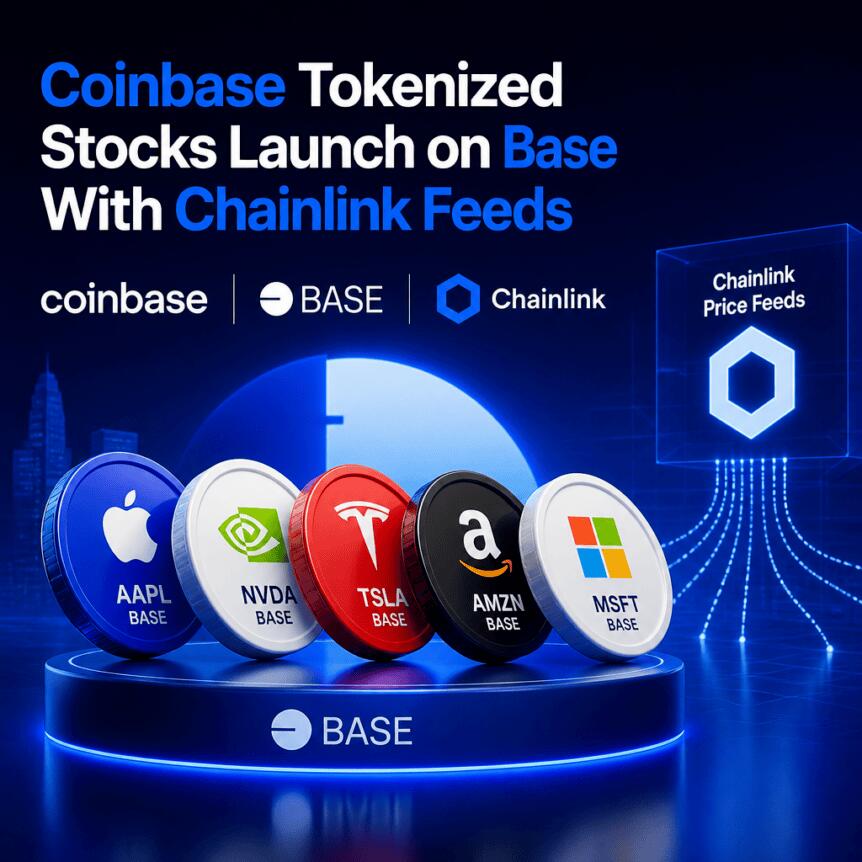
Coinbase has expanded its experiment with tokenized equities by launching tokenized US stocks on Base, bringing additional real-world asset options into Ethereum-compatible DeFi. The rollout also includes an integration with Chainlink Data Feeds designed to supply ongoing price data so decentralized applications can value and use the tokens reliably.
As tokenized stocks continue to attract liquidity and new holders, the Coinbase–Base move underscores a growing push to make regulated, share-backed assets more usable onchain—whether for lending, trading, or structured products.
Key takeaways
- Coinbase’s tokenized US stocks started trading on Base, with Chainlink Data Feeds providing continuous pricing for DeFi integrations.
- The feeds are designed to reflect underlying stock prices while applying a Coinbase multiplier that accounts for dividends and corporate actions.
- Tokens are issued as B20 tokens on Base and are available to non-US users in eligible jurisdictions.
- Each B20 token represents a claim on an underlying share held through a regulated structure involving Alpaca under Abu Dhabi Global Market supervision.
- RWA.xyz data shows tokenized stocks at roughly $2.48 billion in total value, with monthly transfer volume reaching $27.28 billion and holder count above 2.1 million.
Chainlink Data Feeds power onchain pricing for tokenized equities
The tokenized stocks won’t be useful to most DeFi protocols unless they can be priced consistently and updated frequently. That’s the purpose of Chainlink’s Data Feeds for Coinbase tokenized equity products, which the project states will deliver continuous valuation data for the assets.
Chainlink’s documentation describes how the feeds value each token based on the underlying stock price plus a Coinbase-supplied multiplier intended to account for dividends and other corporate actions. The goal is to help DeFi platforms incorporate these assets into critical functions such as collateral valuation, trading, and automated product logic.
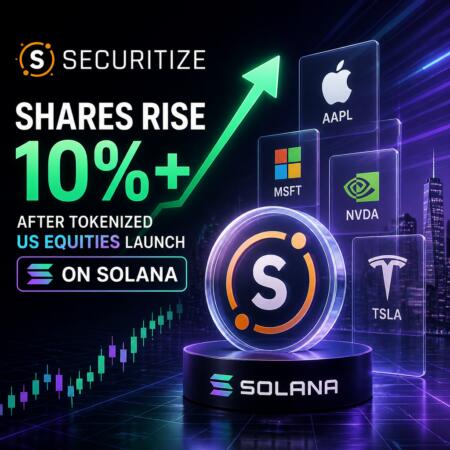
Chainlink Data Feeds are intended to cover major equities including Nvidia, Apple, Meta, and Alphabet. With that price feed layer in place, DeFi applications can more directly treat tokenized stocks as composable assets rather than relying on bespoke pricing approaches for each listing.
How Coinbase’s tokenized stocks are structured on Base
Base says the tokenized stocks are issued as B20 tokens on its network. The tokens are designed for broader accessibility: Base indicates they are available to non-US users in eligible jurisdictions rather than serving as a general product for every market.
Each token represents a direct claim on an underlying share that Base says is held through a regulated broker and custodian relationship. Specifically, the underlying shares are managed via a structure involving Alpaca under supervision overseen by the Abu Dhabi Global Market. Base also notes that users can hold the B20 tokens in self-custody wallets and trade them around the clock.
This matters for DeFi because it shifts tokenized equities from a “closed” issuance model toward an actively tradable onchain representation—something that can support continuous market access and integration with decentralized liquidity venues.
DeFi utility: collateral, trading, and structured use cases
Base positioned the launch around real DeFi integrations, highlighting ways tokenized stocks can be plugged into existing infrastructure. The platform points to lending markets where tokenized shares can serve as collateral, as well as decentralized exchanges where tokenized Apple shares, for example, could be supplied for trading or liquidity strategies.
In practice, this type of integration depends on two things working together: the token’s onchain transfer and custody model, and a reliable pricing feed. The Chainlink Data Feeds component is the technical bridge that allows lending platforms to assess collateral value and helps exchanges manage the token’s market-facing price inputs.
Base also indicated additional Coinbase tokenized stocks are expected to launch on Base in the coming weeks. For users and builders, the key watch item will be whether liquidity deepens as new tickers are added and whether DeFi protocols expand their supported collateral or routing logic beyond the initial listings.
Tokenized equities keep expanding, even as DeFi matures
The Base rollout arrives during continued growth in the tokenized stock sector. According to RWA.xyz data, tokenized stocks have reached about $2.48 billion in total value, up 5.2% over the past 30 days. The same dataset shows monthly transfer volume of $27.28 billion and a holder count surpassing 2.1 million.
Those figures suggest that tokenized equities are not just a niche issuance story—they are accumulating participants and circulation. Yet the practical value of the market is increasingly tied to integration depth: whether tokens can be used as collateral in major lending venues, accessed through decentralized trading, and reliably priced via oracle infrastructure.
The Coinbase and Base launch, backed by Chainlink pricing feeds, targets that integration gap directly. It also signals that the competition for RWA liquidity isn’t only about issuing tokenized shares—it’s about making them operationally compatible with DeFi’s core tooling.
What to monitor next
Readers should watch for how quickly new tokenized stocks roll out on Base, whether major DeFi protocols expand collateral support beyond initial assets, and how liquidity and holder growth respond as more tokenized equities become compatible with onchain pricing and lending workflows.