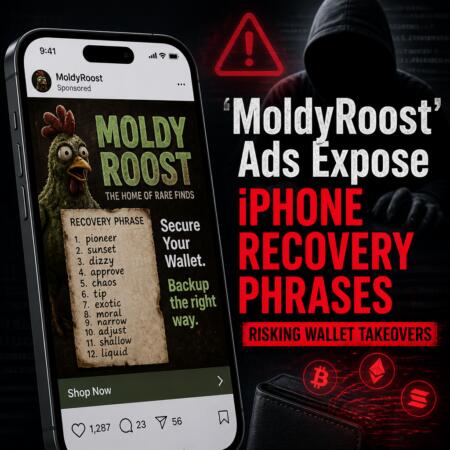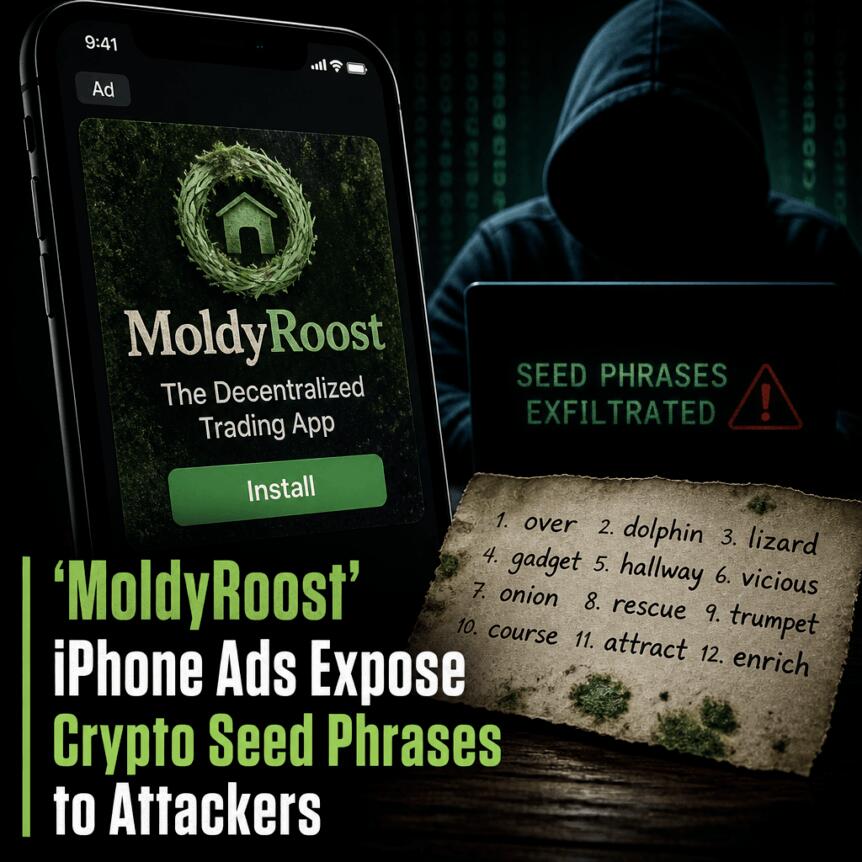
Hackers are increasingly relying on malvertising to reach crypto users—not through obvious scam websites, but by buying ads that deliver malware capable of stealing wallet recovery phrases from vulnerable iPhones. According to cybersecurity firm Confiant, the campaign, dubbed MoldyRoost, has been linked to at least 480 ad domains and has targeted users across more than 47 countries.
Confiant says that on an affected device, even simply loading the landing page of a MoldyRoost advertisement can be enough to trigger infection. Once attackers obtain a wallet’s seed phrase, they can use those words to gain access to the funds from another device.
Key takeaways
- Confiant links the MoldyRoost campaign to at least 480 ad domains used between May 12 and Nov. 17.
- The ads were aimed at iPhone users and reportedly could infect devices just by loading the ad’s landing page.
- Confiant describes tools that can search Apple Notes for seed phrases and read QR codes from saved images.
- The activity targets “recovery phrase” workflows, enabling attackers to move funds after obtaining the words.
- Google and other researchers previously warned about similar wallet-stealing tools, including Coruna and DarkSword.
MoldyRoost: malvertising as a path to seed-phrase theft
Confiant’s report frames MoldyRoost as a straightforward but highly effective malvertising operation: attackers purchase advertising inventory and route victims to malicious landing pages. The firm says that during the observed window—May 12 through Nov. 17—it identified at least 480 ad domains tied to the campaign, with targeting in more than 47 countries.
What makes the campaign particularly dangerous is the reported trigger behavior. Confiant states that on a vulnerable iPhone, merely loading the landing page of an ad associated with MoldyRoost can lead to infection. That shifts the risk profile away from “did the user click?” and toward “did the user view or load the ad content?”
How attackers can turn iPhone data into wallet access
At the center of this threat is the theft of recovery phrases (seed phrases). Confiant says the campaign’s toolset can locate those phrases in common Apple workflows and extract them from user-created content.
The report notes that Coruna—described by Google Threat Intelligence in March as part of crypto-themed credential theft activity—can search Apple Notes for wallet seed phrases and also interpret QR codes embedded in saved images. Google’s earlier coverage highlighted that criminals were using Coruna to target visitors to fake crypto sites, but the pattern of abuse appears to be broader: MoldyRoost used ads to spread similar tooling on sites unrelated to cryptocurrency.
This matters because many users store seed phrases in exactly the places where a tool like Coruna can look. If attackers obtain the seed phrase words, they can use them to access the same wallet on a different device—meaning the victim’s location does not protect them once the recovery material is exposed.
DarkSword adds another route to the same outcome
MoldyRoost did not rely on a single capability. Confiant says the campaign also used DarkSword, another tool aimed at stealing wallet-related data. Google researchers had similarly warned in March about DarkSword, underscoring a broader trend: criminals are chaining multiple tools and delivery methods to harvest the same high-value target—seed and wallet access information.
In a separate warning issued on Nov. 6, blockchain security firm CertiK urged iPhone users to update their software and to avoid keeping seed phrases in Apple Notes, photos, or screenshots. CertiK also recommended avoiding unfamiliar links and using a hardware wallet for larger holdings.
Why this threat changes how users should think about “ad safety”
The MoldyRoost campaign illustrates a persistent problem in digital advertising ecosystems: threat actors can weaponize the distribution layer. Even when users avoid overt scam pages, malvertising can still deliver malicious landing pages through ad networks, and in this case Confiant suggests infection may occur before a user actively clicks away from the page.
It also highlights an asymmetry that investors and builders alike should watch. Users typically focus on phishing links and fake exchanges, but the operational goal here is more specific and more damaging: extracting seed phrases from everyday note-taking and media libraries. That shifts “best practices” from generic scam-avoidance toward concrete hygiene—where recovery phrases are stored, and how devices are kept patched.
For iPhone owners, the practical implications align with the warnings already issued by CertiK: keep iOS updated, be cautious with unexpected links, and avoid placing recovery material in Apple Notes, photos, or screenshots. For larger balances, CertiK’s recommendation to use a hardware wallet reflects the idea that reducing exposure to single-device compromise can materially lower the chance of total loss after the seed phrase is leaked.
As with Coruna and DarkSword, the broader lesson is that these are not isolated hacks. The same seed-phrase theft objectives recur across different tools, and Confiant’s identification of a wide set of ad domains suggests the delivery method can scale quickly—making timely patching and storage practices as important as scam awareness.
Users should monitor security guidance from their device vendors and update iOS promptly, while watching for further research on how widely malvertising campaigns like MoldyRoost are deployed and which iPhone software versions remain most exposed.