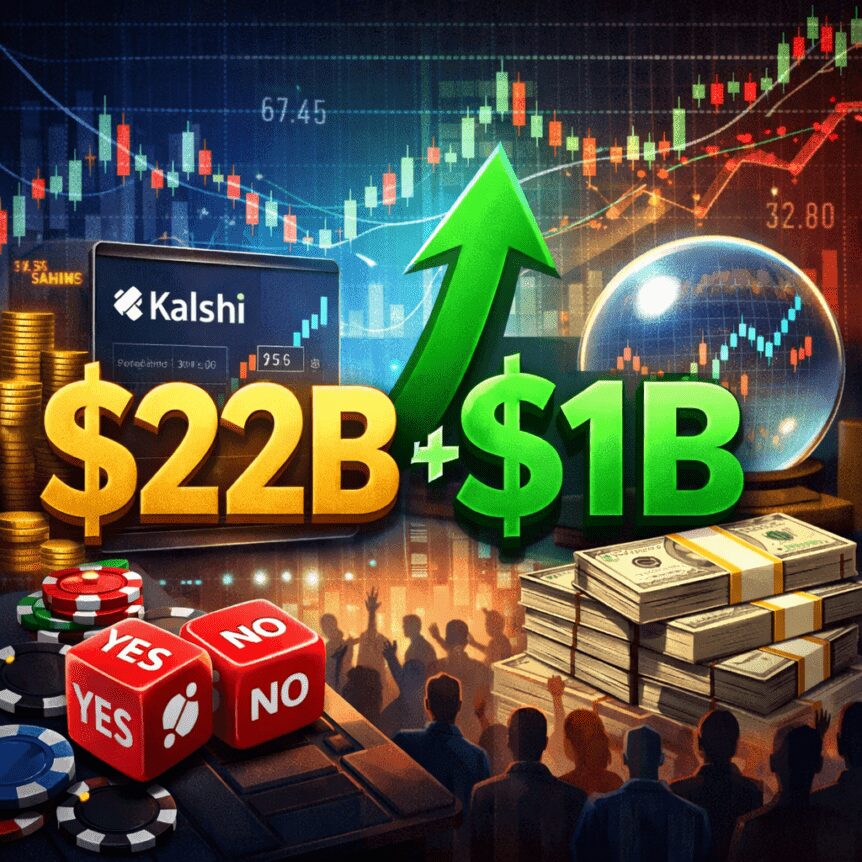
Kalshi, the prediction-market platform, has closed a $1 billion Series F funding round at a $22 billion valuation, led by Coatue Management with participation from Andreessen Horowitz, Sequoia Capital, Morgan Stanley and Ark Invest. The raise more than doubles Kalshi’s valuation in about five months, underscoring a rising appetite among venture investors for prediction markets as retail adoption accelerates.
A Kalshi spokesperson told Bloomberg that the company’s annualized revenue run rate has surpassed $1.5 billion, a milestone investors are watching as the market matures beyond novelty use cases into real-world, scalable finance. The round’s size and backing come as a16z Crypto’s latest fundraising cycle highlighted prediction markets as a key thematic area for institutional capital. For context, a16z Crypto recently raised a multibillion-dollar fund and signaled notable interest in this segment.
Kalshi operates a centralized, federally regulated marketplace that lets users trade on the outcomes of real-world events—ranging from elections and economic data releases to sports. By contrast, Polymarket operates on decentralized blockchain infrastructure. Collectively, Kalshi and Polymarket accounted for the bulk of more than $25 billion in prediction-market trading volume last month, underscoring how the sector has moved into the mainstream of digital finance.
In line with its broader growth plan, Kalshi has pushed deeper into crypto. The company recently appointed John Wang as head of crypto, and Wang told Forbes that Kalshi hopes to have its prediction markets embedded in every large crypto application, signaling a broader strategy to integrate event-based trading into crypto ecosystems.
Regulatory scrutiny and a strategic policy response
Industry observers frame the latest funding as a sign that prediction markets are evolving from retail-oriented entertainment into institutional risk-management tools. Bernstein Research described the space as entering an “institutional era,” driven by demand for bespoke block trades and contract structures designed to hedge macro and geopolitical risk.
However, the regulatory backdrop remains tense in the United States. NPR reports that Kalshi is involved in at least 19 federal lawsuits alleging that some of its event contracts may violate state gambling laws. States including Massachusetts, New Jersey, Arizona, Nevada, Illinois and Connecticut have challenged Kalshi’s operations, arguing that certain sports and event-based contracts amount to unlicensed gambling. Political pressure has also intensified in Washington, with lawmakers calling for tighter oversight amid concerns about “suspicious trades.”
In response to this heightened scrutiny, Kalshi has expanded its policy bench, hiring former Obama adviser Stephanie Cutter as a policy adviser—an addition widely seen as an effort to strengthen ties with policymakers and navigate evolving oversight.
What the market shift means for investors and builders
The momentum behind Kalshi’s funding round and the broader adoption of prediction markets reflect a broader market recalibration. The sector’s move toward institutional-grade products—such as bespoke macro and geopolitical event contracts—could expand the pool of participants beyond retail traders and venture backers to traditional financial institutions seeking hedging tools in volatile environments. The convergence of centralized, regulated platforms with growing crypto integration suggests a hybrid path where compliance and innovation go hand in hand.
For readers tracking the ecosystem, several questions remain pivotal. How quickly regulators will clarify the status of event-based contracts across jurisdictions, and whether other traditional financial players will participate in this space, will shape Kalshi’s path. The crypto push also raises questions about how Kalshi will balance compliance with rapid product expansion across both fiat and crypto rails.
Looking ahead, watchers will evaluate regulatory filings, potential settlements, and the cadence of new product launches that could broaden access to prediction markets. The next set of developments—ranging from policy guidance to potential integrations with major crypto platforms—will help determine whether Kalshi’s ambitious roadmap translates into durable, institution-friendly growth or if regulatory friction slows progress.