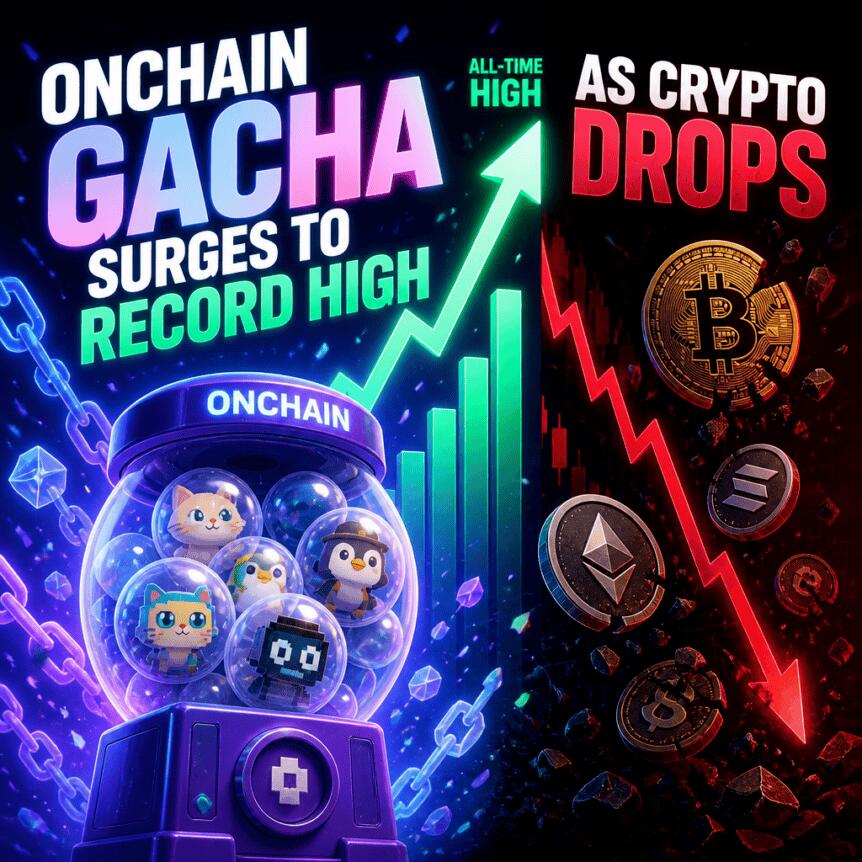
Crypto prices may have been in freefall in June 2026, but a niche corner of the tokenization boom is showing just how resilient consumer demand can be. Bitcoin dropped more than 20% and traded near a 21-month low, while spot Bitcoin exchange-traded funds recorded their worst stretch on record with $4.5 billion in outflows, according to Cointelegraph coverage.
At the same time, Blockworks Research reported that users spent a record $324 million on onchain gacha—an enormous jump from roughly $50 million in the same month a year earlier. The activity underscores how “randomized” collectibles mechanics, now tokenized and accelerated on blockchain rails, are drawing attention even during broader market stress.
Key takeaways
- Onchain gacha spending hit $324 million in June 2026, per Blockworks Research—up sharply from about $50 million a year earlier.
- Tokenized trading cards rely on physical custody and grading assumptions, shifting risk from buyers of cards to users of NFTs.
- Instant buyback and rapid trade cycles mimic gacha/loot-box behavior while compressing the time required to sell offchain.
- Collectors still participate in real-card redemption, including NFT burns that represent claims to physical assets on platforms like Courtyard, based on Dune.
From booster packs to blockchain packs
Gacha traces its roots to Japanese vending machines: pay a fixed amount and receive a randomized item. In traditional trading card games, this typically takes the form of sealed booster packs that contain an unpredictable assortment. The value of the cards inside can vary dramatically based on rarity, condition, print run, and the year of release—creating a market where prices can span from very small amounts to prices that reach the hundreds of thousands of dollars for pristine copies.
Because condition and authenticity matter so much at the high end, grading has become central to how these collectibles trade. Independent graders such as PSA, Beckett, or CGC evaluate attributes like centering, wear on corners and edges, and surface imperfections, then encapsulate the card in a sealed holder (“slab”). Two visually similar cards can command very different prices once graded.
That is the gap blockchain projects aim to bridge. According to the article, platforms such as Collector Crypt and Courtyard tokenize real collectibles by accepting physical cards (often already graded), storing them in vaults, and issuing NFTs tied to specific cards and stated grades. When a user opens a pack, the system delivers a token backed by a corresponding physical asset held in custody. Users can keep the NFT, trade it on marketplaces, sell it back to the platform, or redeem it for the physical card.
The core dependency is straightforward but important: the NFT value depends on whether the vault truly holds the exact card in the claimed condition. That places custodial and integrity risk on platform operators—risk that the article notes is not theoretical, as grading companies themselves report fraud and counterfeits.
What drove the June surge
Tokenized gacha’s rise is unlikely to be explained by one variable. The report points to several converging factors, including strong brand momentum in Pokémon and an onchain infrastructure that makes buying, trading, and verification feel immediate.
On the consumer side, the article cites Circana research saying Pokémon became the most popular toy brand in the U.S. in 2025, generating $2.5 billion in sales—up 87% year over year. It also points to interest from older collectors, not just children, alongside heightened demand for card grading.
That grading demand appears to have spilled into operations. In June, PSA reportedly suspended new submissions across four basic service levels while working through a backlog of nearly 10 million cards, according to the service-level update referenced in the article. Tokenization, in this framing, plugs into a market where collectors want liquidity and frictionless access, but where traditional channels can be slow and expensive.
The article also draws a direct line between tokenized packs and mainstream excitement around trading cards, noting that high-profile buyers such as Logan Paul have helped keep Pokémon in the public spotlight.
The mechanics: speed, buybacks, and speculation
While the collectibles are physical, the market behavior is increasingly shaped by how fast users can cycle positions. A major friction in the traditional offchain trading-card market is liquidity. Selling a card often requires finding a counterparty, confirming authenticity and grade, and arranging shipping.
Onchain tokenized trading cards can reduce that friction by offering built-in pathways for trading. The article specifically describes an “instant buyback” mechanism: many platforms allow users to sell packs/cards back shortly after opening—so if the outcome disappoints, users can cash out quickly (for example, at a discount such as 85% of value in the article’s description) and open another pack. If the card is desirable, users can list it or hold it.
This creates a “gacha loop” that compresses what can take weeks offchain into minutes or seconds onchain. The article compares the effect to loot boxes in video games—where users pay for randomized outcomes and the appeal often includes the dopamine and uncertainty around rare pulls.
There are regulatory implications in the background. The article notes that some jurisdictions have tried to bring loot boxes under gambling frameworks. Whether tokenized TCG mechanics fall into similar categories could depend on how large the sector becomes and how platforms structure odds, marketing, and redemption terms. For now, the key operational difference highlighted is tempo: the same gacha logic plays out faster in the onchain environment.
Collectors haven’t disappeared—redemption still exists
Despite the gambling-like loop, tokenized trading cards also serve a less flashy purpose: enabling real collectors to hold and redeem physical assets. According to Dune data cited in the article, users burn 5% to 8% of NFTs issued on Courtyard each week, with each burn representing a claim to a physical card.
Collector Crypt’s head of marketing, Dakota Campbell, is cited as saying that around 30% of its users eventually redeem a card. He also claims that many users choose to hold rather than constantly flip, often beyond the 72-hour buyback window described in the article.
Campbell further reports that, in the prior 30 days referenced in the piece, 5,400 assets were shipped to 634 unique users with a total insured value of $3.29 million. That detail matters because it anchors the story in actual custody and logistics, not only trading behavior.
Why this matters beyond one record month
Blockchain startups are essentially taking an established collectibles playbook—tokenizing and routing demand through faster rails. But the sustainability of onchain gacha is an open question. The article emphasizes that inflows can reverse quickly, since the gacha loop runs in both directions and user engagement can be sensitive to broader sentiment.
For readers and market participants, the key thing to watch next is whether platforms can maintain trust and real-world custody at scale—especially as counterfeit risk and consumer protection concerns remain persistent themes in graded-card markets—while also building durable collector communities that go beyond short-term speculation.