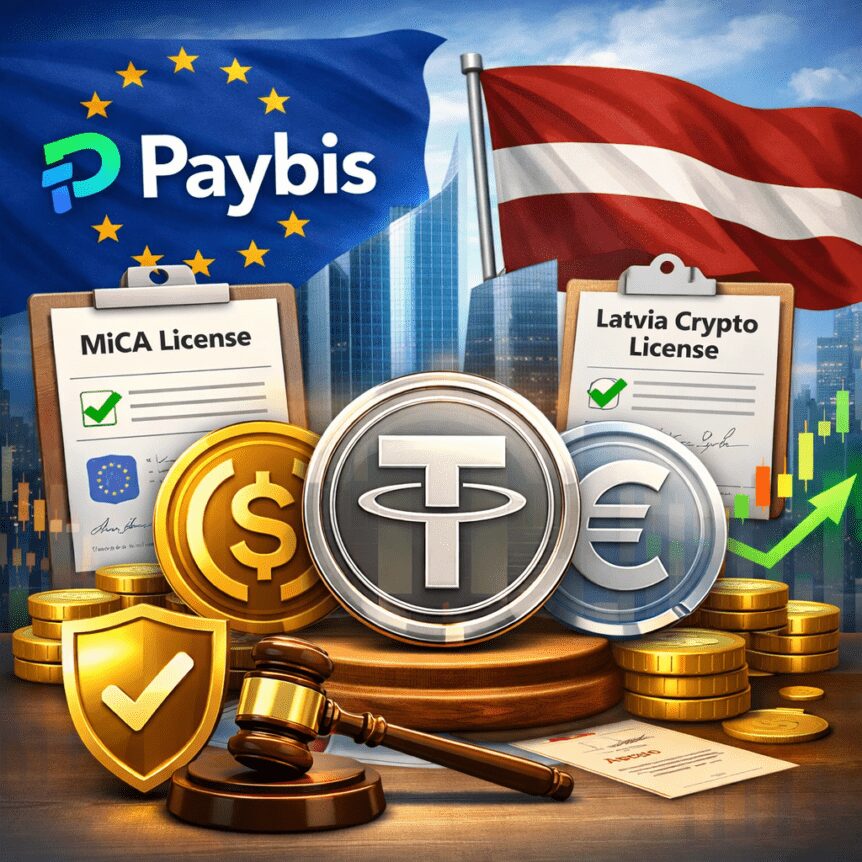
Latvia-based cryptocurrency platform Paybis has been granted two licenes by Latvijas Banka, expanding its EU-regulated footprint under the European Union’s Markets in Crypto-Assets Regulation (MiCA) and the Payment Services Directive 2 (PSD2). The licences, issued on May 12 to SIA Paybis Europe—the company’s EU entity—mark a notable milestone in Latvia’s bid to host MiCA-compliant crypto businesses, according to an announcement from the central bank. Latvijas Banka noted that Paybis is the third Latvian firm to receive a MiCA crypto-asset service provider (CASP) licence.
The MiCA licence encompasses custody and administration of crypto assets on behalf of clients, the exchange of crypto-assets for funds or other crypto assets, the execution of orders, transfer services, and crypto asset advisory services, Latvijas Banka stated. The PSD2 payment institution licence, meanwhile, enables Paybis’s EU entity to execute payments and transfers to payment accounts.
Paybis CEO and co-founder Innokenty Isers described the dual licensing as enabling a broad, future-focused offering, including collaboration with stablecoins.
Related: MiCA has made euro stablecoins safe but weak, new report argues
Paybis eyes B2B crypto infrastructure push
Konstantins Vasilenko, Paybis’s co-founder and chief business development officer, told Cointelegraph that the company is pursuing a white-label crypto infrastructure stack aimed at business clients. The proposed stack would cover on/off-ramps, buy/sell/swap functions, payment acceptance, and stablecoin payouts, all delivered through a single API. The goal is to enable non-crypto firms to offer crypto services to their own customers without having to establish their own regulated framework from scratch.
“This is where the combination of MiCA CASP authorisation and PSD2 PI licensing is particularly important, because it allows us to connect crypto asset services with regulated payment rails,” he said.
Paybis, founded in 2014, currently supports 90 cryptocurrencies and serves roughly seven million users across 180 countries. The company also holds money services business licences in the United States and Canada, highlighting its cross-border regulatory posture as it pursues deeper EU integration.
Related: MiCA-licensed Banking Circle joins bank stablecoin settlement race in Europe
EU regulatory backdrop: MiCA evolution and cross-border oversight
The licensing news arrives as EU policy makers and industry participants consider how MiCA should evolve as the market matures. In April, a European Commission adviser suggested MiCA regulation is likely to evolve over time, with the Commission planning a public consultation to determine whether the rules are functioning as intended for market participants. Speaking at Paris Blockchain Week 2026, Peter Kerstens stated that it would be “rather unusual” if there were no “MiCA 2” at some point, noting that EU financial legislation typically develops in stages.
The dialogue around MiCA 2 has coincided with ongoing industry scrutiny and debate. Stablecoin issuer Circle has pushed back on euro stablecoin thresholds, and policymakers continue to debate whether oversight of major crypto firms should be centralized under the European Securities and Markets Authority (ESMA). These discussions underscore the tension between advancing a unified European regulatory framework and addressing concerns about competitiveness, innovation, and cross-border compliance.
From a practical standpoint, the Latvia licensing milestone illustrates how a MiCA-approved CASP and PSD2-compliant payment institution can be combined to deliver regulated, cross-border crypto services. For Paybis, the integration of regulated payment rails with crypto-asset services could streamline onboarding for institutions seeking to offer crypto products to their client bases without bearing the full burden of building a compliant infrastructure from scratch. For policymakers, the development signals both the effectiveness of MiCA’s licensing regime in attracting compliant players and the need for ongoing assessment of how the rules map onto evolving payment and settlement ecosystems.
As the EU contemplates MiCA 2 and related supervisory paradigms, the Paybis milestone raises questions about licensing timelines, international interoperability, and the degree to which national regulators can harmonize with centralized EU oversight. Financial institutions and crypto firms monitoring these trajectories should consider not only the immediate regulatory approvals but also the implications for licensing pipelines, cross-border operations, and the bank-crypto nexus as stablecoins and other digital assets move closer to mainstream payment rails.
Looking ahead, the Latvian licensing development exemplifies a broader EU trend toward harmonized, regulated crypto infrastructure that can accommodate institutional clients while preserving safeguards around payments, custody, and asset transfers. The continued evolution of MiCA, including any prospective enhancements under MiCA 2, will shape how firms design cross-border products and coordinate with traditional financial rails, with significant implications for licensing strategies, regulatory compliance, and market structure in Europe.