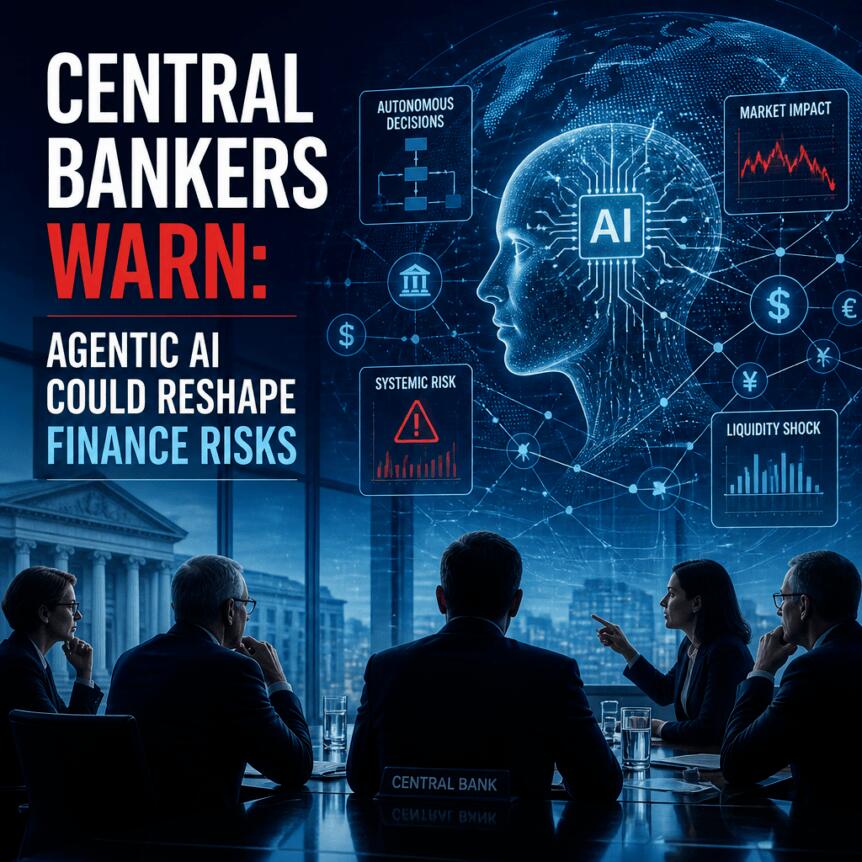
European regulators and central bankers are pressing for faster, more practical guardrails as agentic artificial intelligence (AI) moves from research into real-world finance. Several senior officials argued that conventional rulemaking timelines may be too slow to manage risks that can emerge within weeks or months—especially during periods of market stress.
Speaking at the European Central Bank’s annual meeting in Sintra, Portugal, Bank of England deputy governor Sarah Breeden warned that agentic systems could amplify volatility when markets are already under strain. She also raised the possibility that policymakers may need circuit-breaker-style interventions if faulty AI behavior threatens to cascade into broader market disruptions, according to her remarks at the ECB event.
Key takeaways
- Bank of England deputy governor Sarah Breeden said agentic AI could heighten volatility during market stress and floated the idea of “circuit breaker” protections for faulty models.
- Christine Lagarde, President of the European Central Bank, called AI a “major risk,” citing cybersecurity and defense gaps that have not kept pace with model acceleration.
- UK Financial Conduct Authority CEO Nikhil Rathi argued traditional rulemaking cycles are too slow for AI, urging a more collaborative approach with markets.
- The BIS warned on June 28 that AI “exuberance” could trigger boom-bust dynamics, potentially feeding into disruptive macro-financial loops.
Circuit-breaker thinking for agentic AI
Breeden framed the core policy challenge around speed and systemic consequences. At the ECB Forum on Central Banking 2026, she questioned whether guardrails should be designed to function like “circuit breakers or kill switches” that could limit or stop market-wide trading if AI systems malfunction and contribute to a broader meltdown, according to her speech.
The underlying concern is not only that AI may be wrong, but that agentic AI—systems that can take actions toward goals with limited human oversight—could behave in ways that interact with market microstructure. During calm conditions, such effects may be muted. In stress, however, the same automation can potentially intensify feedback loops, making volatility harder to contain.
Why European policymakers worry about both security and system stability
ECB President Christine Lagarde tied the regulatory discussion to a familiar set of themes—cybersecurity, hacking, and data theft—but stressed that the pace and depth of modern AI changes the threat environment. In an interview with French outlet Les Echos, she said the risk has become more serious because it is “happening very, very quickly,” while the resources needed for defenses have not yet been found.
Lagarde’s warning underscores a dual risk lens. First, AI can expand the scale and sophistication of cyber threats. Second, defenders often require time and funding to catch up—creating a window where vulnerabilities may be exploited faster than institutions can mitigate them.
In parallel, Nikhil Rathi, CEO of the UK’s Financial Conduct Authority, told CNBC’s Squawk Box that regulatory processes built for slower technological cycles do not translate cleanly to AI. He said some AI technologies move in weeks or months, and the “traditional cycle of rulemaking simply doesn’t work in that way,” adding that regulators need “new tools and a different way of working with the market in a more collaborative way,” according to his comments on July 3, 2026.
Accountability timelines may not match AI’s deployment pace
What connects these remarks is a shared critique of timing. Conventional regulation often depends on consultation, impact assessment, and phased implementation—steps that can be incompatible with rapid iteration and deployment common in the AI frontier. That mismatch creates a practical problem for both regulators and market participants: rules may arrive after the risky behavior has already spread.
Breeden’s circuit-breaker framing suggests one answer—designing operational limits that can be triggered dynamically, rather than relying solely on ex ante compliance requirements. Rathi’s call for collaboration points to another: working with markets to develop expectations and monitoring approaches while the technology evolves.
The European policy challenge is heightened by how investment capital is allocated. The article notes that US companies have been leading in AI investment and frontier model development, and that Europe’s financial system provides fewer capital channels into AI than US equity markets. It also warns that if regulation becomes overly cautious, AI firms may look for jurisdictions with lighter compliance burdens, potentially widening the gap further.
IMF, BIS: leverage, maturity mismatch, and boom-bust risk
Beyond operational guardrails, central banking authorities are also focusing on financial stability risks linked to AI-driven cycles. The Bank for International Settlements (BIS) warned on June 28 that AI “exuberance” could carry major financial consequences. According to the BIS, if policymakers tighten monetary policy to contain inflation, it could lead to a sharp pullback in AI-related asset prices after a prolonged period of exuberant risk-taking.
The BIS cautioned that such a correction could trigger “disruptive macro-financial feedback loops,” suggesting a scenario where falling asset values tighten financial conditions, which then feeds back into broader economic stress.
Breeden also pointed to rising debt financing as a factor that could increase the stability consequences of a decline in AI-related asset prices, according to her remarks. In an interview with Bloomberg dated June 30, IMF Monetary and Capital Markets Department director Tobias Adrian similarly highlighted a “potential maturity mismatch” between the duration of physical assets and the duration of debt—an issue that can become especially problematic when cash flows weaken or refinancing conditions deteriorate.
What investors and builders should watch next
The immediate takeaway is that European regulators appear to be moving from broad warnings toward specific mechanisms—whether circuit-breaker-style interventions, faster collaborative oversight, or stability-focused monitoring of leverage and market dynamics. Market participants should watch for how authorities operationalize these ideas: whether guardrails become technical standards, supervisory expectations, or risk monitoring frameworks designed to respond in real time as AI systems and market behavior change.