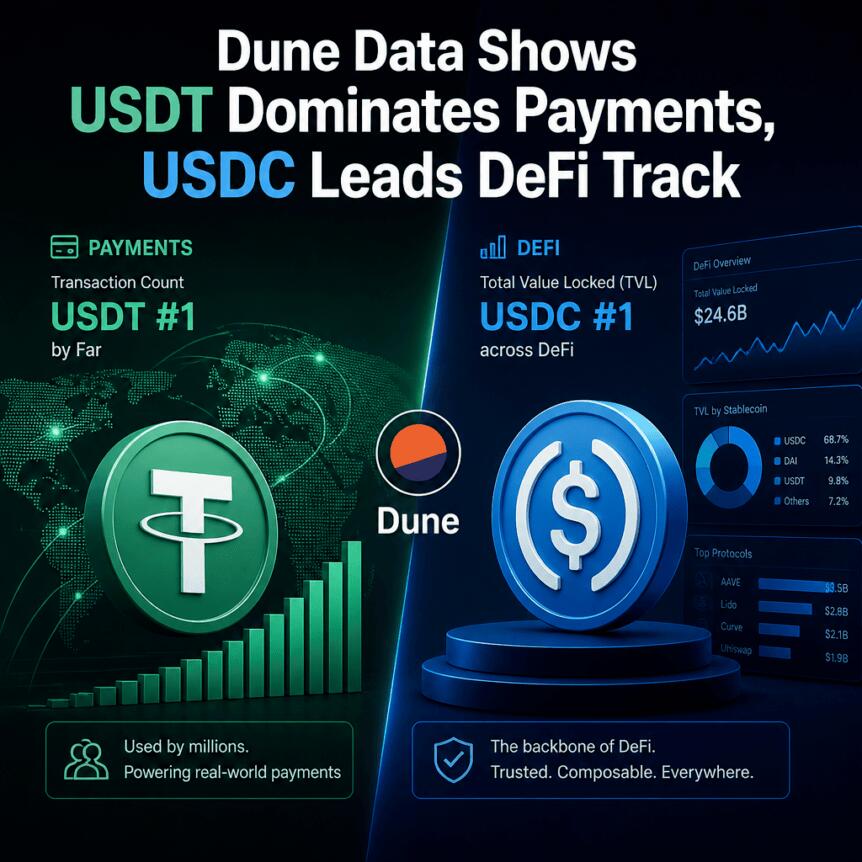
Stablecoin competition is increasingly giving way to specialization. Data from Dune’s Digital Asset Brief suggests Tether’s USDt (USDT) and Circle’s USDC are fulfilling different jobs across the crypto economy—less “winner-takes-all,” more complementary roles feeding payments on one side and DeFi and trading infrastructure on the other.
In the first half of 2026, Dune estimates the biggest stablecoin by activity settled about $95 billion in identified commerce payments. The same dataset points to roughly $14 billion for USDC in those commerce payments and puts USDT at about 92% of the $48 billion business-to-business (B2B) payment volume. On Tron, Dune also reports that approximately 93% of USDT’s supply sits in ordinary wallets rather than exchanges, reinforcing its use as a payment and remittance asset.
Key takeaways
- USDT is leading on real-world-style payments: Dune data shows about $95B in identified commerce payments in H1 2026 versus about $14B for USDC.
- USDC is more central to on-chain finance: USDC transfer volume on Base reached roughly $2.6T in June, with about $1.6T on Ethereum.
- Token distribution hints at use cases: On Tron, Dune estimates ~93% of USDT supply is held in non-exchange wallets, consistent with payments rather than trading.
- Regulatory momentum may change how stablecoins scale: The US GENIUS Act created a federal framework for payment stablecoins, while the CLARITY Act could reshape broader market structure affecting issuers and platforms.
USDT’s payment dominance and what the wallet data implies
Dune’s analysis is particularly telling because it doesn’t just measure token transfers—it focuses on “identified commerce payments.” That framing matters: it aims to map stablecoin flows that resemble merchant and transactional activity rather than purely speculative movement.
According to Dune’s Digital Asset Brief, USDT’s share in B2B commerce is especially large. With roughly 92% of the approximately $48 billion B2B payment volume going to the leading stablecoin, USDT appears positioned as the default settlement rail for corporate and cross-party transfers—at least in the portion of commerce activity Dune can identify.
On Tron, Dune’s “where the supply lives” view adds another layer. With about 93% of USDT supply held in ordinary wallets rather than exchange custody, the stablecoin’s on-chain footprint looks less like an instrument primarily circulating between trading venues and more like an asset staying in the hands of payers, merchants, and intermediaries that use it to settle obligations.
USDC’s DeFi and transfer velocity on Base and Ethereum
While USDT’s dataset emphasizes payments, USDC’s role looks more tied to crypto market plumbing—especially decentralized finance and exchange-like activity. Dune reports that USDC on Base processed roughly $2.6 trillion in transfer volume in June, the highest transfer volume of any token-chain pair. On Ethereum, USDC handled another approximately $1.6 trillion.
Velocity also points to broader usage intensity. Dune notes that USDC on Base recorded daily velocity of about 20 times its circulating supply in June. In practical terms, velocity rising far above one suggests frequent movement of the same supply across trading, lending, or routing activities—patterns often associated with on-chain markets rather than simple payment holding.
Put together, these metrics shift the conversation. Instead of asking which stablecoin “wins,” the more useful question may be where each stablecoin fits in the on-chain stack: USDT appearing to concentrate around payments and remittances, while USDC is more deeply embedded in transfer-heavy trading and DeFi ecosystems.
Why the USDT-versus-USDC narrative is losing clarity
Dune’s findings effectively argue that the traditional framing—USDT competing directly with USDC as the default stablecoin—does not capture how stablecoins actually behave across chains and use cases.
One way to see this is through concentration patterns. Dune reports USDT’s supply is split almost evenly between Tron and Ethereum, whereas USDC remains heavily concentrated on Ethereum despite expanding to newer blockchains. That distribution aligns with the performance profile the dataset shows: USDC’s most prominent volume and velocity signals appear tied to Ethereum and Base activity, while USDT’s stronger commerce-payments footprint aligns with Tron’s large role in everyday transfers.
Meanwhile, the stablecoin market remains dominated by both issuers’ assets. Dune tracked more than 200 stablecoin tokens across multiple blockchains and estimates USDT and USDC together account for roughly 83% of the sector’s approximately $315 billion market capitalization. In other words, even if the “competition” is shifting toward specialization, the center of gravity is still concentrated in these two tokens.
US policy moves: GENIUS passed, CLARITY could broaden the ruleset
These data-driven role distinctions are emerging alongside renewed US regulatory momentum. Earlier this year, the US stablecoin sector gained traction following the passage of the GENIUS Act. Signed into law in 2025, GENIUS created the first federal regulatory framework for payment stablecoins, with the stated goal of enabling banks and other companies to issue US dollar-pegged digital assets. (For background, Cointelegraph previously covered the legislation here: https://cointelegraph.com/news/treasury-genius-act-rule-illicit-finance.)
Lawmakers are now debating the CLARITY Act, which would establish a broader market structure for digital assets by clarifying when crypto assets fall under either the US Securities and Exchange Commission or the US Commodity Futures Trading Commission. While the bill does not target stablecoins directly, it could still influence the operating environment for stablecoin issuers, exchanges, and DeFi platforms through how regulators classify and supervise related activity.
CLARITY cleared the Senate Banking Committee in May and may be brought to a full Senate vote before the August recess, although the odds have been changing as lawmakers face time constraints. Cointelegraph reported that Galaxy trimmed its odds of passage to 50% before the break: https://cointelegraph.com/news/galaxy-cuts-2026-clarity-act-odds-50.
Going forward, investors and builders may want to track more than headline stablecoin market share. Dune’s results suggest that chain distribution, wallet versus exchange custody, and transfer velocity are increasingly important signals of real utility. The next question is how regulation—starting with GENIUS and potentially shaped by CLARITY—will affect which stablecoin roles can scale most easily across payments, lending, and trading.